



In short ⚡
Density rate is a logistics metric that compares cargo volume to weight, determining how space is utilized in transportation. It directly impacts freight costs, as carriers charge based on either actual weight or volumetric weight—whichever generates higher revenue. Understanding density rate is essential for optimizing shipping expenses and container utilization.
Introduction
Many importers discover too late that their lightweight shipment costs more than expected. The culprit? Poor density rate management. In international logistics, carriers don’t just weigh your cargo—they measure how much space it occupies relative to its mass.
This ratio determines whether you pay for actual weight or dimensional weight. For businesses shipping high-volume, low-weight goods like textiles or electronics packaging, miscalculating density rate can inflate costs by 30-50%. Understanding this metric is non-negotiable for cost-effective supply chain management.
Key characteristics of density rate:
- Dual pricing trigger: Activates volumetric weight calculations when density falls below carrier thresholds
- Mode-specific standards: Air freight uses 167 kg/m³, ocean freight 1,000 kg/m³, road transport 333 kg/m³
- Cost optimization lever: Proper packaging can reduce billable weight by 20-40%
- Customs classification impact: Affects freight class determination in LTL shipments
- Container loading efficiency: Directly influences TEU utilization and consolidation strategies
Technical Mechanisms & Strategic Implications
Density rate calculation follows a standardized formula: Actual Weight (kg) ÷ Volume (m³) = Density (kg/m³). Carriers compare this figure against modal thresholds. If your cargo’s density falls below the standard, they calculate volumetric weight by multiplying volume by the threshold coefficient.
For air freight, the IATA standard uses 167 kg/m³ (or 1:6 ratio). A shipment measuring 2 m³ weighing only 200 kg would be charged at 334 kg (2 × 167), not its actual 200 kg. This 67% cost increase catches unprepared shippers off guard.
Ocean freight applies different logic. The 1,000 kg/m³ rule means most containerized cargo is charged by actual weight unless extremely bulky. However, breakbulk and LCL consolidations face stricter scrutiny. At DocShipper, we systematically pre-calculate density rates during quotation to prevent billing surprises at origin ports.
Legal implications extend beyond pricing. The freight class system (NMFC codes in North America) uses density as a primary classification factor. Items under 1 lb/ft³ (16 kg/m³) fall into Class 500, while those exceeding 50 lb/ft³ (800 kg/m³) drop to Class 50. Misclassification can trigger audits and penalty charges.
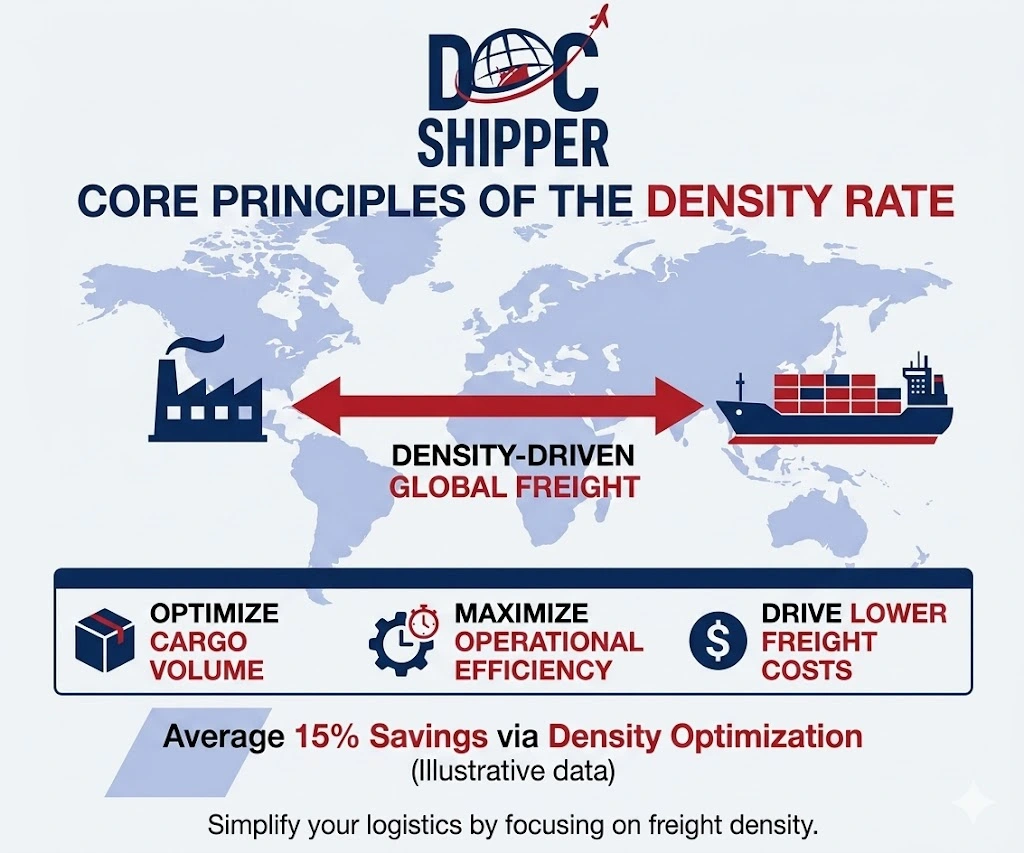
Strategic packaging adjustments offer significant savings. Reducing void fill, using compression for textiles, or switching to collapsible containers can increase density by 25-40%. For recurring shipments, investing in custom-sized packaging pays for itself within 3-6 months through reduced volumetric charges.
Practical Examples & Comparative Data
Consider three common scenarios where density rate determines final costs:
| Cargo Type | Actual Weight | Volume | Density Rate | Chargeable Weight (Air) | Cost Impact |
|---|---|---|---|---|---|
| Electronics (poorly packed) | 300 kg | 3.5 m³ | 85.7 kg/m³ | 584 kg | +95% cost |
| Machinery parts (dense) | 800 kg | 1.2 m³ | 666 kg/m³ | 800 kg | No penalty |
| Textiles (optimized) | 450 kg | 2.8 m³ | 160.7 kg/m³ | 467 kg | +3.8% cost |
Use Case: E-commerce Fulfillment Optimization
A European retailer importing 500 cartons of plush toys from China faced recurring overcharges. Initial packaging yielded 120 kg/m³ density. After DocShipper’s audit, we implemented vacuum compression and reduced carton sizes by 30%. New density: 185 kg/m³. Result: €12,400 annual savings on a €38,000 freight budget—a 32.6% reduction.
Modal comparison reveals strategic choices:
- Air freight: Critical below 200 kg/m³; consider sea-air hybrid for 150-180 kg/m³ cargo
- Ocean LCL: Economical for 300-600 kg/m³; consolidate with complementary shippers
- Road transport: Density matters less for full truckloads; crucial for groupage services
- Rail freight: Emerging option for 400+ kg/m³ Asia-Europe corridors
- Express couriers: Strictest enforcement; often use 200 kg/m³ thresholds
Industry benchmarks show pharmaceutical products average 220 kg/m³, automotive parts 450 kg/m³, and furniture only 95 kg/m³. Knowing your product category’s typical density helps negotiate better carrier contracts and identify packaging inefficiencies early.
Conclusion
Mastering density rate transforms it from a hidden cost driver into a competitive advantage. By aligning packaging strategies with carrier thresholds and modal characteristics, businesses can reduce freight expenses by 20-40% while maintaining service levels.
Need expert guidance on optimizing your cargo density and freight costs? Contact DocShipper for a comprehensive logistics audit tailored to your supply chain.
📚 Quiz
Test Your Knowledge: Density Rate
Q1 — What does "density rate" measure in freight logistics?
Q2 — A shipment weighs 200 kg and occupies 2 m³. Shipped by air (IATA threshold: 167 kg/m³), what weight will the carrier charge?
Q3 — A retailer wants to reduce air freight overcharges on bulky plush toys. Which strategy correctly applies density rate optimization?
🎯 Your Result
📞 Free Quote in 24hFAQ | Density Rate: Definition, Calculation & Practical Examples
Density rate is the ratio of weight to volume (kg/m³), while volumetric weight is a billing construct calculated by multiplying volume by a carrier-specific coefficient. Density determines whether volumetric weight applies.
Measure the longest, widest, and highest points to create a rectangular envelope. Calculate volume (L × W × H), then divide actual weight by this volume. Always round dimensions up to the nearest centimeter.
Yes, for high-volume shippers. Contracts may specify custom density rates (e.g., 180 kg/m³ instead of 167) or minimum charge reductions. Requires demonstrating consistent shipping patterns and volume commitments.
Air cargo faces strict weight-to-lift ratios due to fuel costs and aircraft capacity. Ocean vessels prioritize volume utilization in containers. The 167 kg/m³ air standard reflects aviation economics, while 1,000 kg/m³ ocean rate accounts for typical container stowage.
Indirectly. Customs duties calculate on CIF value, not freight weight. However, density influences freight class, which affects total landed costs. Some HS codes also have specific gravity requirements for classification purposes.
Vacuum-sealed bags for textiles, custom-fit corrugated boxes, foam-in-place systems, and collapsible containers. Avoid excessive void fill—use air pillows only where necessary for product protection, not to fill empty space.
Major carriers perform random physical checks on 5-15% of shipments. Automated dimensioning systems at hubs scan 100% of parcels. Consistent discrepancies trigger account reviews and potential retroactive billing adjustments.
No exemptions exist, but dangerous goods often require oversized packaging for compliance, reducing density. UN-certified packaging adds weight and volume. Factor 15-25% density reduction when shipping IMDG/IATA Class 3-9 materials.
Splitting rarely helps—you'll pay multiple minimum charges and potentially higher per-kg rates. Better strategy: consolidate with complementary products or use slower modes. Calculate break-even points before deciding.
Lower density means more trips for the same cargo weight, increasing emissions per ton-kilometer. Optimizing density to 200+ kg/m³ can reduce transportation emissions by 30-50% compared to 100 kg/m³ shipments.
TMS platforms like Freightos, CargoWise, and ShipStation include density calculators. 3D scanning apps (CubiScan, Cargo Spectre) provide precise measurements. Most WMS systems integrate dimensional weight modules for warehouse operations.
Yes, but with variations. USPS uses 194 kg/m³ for Priority Mail International. UPU standards allow each country to set thresholds. Cross-border e-commerce parcels increasingly face volumetric pricing as postal services adopt commercial carrier practices.
Need Help with
Logistics or Sourcing ?
First, we secure the right products from the right suppliers at the right price by managing the sourcing process from start to finish. Then, we simplify your shipping experience - from pickup to final delivery - ensuring any product, anywhere, is delivered at highly competitive prices.


Fill the Form
Prefer email? Send us your inquiry, and we’ll get back to you as soon as possible.
Contact us




