


In short ⚡
Detention is a logistics charge imposed when cargo containers or equipment are held beyond the agreed free time at a terminal or facility. This fee compensates carriers for the loss of asset availability, typically calculated per day after the free period expires, and represents a significant cost factor in international trade operations.
Introduction
Many importers confuse detention with demurrage, leading to unexpected costs that can erode profit margins by 3-7%. Understanding detention is critical because it directly impacts cash flow and operational efficiency in supply chain management.
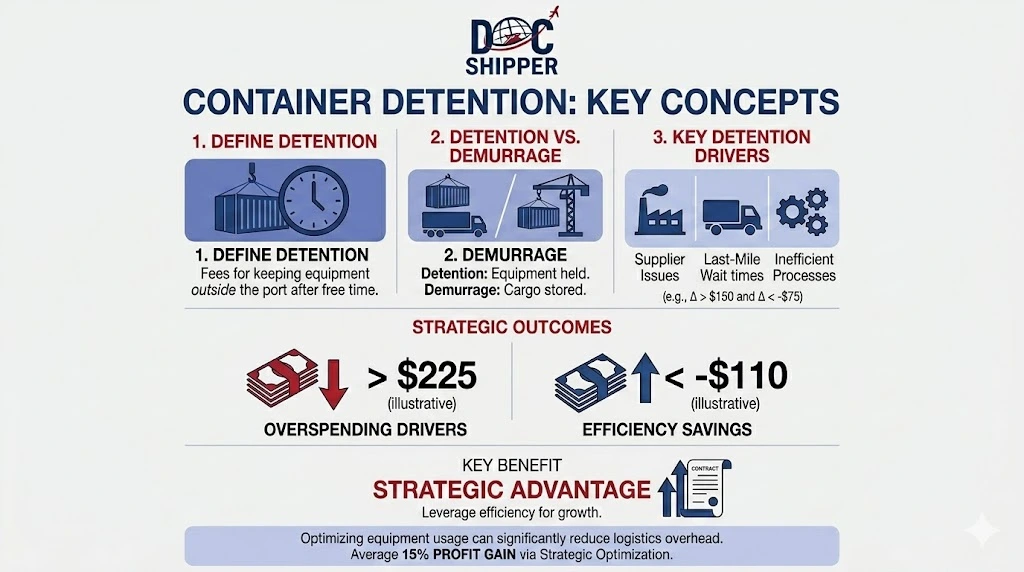
In international freight, detention occurs when containers remain with the consignee beyond the carrier’s free time allowance. Unlike demurrage (which applies at the port), detention charges apply once the container leaves the terminal but hasn’t been returned empty.
- Free time period: Typically 3-7 days depending on carrier and trade lane
- Charge structure: Daily rates escalating after free time expires
- Liability: Falls on the party holding the equipment (consignee or shipper)
- Prevention strategy: Efficient cargo handling and timely container return
- Financial impact: Can range from $75 to $300+ per container per day
Technical Framework & Regulatory Context
Detention charges are governed by carrier tariffs and contractual terms outlined in the bill of lading. The Federal Maritime Commission (FMC) in the United States requires that these charges be reasonable and clearly communicated, as established in the Shipping Act of 1984.
The free time calculation begins when the container is released from the terminal (gate-out) and ends when the empty container is returned. This differs fundamentally from demurrage, which applies while cargo remains at the port facility.
Escalating rate structures are standard industry practice. Charges typically increase in tiers: days 1-3 might cost $75/day, days 4-6 increase to $150/day, and subsequent days can reach $300 or more. This progressive pricing incentivizes rapid equipment turnover.
The per diem system operates on a 24-hour cycle, meaning partial days count as full days. If a container is returned even one hour late beyond the free period, a full day’s charge applies. This strict calculation method requires precise logistics coordination.
Force majeure clauses may provide relief in exceptional circumstances such as natural disasters, port strikes, or government-imposed restrictions. However, carriers typically require documented evidence and formal dispute procedures.
At DocShipper, we implement automated tracking systems that monitor container free time and send alerts 48 hours before detention charges begin, helping clients avoid unnecessary costs through proactive container management.
Practical Examples & Cost Analysis
Understanding detention through real-world scenarios reveals its financial impact. The following comparative analysis demonstrates how different handling speeds affect total costs.
| Scenario | Free Time | Actual Days Held | Detention Days | Daily Rate | Total Cost |
|---|---|---|---|---|---|
| Efficient Operation | 5 days | 4 days | 0 days | $0 | $0 |
| Standard Delay | 5 days | 8 days | 3 days | $100 | $300 |
| Severe Delay | 5 days | 12 days | 7 days | $150 (escalated) | $1,050 |
| Critical Delay | 5 days | 15 days | 10 days | $200 (tier 3) | $2,000 |
Use Case: Electronics Importer
A California-based electronics retailer imports 40 containers monthly from Shenzhen. With 5 days free time and an average 7-day container hold period, they incur 2 detention days per container at $125/day. Monthly detention costs: 40 containers × 2 days × $125 = $10,000. Annually, this represents $120,000 in avoidable expenses.
Mitigation strategies include:
- Pre-clearance customs processing: Complete documentation before vessel arrival
- Dedicated unloading facilities: Reduce container dwell time at consignee premises
- Strategic depot partnerships: Use off-site container yards for faster turnaround
- Real-time tracking systems: Monitor free time expiration and automate alerts
- Negotiated extended free time: Leverage shipping volume for better carrier terms
Industry data shows that 68% of detention charges result from documentation delays rather than physical cargo handling issues. Proper customs preparation can eliminate the majority of these costs.
Conclusion
Detention charges represent a controllable cost element that directly impacts supply chain profitability. Strategic planning, efficient cargo handling, and proactive monitoring systems can reduce or eliminate these expenses entirely.
Need expert guidance on managing detention costs in your logistics operations? Contact DocShipper for customized solutions that optimize your container management and reduce unnecessary charges.
📚 Quiz
Test Your Knowledge: Detention
Q1 — What does a detention charge apply to in international freight?
Q2 — A container is returned just one hour after the free time period expires. How many days of detention will be charged?
Q3 — An electronics importer holds 40 containers per month for an average of 7 days, with 5 days of free time at $125/day. Which action would most effectively reduce their $120,000 annual detention bill?
🎯 Your Result
📞 Free Quote in 24hFAQ | Detention: Definition, Calculation & Practical Examples
Demurrage applies while containers remain at the port terminal after free time expires. Detention begins when the container leaves the terminal and hasn't been returned empty within the allowed period. Both are separate charges with distinct calculation methods.
Free time starts when the container is released from the terminal (gate-out timestamp) and ends when the empty container is returned to the designated depot. The period is typically 3-7 calendar days depending on carrier policy and trade lane.
Yes, shippers with consistent volume can negotiate extended free time or reduced daily rates. Service contracts often include detention provisions that differ from standard tariff rates. Negotiation leverage increases with shipping frequency and carrier relationship strength.
The party holding the container beyond free time bears responsibility. This is typically the consignee (importer) but can be the shipper if equipment is held before loading. Contractual terms in the bill of lading specify liability.
Carriers require written disputes within specified timeframes (usually 30-60 days). Documentation proving timely return, force majeure events, or carrier equipment unavailability strengthens disputes. Unresolved disputes may require mediation or FMC intervention.
No, rates vary by equipment type. Standard dry containers typically have lower rates than specialized equipment like refrigerated containers (reefers), flat racks, or open tops. High-cube containers may also carry premium detention rates.
Most carriers calculate detention on a calendar day basis, including weekends and holidays. Some service contracts exclude these days, but this must be explicitly stated. Always verify your specific carrier's policy regarding non-business days.
A detention waiver exempts charges due to circumstances beyond the shipper's control. Common grounds include port congestion, customs exam delays, carrier equipment shortages, or documented force majeure events. Waivers require formal requests with supporting evidence.
Some carriers offer "per diem protection" or extended free time for an upfront fee. This insurance-like product provides additional days before detention begins. Cost-effectiveness depends on cargo characteristics and unloading speed predictability.
Rates vary significantly: Maersk, MSC, and CMA CGM typically charge $75-150/day initially, escalating to $200-300+ after day 6. Asian carriers often have slightly lower rates. Trans-Pacific routes generally have longer free time (5-7 days) than intra-regional trades (3-5 days).
Transportation Management Systems (TMS) with container tracking, automated free-time alerts, and depot integration reduce detention risk. Real-time visibility platforms enable proactive decision-making. Mobile apps allow instant empty return scheduling and documentation upload.
Yes, detention fees are generally deductible as ordinary business expenses related to cost of goods sold or freight expenses. Proper documentation and categorization in accounting systems ensure compliance. Consult tax professionals for jurisdiction-specific guidance.
Need Help with
Logistics or Sourcing ?
First, we secure the right products from the right suppliers at the right price by managing the sourcing process from start to finish. Then, we simplify your shipping experience - from pickup to final delivery - ensuring any product, anywhere, is delivered at highly competitive prices.


Fill the Form
Prefer email? Send us your inquiry, and we’ll get back to you as soon as possible.
Contact us




