


In short ⚡
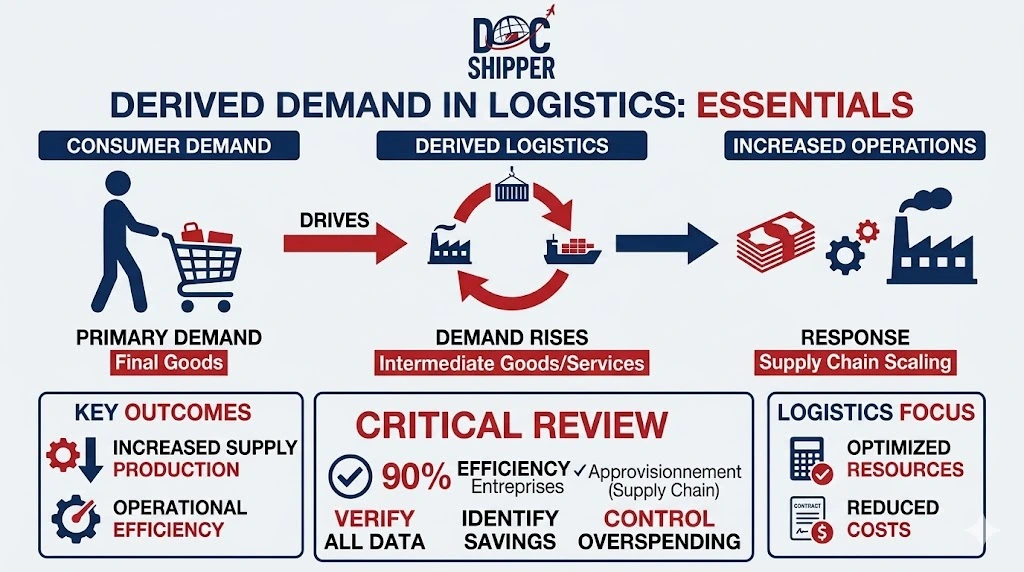
Derived demand is the demand for a good or service that results from the demand for another related good or service. In international logistics, transportation and warehousing services exist because of the underlying demand for the products being moved, making supply chain operations fundamentally dependent on consumer market dynamics.
Introduction
Many logistics professionals struggle to forecast capacity needs because they focus on transportation metrics rather than the underlying consumer demand driving their operations. This disconnect leads to inefficient resource allocation and missed opportunities.
Understanding derived demand is critical in international trade. Freight forwarders, customs brokers, and warehouse operators don’t generate demand independently—their services are needed only when manufacturers, retailers, or consumers require goods to be moved.
Key characteristics of derived demand in logistics include:
- Volatility amplification: Small changes in consumer demand create larger fluctuations in logistics services
- Time lag effects: Logistics demand responds with delay to market shifts
- Interdependency: Multiple service layers (transport, warehousing, customs) depend on the same root demand
- Seasonality transfer: Consumer purchasing patterns directly impact freight volume cycles
- Economic sensitivity: Logistics demand contracts faster during economic downturns than primary goods demand
Understanding Derived Demand Mechanisms
The bullwhip effect exemplifies derived demand in supply chains. A 10% increase in retail sales can trigger a 20% increase in warehouse orders, which creates a 40% spike in manufacturing orders, ultimately generating disproportionate demand for international shipping capacity.
Three fundamental mechanisms drive derived demand in logistics:
Input-output relationships connect logistics services to production processes. Container shipping exists because factories need raw materials and retailers need finished goods. The World Trade Organization reports that global merchandise trade volumes correlate directly with manufacturing output, demonstrating this linkage.
Elasticity transfer means logistics demand inherits the price sensitivity of the goods being transported. Luxury goods with inelastic demand create stable freight volumes regardless of economic conditions, while commodity products generate highly volatile shipping requirements.
Multiplier effects occur when single consumer purchases trigger multiple logistics transactions. One smartphone sale initiates component sourcing from five countries, assembly transportation, quality inspection shipping, retail distribution, and potential return logistics—each representing derived demand.
At DocShipper, we analyze our clients’ end-market demand patterns before designing logistics solutions, ensuring capacity planning aligns with actual market dynamics rather than historical shipping data alone.
The acceleration principle states that small percentage changes in consumer demand create proportionally larger changes in capital goods and services demand. When smartphone sales increase 5%, semiconductor manufacturing equipment orders might surge 25%, dramatically increasing air freight demand for specialized components.
Practical Examples in Logistics Operations
Real-world scenarios demonstrate how derived demand shapes international logistics:
| Consumer Market | Primary Demand | Derived Logistics Demand | Impact Multiplier |
|---|---|---|---|
| E-commerce Growth | Online retail sales +15% | Last-mile delivery capacity +30% | 2.0x |
| Electric Vehicle Adoption | EV sales +20% | Lithium battery shipping +60% | 3.0x |
| Fast Fashion Trends | Apparel consumption +8% | Air freight textile volume +25% | 3.1x |
| Pharmaceutical Innovation | Biotech drug approvals +12% | Cold chain logistics +18% | 1.5x |
Case Study: Holiday Season Logistics
A major European retailer experiences 40% annual sales concentration in Q4. This primary demand creates:
- Container bookings increase 120% (August-October)
- Warehouse space requirements surge 85% (September-November)
- Customs clearance volumes jump 95% (October-December)
- Last-mile delivery capacity needs expand 150% (November-December)
- Reverse logistics capacity requirements spike 200% (January-February)
The derived demand coefficient can be calculated as: (% Change in Logistics Service Demand) ÷ (% Change in End Product Demand). Values above 1.0 indicate amplification, common in logistics due to inventory buffering and lead time management.
DocShipper’s clients in the electronics sector regularly experience coefficients of 2.5-3.0, meaning a 10% increase in consumer electronics sales generates 25-30% more international freight demand during restocking cycles.
Geographic demand cascades illustrate derived demand complexity. When U.S. housing starts increase 5%, this triggers:
- Chinese furniture export volume +12%
- Trans-Pacific container rates +8%
- West Coast port congestion +15%
- Inland trucking rates +10%
- Warehouse occupancy rates +6%
Conclusion
Derived demand fundamentally shapes logistics operations, creating both opportunities and risks through demand amplification and volatility transfer. Successful international trade operations require monitoring end-market indicators rather than relying solely on historical shipping patterns.
Need strategic guidance on aligning your logistics capacity with market demand patterns? Contact DocShipper for expert consultation on demand forecasting and supply chain optimization.
📚 Quiz
Test Your Knowledge: Derived Demand
Q1 — What best defines "derived demand" in the context of international logistics?
Q2 — A retailer's online sales grow by 10%. According to the derived demand coefficient, what is the most likely outcome for last-mile delivery capacity demand?
Q3 — A logistics manager wants to forecast freight demand more accurately. Which approach best applies the concept of derived demand?
🎯 Your Result
📞 Free Quote in 24hFAQ | Derived Demand: Definition, Calculation & Concrete Examples
Direct demand is consumer desire for a product itself (smartphones, clothing), while derived demand is the need for services or inputs required to produce or deliver that product (freight forwarding, packaging materials).
Businesses amplify demand changes through inventory adjustments. A 5% sales increase might prompt 15% inventory restocking, creating disproportionate logistics demand spikes that exceed the original consumer demand change.
When consumer demand surges, logistics capacity becomes constrained faster than primary goods production, causing freight rates to spike more dramatically than product prices due to fixed transportation infrastructure.
Yes, through diversification across industries with uncorrelated demand cycles, flexible capacity contracts, and predictive analytics monitoring end-market indicators rather than lagging logistics metrics.
Capital goods manufacturing, construction materials, automotive components, and seasonal consumer products exhibit multipliers of 2.0-4.0x, meaning logistics demand fluctuates two to four times more than end-product sales.
Recessions hit logistics harder than retail sales because businesses cut inventory first, creating demand contractions of 15-20% when consumer spending drops only 5-8%, demonstrating negative derived demand amplification.
Just-in-time inventory minimizes derived demand amplification but increases frequency, while safety stock strategies create larger but less frequent logistics demand spikes, each requiring different capacity planning approaches.
Monitor leading indicators like manufacturing PMI, retail sales trends, housing starts, and consumer confidence indexes rather than historical shipping data, which represents lagging indicators of market conditions.
Yes, e-commerce creates higher-frequency, smaller-shipment derived demand compared to traditional retail's bulk distribution model, requiring different logistics infrastructure and increasing last-mile delivery requirements proportionally more than warehouse needs.
International freight demand elasticity typically ranges from 1.5 to 3.0, meaning a 10% change in global trade volumes generates 15-30% change in shipping service demand, varying by trade lane and commodity type.
Tariffs and trade restrictions alter sourcing patterns, creating sudden derived demand shifts between trade lanes. A 25% tariff might reduce direct imports 15% but increase transshipment logistics demand 40% through third countries.
AI-powered demand sensing and collaborative planning reduce bullwhip effects by 20-35%, smoothing derived demand fluctuations through better information sharing across supply chain tiers and improved forecast accuracy.
Need Help with
Logistics or Sourcing ?
First, we secure the right products from the right suppliers at the right price by managing the sourcing process from start to finish. Then, we simplify your shipping experience - from pickup to final delivery - ensuring any product, anywhere, is delivered at highly competitive prices.


Fill the Form
Prefer email? Send us your inquiry, and we’ll get back to you as soon as possible.
Contact us




