


In short ⚡
A Duty Free Zone (DFZ) is a designated geographical area within a country where imported goods can be stored, handled, manufactured, or reconfigured without being subject to customs duties, taxes, or import regulations until they enter the domestic market or are re-exported internationally.
Introduction
Many importers face confusion between free zones, bonded warehouses, and customs warehouses. Understanding the precise definition of a Duty Free Zone is critical for optimizing supply chain costs and compliance strategies.
In international trade, DFZs serve as strategic hubs that enable businesses to defer or eliminate customs duties while maintaining operational flexibility. These zones are instrumental in reducing cash flow pressure and facilitating global distribution networks.
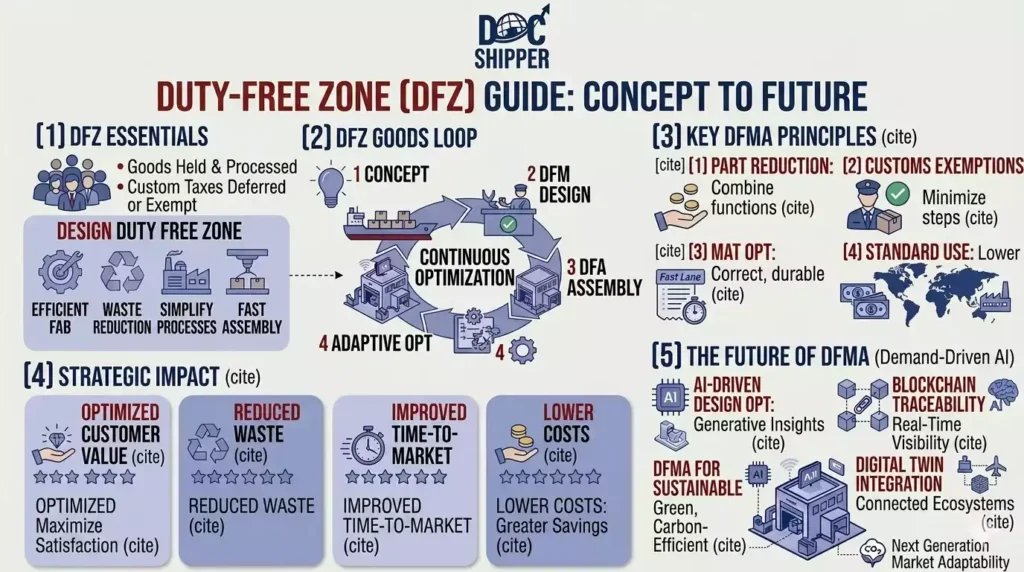
Key characteristics of Duty Free Zones include:
- Customs duty suspension: No duties paid until goods leave the zone for domestic consumption
- Value-added activities permitted: Manufacturing, assembly, repackaging, and quality control allowed
- Unlimited storage duration: Most zones impose no time limits on goods storage
- Streamlined customs procedures: Simplified documentation and reduced administrative burden
- Re-export facilitation: Goods can be shipped internationally without ever entering the domestic market
Legal Framework & Operational Mechanisms
Duty Free Zones operate under specific legal frameworks established by national customs authorities. In the European Union, these zones are governed by the Union Customs Code, while in the United States, they fall under Foreign-Trade Zones regulations administered by the U.S. Customs and Border Protection.
The fundamental principle behind DFZs is customs territory fiction. Goods within these zones are legally considered outside the customs territory, even though they remain physically within national borders. This legal construct enables the suspension of duties and taxes.
Operational mechanisms include several key components. First, zone authorization requires businesses to obtain specific permits from customs authorities, demonstrating adequate security measures and inventory tracking systems. Second, inventory management mandates detailed record-keeping of all goods entering, stored, processed, and leaving the zone.
Third, permitted activities vary by jurisdiction but typically include storage, exhibition, sorting, grading, sampling, relabeling, and light manufacturing. Fourth, exit procedures determine the customs treatment when goods leave the zone—domestic consumption triggers duty payment, while re-export maintains duty-free status.
At DocShipper, we assist clients in navigating DFZ regulations across multiple jurisdictions, ensuring compliance with local customs requirements while maximizing the financial benefits of duty deferral and operational flexibility.
The security requirements for DFZ operations are stringent. Zones must maintain physical barriers, surveillance systems, and controlled access points. Customs authorities conduct regular audits to verify inventory accuracy and compliance with zone regulations.
Concrete Examples & Comparative Data
Understanding the practical application of Duty Free Zones becomes clearer through real-world scenarios and comparative analysis across different operational models.
Use Case: Electronics Distributor
A European electronics distributor imports smartphones from Asia valued at €1,000,000. The applicable customs duty rate is 5%, and VAT is 20%.
Without DFZ: Immediate payment of €50,000 (duties) + €210,000 (VAT on goods + duties) = €260,000 upfront cost.
With DFZ: Goods stored in the zone for 90 days. During this period, 60% are re-exported to other markets (duty-free), and 40% enter the domestic market. Duties and VAT paid only on €400,000 = €104,000. Savings: €156,000 in deferred/eliminated costs.
Comparative Analysis: DFZ vs. Standard Import
| Criteria | Standard Import | Duty Free Zone |
|---|---|---|
| Duty Payment Timing | Immediate upon arrival | Deferred until domestic entry |
| Storage Duration | Limited (typically 90 days) | Unlimited in most jurisdictions |
| Value-Added Activities | Restricted | Permitted (assembly, repackaging) |
| Re-Export Process | Complex duty drawback procedures | Simplified, no duty refund needed |
| Cash Flow Impact | High upfront capital requirement | Reduced working capital needs |
Key Operational Benefits
- Inventory optimization: Consolidate regional distribution without triggering multiple duty payments
- Market testing: Store goods duty-free while assessing demand before committing to domestic import
- Manufacturing flexibility: Import components, assemble products, and re-export without duty burden
- Supply chain resilience: Maintain buffer stock in strategic locations without tax implications
- Compliance simplification: Reduced customs declarations and streamlined procedures for zone operations
According to World Bank data, companies utilizing free zones report an average 15-30% reduction in logistics costs and 20-40% improvement in working capital efficiency compared to traditional import models.
Conclusion
Duty Free Zones represent a powerful strategic tool for international traders seeking to optimize costs, enhance operational flexibility, and improve cash flow management. Understanding their legal framework and practical applications is essential for competitive advantage in global markets.
Need expert guidance on leveraging DFZ benefits for your supply chain? Contact DocShipper for tailored logistics solutions.
📚 Quiz
Test Your Knowledge: Duty Free Zone (DFZ)
Q1 — What is the core principle that defines how a Duty Free Zone operates?
Q2 — A common misconception about Duty Free Zones is that selling goods directly from a DFZ to domestic customers remains duty-free. What actually happens in this scenario?
Q3 — A European electronics distributor imports €1,000,000 worth of smartphones from Asia. 60% will be re-exported and 40% will enter the domestic market. Which approach maximizes cost savings?
🎯 Your Result
📞 Free Quote in 24hFAQ | DFZ (Duty Free Zone): Definition, Benefits & Practical Examples
The terms are often used interchangeably, but Free Trade Zones may include broader economic incentives like tax exemptions and relaxed labor regulations, while Duty Free Zones specifically focus on customs duty suspension for imported goods.
Businesses must apply for authorization from customs authorities, demonstrating adequate security measures, inventory systems, and compliance capabilities. Approval criteria vary by jurisdiction but generally require financial guarantees and operational transparency.
Most jurisdictions impose no time limits for goods stored in Duty Free Zones, unlike temporary admission procedures or bonded warehouses which typically have storage duration restrictions ranging from 90 days to several years.
Zone operators must report losses or damages to customs authorities. Depending on circumstances, duties may be waived if destruction is verified, or operators may be liable for duty payment if losses result from negligence or inadequate security.
Yes, but such sales trigger customs clearance procedures and require payment of applicable duties and taxes as if the goods were being imported into the domestic market. The DFZ advantage is lost for domestic sales.
Permitted activities vary by zone but typically include assembly, packaging, labeling, quality testing, light manufacturing, and product customization. Heavy industrial manufacturing may require special authorization or be restricted in certain zones.
Goods can be imported into a DFZ, stored or processed, and then re-exported without ever paying customs duties or undergoing complex duty drawback procedures, significantly simplifying international distribution logistics.
Most zones prohibit or restrict dangerous goods, controlled substances, weapons, and items subject to trade embargoes. Some zones also exclude certain agricultural products or goods requiring special health and safety certifications.
VAT treatment varies by country. In the EU, goods in DFZs are generally not subject to VAT until they enter domestic circulation. Some jurisdictions suspend VAT entirely for zone operations, while others apply special VAT regimes.
Yes, many zones permit IP-related activities such as product customization, branding, software installation, and quality certification. However, counterfeit goods and IP-infringing products are strictly prohibited and subject to seizure and penalties.
Required documentation typically includes zone entry declarations, detailed inventory records, processing activity logs, and exit declarations. Electronic systems are increasingly used for real-time reporting to customs authorities.
Modern DFZs require sophisticated inventory management systems providing real-time visibility to customs authorities. This enhances supply chain transparency and enables better demand forecasting and inventory optimization for businesses.
Need Help with
Logistics or Sourcing ?
First, we secure the right products from the right suppliers at the right price by managing the sourcing process from start to finish. Then, we simplify your shipping experience - from pickup to final delivery - ensuring any product, anywhere, is delivered at highly competitive prices.


Fill the Form
Prefer email? Send us your inquiry, and we’ll get back to you as soon as possible.
Contact us




:%20Definition,%20Benefits%20&%20Practical%20Examples)