


In short ⚡
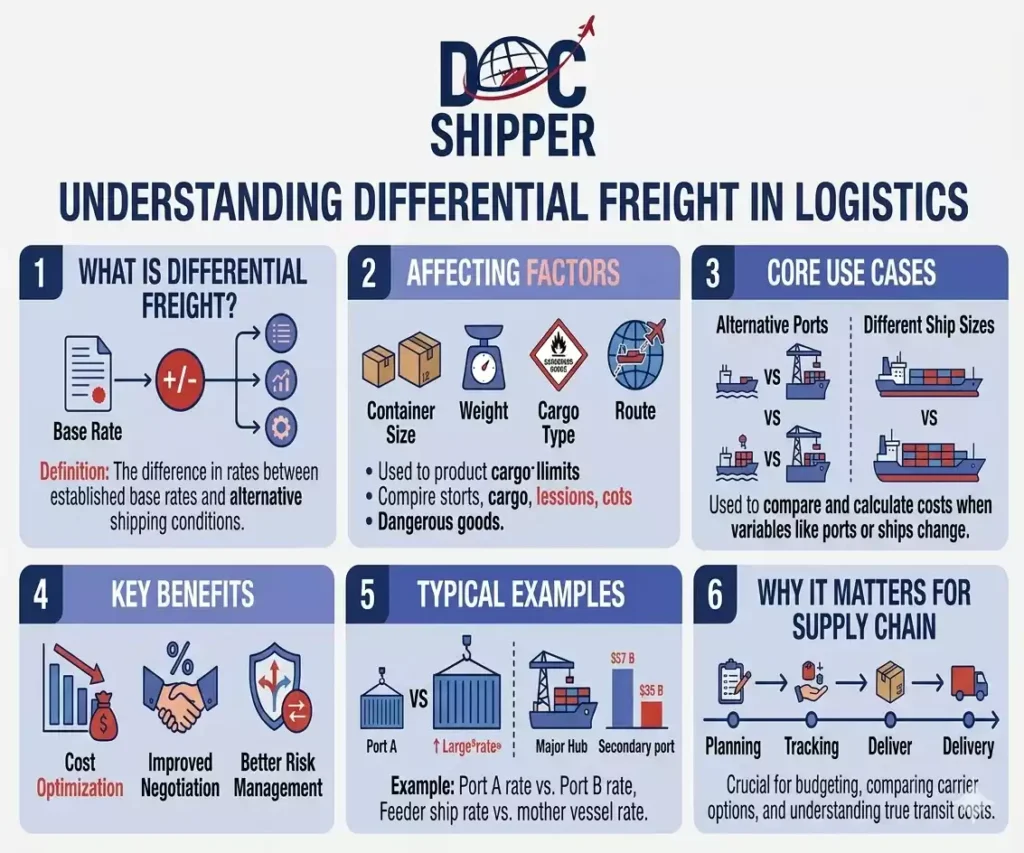
Differential refers to the price adjustment or surcharge applied to freight rates based on specific cargo characteristics, routing variations, or service modifications. In international logistics, differentials compensate carriers for additional costs related to cargo handling, port congestion, seasonal demand, or commodity-specific requirements that deviate from standard shipping conditions.
Introduction
Importers and exporters frequently encounter unexpected cost variations in their shipping quotes. These fluctuations often stem from differentials—adjustments that reflect the true cost of transporting specific goods under particular conditions.
Understanding differentials is essential for accurate budgeting and vendor negotiations. These surcharges directly impact landed costs and can significantly affect profit margins on international transactions.
Key characteristics of freight differentials include:
- Applied to base freight rates as percentage increases or flat fees
- Vary by commodity type, weight class, and cargo dimensions
- Reflect operational costs such as specialized handling or equipment
- Change based on seasonal demand patterns and market conditions
- Governed by carrier tariffs and service contract terms
Understanding Differentials in Freight Operations
Freight differentials emerge from the fundamental principle that not all cargo incurs equal transportation costs. Carriers establish base rates for standard shipments, then apply differentials to account for deviations requiring additional resources or presenting higher operational risks.
The most common differential categories include commodity differentials, which adjust rates for goods requiring special handling like hazardous materials, perishables, or high-value electronics. These adjustments compensate for compliance requirements, insurance premiums, and specialized storage conditions.
Port differentials reflect varying operational costs across terminals. Congested ports with limited infrastructure or remote locations with reduced vessel frequency typically command higher differentials. The World Shipping Council regularly publishes port efficiency metrics that influence these adjustments.
Seasonal and demand-based differentials respond to market dynamics. Peak season surcharges during high-volume periods (pre-holiday shipping, harvest seasons) help carriers manage capacity constraints. Conversely, off-peak incentives may reduce differentials to maintain vessel utilization.
Weight and dimension differentials address the physical challenges of cargo handling. Overweight containers, awkward dimensions, or items exceeding standard measurements trigger heavy lift charges or out-of-gauge fees. At DocShipper, we systematically calculate these differentials during quotation to eliminate surprise costs for our clients.
Contractual differentials appear in service agreements where shippers negotiate customized rates. Volume commitment discounts may offset certain differentials, while guaranteed space allocation during peak periods might increase them. Understanding these contractual nuances ensures optimal carrier selection.
Practical Examples & Cost Comparisons
Consider a standard 40-foot container shipment from Shanghai to Rotterdam with a base rate of $2,000. Various differentials modify this foundational cost based on cargo specifications and routing choices.
| Differential Type | Application Scenario | Adjustment | Final Rate |
|---|---|---|---|
| Base Rate | Standard dry cargo, general merchandise | — | $2,000 |
| Hazardous Material | Class 3 flammable liquids (IMO certification) | +35% | $2,700 |
| Refrigerated Cargo | Temperature-controlled perishables (-18°C) | +50% | $3,000 |
| Peak Season | September-November Asia-Europe lane | +$800 | $2,800 |
| Heavy Container | Cargo weight exceeds 27 tons | +$450 | $2,450 |
| Port Congestion | Destination terminal delays >5 days | +$300 | $2,300 |
A practical case illustrates cumulative differential impact: An electronics manufacturer ships lithium batteries (hazardous) during peak season to a congested European port. The combined differentials transform the $2,000 base rate into $3,800—a 90% increase requiring careful financial planning.
Volume shippers can negotiate differential caps in annual contracts. A company committing to 200 TEU annually might secure a hazmat differential reduction from 35% to 25%, saving $200 per container or $40,000 annually on qualifying shipments.
Regional routing choices demonstrate differential variations. Shanghai to Hamburg via Suez Canal carries a $2,000 base rate, while the longer Cape of Good Hope route (avoiding canal fees) might show a $1,850 base but add a $400 distance differential, resulting in comparable final costs with different risk profiles.
Dimensional weight calculations trigger differentials when cargo volume exceeds weight. A shipment of 15 cubic meters weighing only 8 tons might incur a cubic meter differential of $50/CBM, adding $750 to standard weight-based pricing. DocShipper’s dimensional analysis tools identify these cost triggers during quotation preparation.
Conclusion
Mastering freight differentials transforms shipping from unpredictable expense to manageable cost component. Accurate differential forecasting enables competitive pricing strategies and protects profit margins in international trade operations.
Need expert guidance on managing shipping differentials for your specific cargo? Contact DocShipper for customized logistics solutions that optimize your freight expenditure.
📚 Quiz
Test Your Knowledge: Differential
1. What is a freight differential?
2. A shipper transporting lithium batteries (hazardous) during peak season to a congested European port faces a base rate of $2,000. Can multiple differentials stack on a single shipment?
3. What is the key difference between a differential and a surcharge in ocean freight?
🎯 Your Result
📞 Free Quote in 24hFAQ | Differential: Definition, Calculation & Practical Examples in Shipping
Hazmat differentials apply when cargo contains substances classified under IMDG regulations requiring special stowage, documentation, and emergency response protocols. Carriers assess these surcharges based on UN hazard class and packing group.
Peak season surcharges reflect supply-demand imbalances during high-volume periods. Carriers analyze historical booking patterns, vessel capacity, and market rates to set temporary differentials, typically announced 30-60 days before implementation.
Spot market differentials are generally fixed, but high-volume shippers or freight forwarders with carrier relationships may secure modest reductions. Contract rates offer better negotiation leverage for differential adjustments.
Differentials modify base rates for cargo-specific characteristics, while surcharges typically address external factors like fuel costs (BAF) or currency fluctuations (CAF). Both increase total freight costs but have distinct calculation methodologies.
Port congestion fees compensate carriers for extended vessel waiting times and reduced port productivity. These differentials activate when average berthing delays exceed carrier thresholds, often 48-72 hours above normal operations.
Reefer differentials vary by carrier, route, and equipment availability. Typical adjustments range from 40-60% above dry container rates, covering energy costs, specialized maintenance, and temperature monitoring systems.
Valid differential charges appear in carrier tariffs, service contracts, or booking confirmations with specific reference codes. Shippers should request detailed invoices showing base rates and itemized differential calculations.
Major carriers review differentials quarterly, with immediate adjustments for significant market disruptions. Seasonal differentials follow predictable annual cycles, while commodity-specific rates may change with regulatory updates.
Yes, shipments frequently incur stacked differentials. A heavy, hazardous cargo moving during peak season through a congested port accumulates all applicable adjustments, making comprehensive cost forecasting essential.
Air cargo differentials focus on dimensional weight, security screening, and commodity classifications. Ocean freight emphasizes container type, stowage requirements, and port-specific factors. Both systems adjust base rates for operational variations.
Annual volume contracts often include differential caps or waivers for loyal customers. Shippers guaranteeing minimum TEU thresholds may negotiate reduced hazmat differentials, waived peak season fees, or preferential equipment access.
Experienced forwarders leverage carrier relationships and market knowledge to minimize differential impacts. They identify cost-effective routing alternatives, consolidate shipments to avoid certain fees, and negotiate favorable differential terms in service contracts.
Need Help with
Logistics or Sourcing ?
First, we secure the right products from the right suppliers at the right price by managing the sourcing process from start to finish. Then, we simplify your shipping experience - from pickup to final delivery - ensuring any product, anywhere, is delivered at highly competitive prices.


Fill the Form
Prefer email? Send us your inquiry, and we’ll get back to you as soon as possible.
Contact us




