



In short ⚡
Direct Channel is a distribution strategy where manufacturers sell products directly to end customers without intermediaries. This approach eliminates wholesalers, distributors, or retailers, enabling companies to control pricing, branding, customer experience, and profit margins while building direct relationships with consumers.
Introduction
Many businesses struggle with margin erosion caused by multi-tiered distribution networks. Intermediaries add costs, reduce control, and create distance between brands and customers.
The direct channel model addresses these challenges by establishing unmediated connections between producers and consumers. This approach has transformed international trade, particularly in e-commerce and B2B logistics.
Key characteristics of direct channel distribution:
- Manufacturer control: Complete authority over pricing, positioning, and customer communication
- Higher margins: Elimination of intermediary markups increases profitability per transaction
- Customer data access: Direct collection of purchasing behavior, preferences, and feedback
- Brand consistency: Unified messaging across all customer touchpoints
- Operational complexity: Requires infrastructure for fulfillment, customer service, and logistics management
Direct Channel Strategy & Implementation
Implementing a direct-to-consumer (DTC) model requires fundamental restructuring of supply chain operations. Companies must develop capabilities traditionally handled by distributors.
The operational framework includes warehouse management, order fulfillment systems, payment processing infrastructure, and customer relationship platforms. Each component demands investment and expertise.
From a legal perspective, direct channels create new compliance obligations. Companies become responsible for consumer protection regulations, data privacy laws (GDPR, CCPA), and cross-border taxation. The WTO framework governs international direct sales, particularly for services.
The logistics challenge intensifies with direct channels. Instead of bulk shipments to distributors, companies manage thousands of individual parcels. This requires partnerships with international carriers, customs brokerage services, and last-mile delivery networks.
Technology integration becomes critical. E-commerce platforms, inventory management systems, and CRM software must synchronize seamlessly. API connections enable real-time visibility across the supply chain.
At DocShipper, we support businesses transitioning to direct channels by managing customs clearance, international shipping coordination, and warehouse operations, allowing companies to focus on customer acquisition rather than logistics complexity.
Concrete Examples & Performance Data
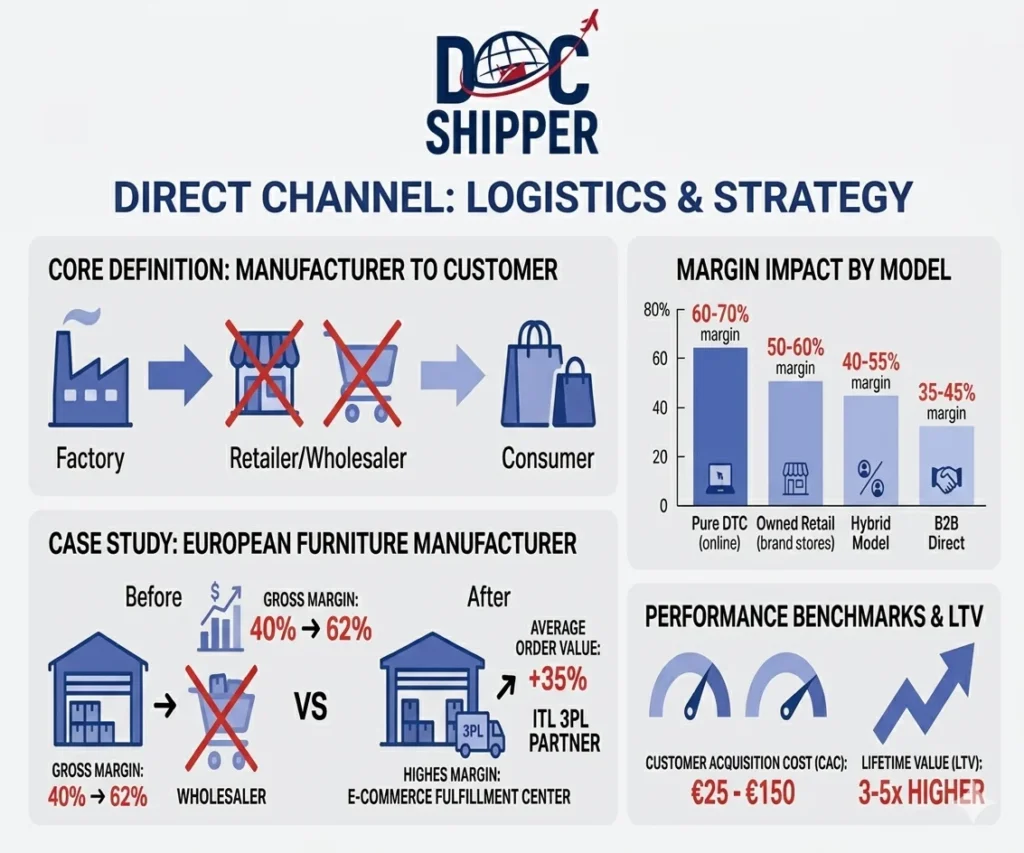
Direct channel strategies vary significantly across industries. The following comparison illustrates different implementation approaches:
| Model Type | Channel Structure | Margin Impact | Best For |
|---|---|---|---|
| Pure DTC | Manufacturer → Customer (online only) | 60-70% gross margin | Digital-native brands, subscription services |
| Owned Retail | Manufacturer → Brand stores → Customer | 50-60% gross margin | Luxury goods, premium electronics |
| Hybrid Model | Manufacturer → Direct + Retail partners | 40-55% gross margin | Established brands expanding reach |
| B2B Direct | Manufacturer → Business customer | 35-45% gross margin | Industrial equipment, software licenses |
Use Case: A European furniture manufacturer shifting from wholesale to direct channel:
- Previous model: Selling to retailers at 40% discount, retailers selling at 100% markup
- Direct channel implementation: E-commerce platform with flat-pack shipping
- Logistics transformation: Partnership with 3PL for warehousing in 5 European markets
- Financial outcome: Average order value increased 35%, gross margin improved from 40% to 62%
- Operational investment: €280,000 initial setup (platform, warehouse contracts, marketing)
Performance benchmarks for direct channels show customer acquisition cost (CAC) ranging from €25-€150 depending on product category, while lifetime value (LTV) typically reaches 3-5x higher than traditional retail due to repeat purchases and data-driven personalization.
Conclusion
Direct channels represent a fundamental shift in distribution strategy, offering margin expansion and customer intimacy at the cost of operational complexity. Success requires integrated logistics, technology, and compliance capabilities.
Need support implementing your direct channel logistics? Contact DocShipper for customized solutions covering international shipping, customs clearance, and fulfillment operations.
📚 Quiz
Test Your Knowledge: Direct Channel
Q1 — What best defines a "Direct Channel" in distribution strategy?
Q2 — A common misconception about direct channels is that they automatically guarantee higher profits. What is the correct interpretation?
Q3 — A European furniture manufacturer switches from selling to retailers to launching its own e-commerce platform with 3PL warehouse partnerships. Which outcome best reflects a direct channel result?
🎯 Your Result
📞 Free Quote in 24hFAQ | Direct Channel: Definition, Strategy & Concrete Examples
Direct channels involve selling directly to end customers without intermediaries, while indirect channels use wholesalers, distributors, or retailers. Direct channels offer higher margins but require companies to manage logistics and customer service themselves.
DTC shipments typically require individual customs declarations for each parcel, increasing administrative complexity. Companies must comply with de minimis thresholds, consumer protection laws, and VAT/sales tax collection in destination countries.
Key challenges include managing high-volume small parcel shipping, international returns processing, last-mile delivery coordination, inventory distribution across multiple warehouses, and maintaining delivery speed expectations while controlling costs.
Yes, this hybrid approach is common. However, it requires careful channel conflict management, differentiated pricing strategies, and clear policies to prevent undercutting retail partners while maintaining direct customer relationships.
Core systems include e-commerce platforms, warehouse management systems (WMS), order management software (OMS), customer relationship management (CRM), and integrated shipping solutions with carrier APIs for real-time tracking and rate shopping.
Direct channels typically increase gross margins by 20-40% by eliminating intermediary markups. However, companies must account for new costs including marketing, customer acquisition, fulfillment operations, and technology infrastructure.
Companies become responsible for VAT/GST registration in destination countries, sales tax nexus determination in the US, and compliance with digital services taxes. Thresholds vary by jurisdiction, typically ranging from €10,000-€35,000 in annual sales.
Direct models require distributed inventory across fulfillment centers near customer populations rather than centralized wholesale warehouses. This increases inventory holding costs but reduces shipping times and costs for end customers.
CAC varies widely by industry: €15-€40 for consumables, €50-€150 for fashion/apparel, and €200-€500 for electronics or furniture. Digital marketing efficiency and organic traffic development significantly impact these costs over time.
Companies must establish reverse logistics infrastructure including return portals, inspection facilities, restocking processes, and refund systems. International returns are particularly complex, often requiring local return centers to manage customs and shipping economics.
Third-party logistics providers handle warehousing, order fulfillment, shipping coordination, and returns processing, allowing manufacturers to operate direct channels without building extensive logistics infrastructure. They provide scalability and geographic coverage.
Most companies require 18-36 months to reach profitability in direct channels. Initial phases focus on platform development, customer acquisition, and logistics optimization. Breakeven typically occurs when LTV exceeds CAC by 3:1 ratio.
Need Help with
Logistics or Sourcing ?
First, we secure the right products from the right suppliers at the right price by managing the sourcing process from start to finish. Then, we simplify your shipping experience - from pickup to final delivery - ensuring any product, anywhere, is delivered at highly competitive prices.


Fill the Form
Prefer email? Send us your inquiry, and we’ll get back to you as soon as possible.
Contact us




