



In short ⚡
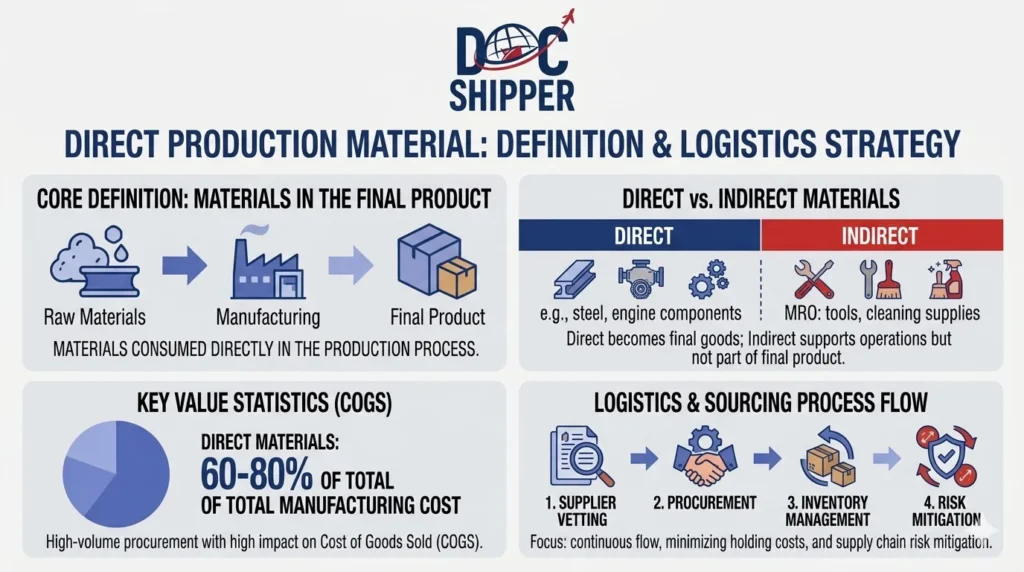
Direct Production Material (DPM) refers to raw materials, components, and consumables physically incorporated into the final product during manufacturing. Unlike indirect materials, DPM becomes part of the finished goods, directly affecting product cost, quality, and customs classification in international trade.
Introduction
Confusion between direct and indirect materials creates significant issues in customs valuation, duty calculations, and inventory management. Misclassifying production inputs can trigger audits, penalties, or incorrect tariff applications.
In international logistics, understanding DPM is critical for accurate landed cost estimation, HS code determination, and compliance with rules of origin. This distinction directly impacts pricing strategies and trade agreement eligibility.
Key characteristics of Direct Production Material:
- Physically incorporated into the finished product
- Traceable in the Bill of Materials (BOM)
- Directly attributable to specific product units
- Subject to customs valuation as part of product value
- Impacts HS classification and origin determination
Technical Classification & Trade Implications
Direct Production Materials fall into three primary categories: raw materials (unprocessed inputs like steel coils or polymers), components (semi-finished parts like circuit boards or fasteners), and consumables (materials depleted during production like welding electrodes or adhesives).
From a customs perspective, DPM determines the transaction value of imported goods. When materials are imported separately then assembled domestically, their declared value must reflect actual purchase price plus transport costs. Undervaluation triggers red flags during customs audits.
The rules of origin framework relies heavily on DPM classification. Under preferential trade agreements like USMCA or EU FTAs, only qualifying direct materials count toward regional value content (RVC) thresholds. A product using 60% qualifying DPM may receive duty-free treatment, while one with 59% faces full tariffs.
Inventory accounting standards (GAAP, IFRS) require DPM to be capitalized as work-in-progress or finished goods inventory, not expensed immediately. This affects financial reporting, tax liability, and transfer pricing documentation for multinational operations.
At DocShipper, we systematically verify DPM classifications during pre-shipment inspections to ensure customs declarations align with actual manufacturing processes, preventing costly delays at borders.
For authoritative customs guidance, consult the World Customs Organization (WCO) technical resources on valuation methods.
Concrete Examples & Customs Treatment
Understanding DPM through real-world scenarios clarifies its customs and operational impact. The following table compares direct versus indirect materials in common manufacturing contexts:
| Industry | Direct Production Material | Indirect Material (Comparison) | Customs Impact |
|---|---|---|---|
| Automotive | Steel sheets, brake pads, wiring harnesses | Machine lubricants, safety gloves | DPM included in vehicle CIF value |
| Electronics | PCBs, resistors, LCD panels | Cleanroom supplies, ESD mats | DPM determines HS code 8517.62 |
| Pharmaceuticals | Active ingredients, gelatin capsules | Packaging tape, calibration fluids | DPM subject to FDA import alerts |
| Textiles | Cotton yarn, zippers, buttons | Sewing machine oil, thread spools (storage) | DPM counts toward yarn-forward rule |
| Food Processing | Wheat flour, sugar, preservatives | Conveyor belts, hairnets | DPM triggers agricultural quotas |
Use Case: Electronics Manufacturer Importing to the EU
A German company imports smartphone components from China. The shipment contains:
- OLED displays (DPM) – €50,000
- Lithium batteries (DPM) – €30,000
- Packaging foam (Indirect) – €2,000
Customs valuation includes only the €80,000 DPM in the transaction value. The 2.5% EU duty applies solely to direct materials. Misclassifying batteries as indirect would undervalue the shipment by 37.5%, risking penalties under EUCDM Article 220.
Critical compliance points for DPM in international trade:
- Certificate of Origin: Only DPM sourced from qualifying countries counts toward preferential treatment
- Transfer Pricing: DPM must be invoiced at arm’s length prices to avoid tax authority challenges
- Drawback Claims: Duties paid on imported DPM may be recoverable if re-exported in finished goods
- FTA Compliance: Detailed DPM records required for audit trails under agreements like CPTPP or RCEP
- Valuation Adjustments: Royalties or assists related to DPM must be added to customs value per WTO rules
Conclusion
Accurate identification of Direct Production Material is non-negotiable for customs compliance, cost control, and trade agreement utilization. Misclassification creates legal exposure and erodes competitive advantage through inflated duties or missed preferential rates.
Need expert guidance on DPM classification for your shipments? Contact DocShipper for comprehensive customs consulting and logistics support.
📚 Quiz
Test Your Knowledge: Direct Production Material (DPM)
Q1 — Which of the following best defines Direct Production Material (DPM)?
Q2 — A textile manufacturer uses cotton yarn (incorporated into garments) and sewing machine oil (used to maintain equipment). Under customs rules of origin, which material counts toward the regional value content (RVC) threshold?
Q3 — A German company imports OLED displays (€50,000) and lithium batteries (€30,000) as DPM, plus packaging foam (€2,000) classified as indirect material. A customs officer asks for the correct dutiable transaction value. What is it?
🎯 Your Result
📞 Free Quote in 24hFAQ | Direct Production Material (DPM): Definition, Classification & Concrete Examples
Direct materials physically become part of the finished product (e.g., fabric in clothing). Indirect materials support production but aren't in the final goods (e.g., machine lubricants).
Only if consumed during production and traceable to specific units. Welding rods used in assembly are DPM; general workshop supplies are indirect.
DPM value is included in the dutiable transaction value. Indirect materials may be excluded, reducing the duty base if properly documented.
Yes, if they're essential for the product's sale (e.g., sterile medical device packaging). Outer shipping boxes are typically indirect.
Bill of Materials (BOM), purchase orders, production records, and supplier invoices showing material incorporation into finished goods.
FTAs require detailed DPM sourcing records. Only materials from partner countries or meeting transformation rules count toward origin qualification.
Yes, if physically incorporated into your product. The subcontractor's DPM also affects your origin calculations under most FTAs.
Customs may reassess duties retroactively, impose penalties, or require bond adjustments. Repeated errors trigger enhanced scrutiny and audits.
No. DPM refers only to tangible goods. Services like assembly labor are production costs but not materials.
At arm's length prices reflecting comparable uncontrolled transactions. Intercompany DPM transfers require robust documentation to withstand tax audits.
Yes. A material might be direct in one process (e.g., adhesive in lamination) but indirect in another (e.g., general workshop adhesive).
Duties paid on imported DPM can be refunded if the finished product is exported, provided proper records link materials to specific shipments.
Need Help with
Logistics or Sourcing ?
First, we secure the right products from the right suppliers at the right price by managing the sourcing process from start to finish. Then, we simplify your shipping experience - from pickup to final delivery - ensuring any product, anywhere, is delivered at highly competitive prices.


Fill the Form
Prefer email? Send us your inquiry, and we’ll get back to you as soon as possible.
Contact us




:%20Definition,%20Classification%20&%20Concrete%20Examples)