


In short ⚡
A distribution center is a specialized warehouse facility designed to receive, store temporarily, and redistribute goods to retail locations, customers, or other supply chain nodes. Unlike traditional warehouses focused on long-term storage, distribution centers prioritize rapid inventory turnover and order fulfillment through advanced sorting, picking, and shipping operations.
Introduction
Many importers confuse distribution centers with simple storage facilities. This misunderstanding creates inefficiencies in supply chain management and increases delivery times.
In international trade, distribution centers serve as critical hubs connecting manufacturing origins with final consumption markets. They transform bulk shipments into customer-ready orders.
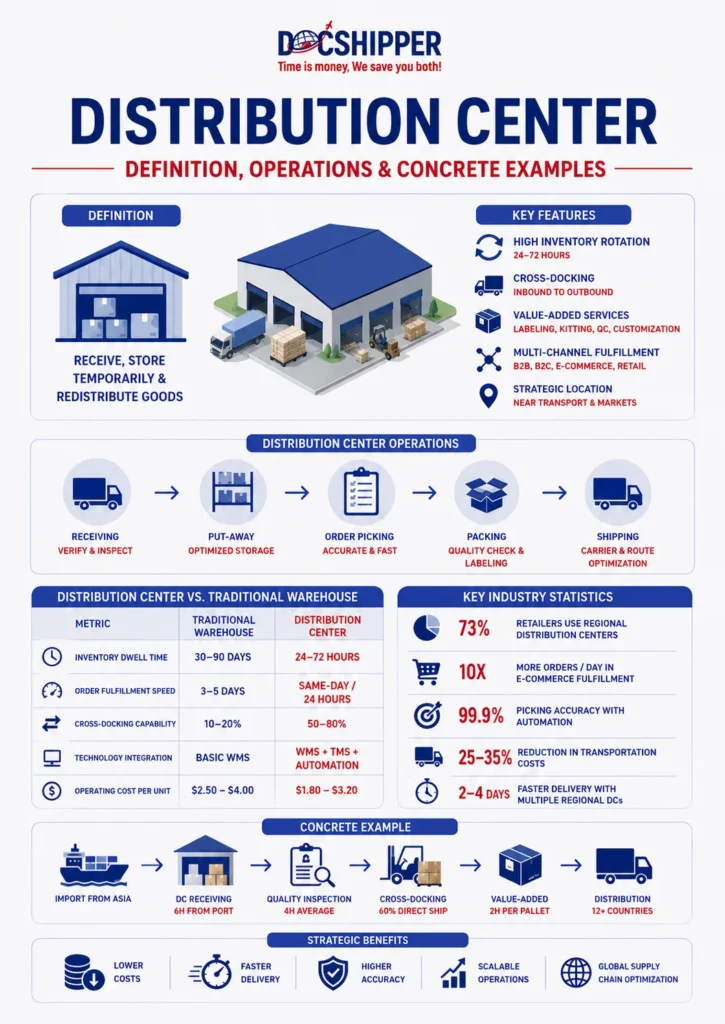
Key characteristics include:
- High inventory rotation – goods remain 24-72 hours on average
- Cross-docking capabilities – direct transfer from inbound to outbound trucks
- Value-added services – labeling, kitting, quality control, customization
- Multi-channel fulfillment – B2B, B2C, e-commerce, retail distribution
- Strategic location – proximity to transportation networks and target markets
Operations & Strategic Expertise
Distribution centers operate through systematic processes designed to minimize handling time while maximizing accuracy. Receiving operations verify shipment compliance against purchase orders and customs documentation.
The put-away process uses warehouse management systems (WMS) to assign optimal storage locations based on product velocity. Fast-moving items occupy easily accessible zones while slower inventory positions further back.
Order picking methods vary by volume and complexity. Discrete picking suits small operations, while batch picking, zone picking, or wave picking optimize high-volume environments. Automated systems like pick-to-light or voice-directed picking reduce error rates below 0.5%.
The packing and shipping stage involves quality verification, compliance labeling, and carrier assignment. Integration with transportation management systems (TMS) ensures optimal routing and cost control.
From a customs perspective, distribution centers operating in free trade zones or bonded warehouses allow duty deferral until goods enter commerce. This provides significant cash flow advantages for importers. According to U.S. Customs and Border Protection, companies using these facilities reduce landed costs by 15-30%.
At DocShipper, we help clients select and configure distribution centers aligned with their import volume, market geography, and regulatory requirements to ensure seamless international operations.
Concrete Examples & Data
Understanding distribution center performance requires examining real-world operational metrics and configurations.
Use Case: Electronics Importer in Europe
A consumer electronics company imports 15,000 units monthly from Asian manufacturers. Their Netherlands distribution center processes goods within 48 hours:
- Receiving: Containerized shipments arrive via Rotterdam port – 6 hours from dock to facility
- Quality inspection: Random sampling of 5% units – 4 hours average
- Cross-docking: 60% of inventory ships directly to retailers without storage
- Value-added services: EU compliance labeling, multi-language packaging – 2 hours per pallet
- Distribution: Same-day dispatch to 12 European countries via integrated courier networks
This configuration reduced their end-to-end delivery time by 40% compared to direct-from-origin shipping.
Comparative Performance Table
| Metric | Traditional Warehouse | Distribution Center |
|---|---|---|
| Inventory dwell time | 30-90 days | 24-72 hours |
| Order fulfillment speed | 3-5 days | Same-day / 24 hours |
| Cross-docking capability | Limited (10-20%) | Extensive (50-80%) |
| Technology integration | Basic WMS | WMS + TMS + automation |
| Operating cost per unit | $2.50-$4.00 | $1.80-$3.20 |
Key Industry Statistics
- 73% of major retailers rely on regional distribution centers for inventory positioning
- E-commerce fulfillment centers process 10x more orders per day than traditional facilities
- Automated distribution centers achieve 99.9% picking accuracy versus 97-98% manual operations
- Strategic DC placement reduces transportation costs by 25-35% on average
- Companies using multiple regional DCs decrease delivery times by 2-4 days compared to centralized models
Conclusion
Distribution centers represent the operational backbone of modern supply chains, enabling rapid market response and cost-effective fulfillment. Their strategic deployment determines competitive advantage in international trade.
Need guidance on distribution center selection or integration for your import operations? Contact DocShipper for expert consultation.
📚 Quiz
Test Your Knowledge: Distribution Center
What is the primary operational focus of a distribution center compared to a traditional warehouse?
A company receives shipments from overseas and immediately transfers 70% of goods to outbound trucks without storage. What distribution center capability are they utilizing?
An importer wants to defer customs duty payments while performing EU compliance labeling on electronics. Which distribution center configuration provides this advantage?
🎯 Your Result
📞 Free Quote in 24hFAQ | Distribution Center: Definition, Operations & Concrete Examples
Warehouses focus on long-term storage (weeks to months) with minimal handling, while distribution centers prioritize rapid throughput (24-72 hours) with extensive sorting, picking, and value-added services. Distribution centers function as dynamic processing hubs rather than static storage facilities.
Cross-docking involves transferring goods directly from inbound trucks to outbound vehicles with minimal or no storage time. Products are received, sorted by destination, and immediately loaded for shipment. This eliminates storage costs and reduces handling time by 50-70% for compatible products.
Advanced facilities deploy warehouse management systems (WMS), transportation management systems (TMS), automated guided vehicles (AGVs), robotic picking systems, radio-frequency identification (RFID), and real-time inventory tracking. Integration with enterprise resource planning (ERP) systems ensures seamless data flow across the supply chain.
Yes, many distribution centers operate as bonded warehouses or within foreign trade zones, allowing goods to enter before customs duties are paid. This provides duty deferral benefits and enables value-added processing before formal importation. Customs clearance can occur when goods leave for final delivery.
Facility sizing depends on monthly throughput volume, product characteristics, and service level requirements. Small operations (500-2,000 orders/month) may need 5,000-10,000 sq ft, while high-volume e-commerce (50,000+ orders/month) requires 100,000+ sq ft with automation. Professional assessment ensures optimal capacity planning.
Strategic geographic positioning near major markets minimizes last-mile delivery distances. Consolidation of shipments increases truck utilization rates from 60-70% to 90-95%. Proximity to transportation hubs (ports, airports, rail terminals) reduces drayage costs and enables multimodal optimization.
Common services include product labeling, kitting and bundling, quality inspection, returns processing, packaging customization, serialization, light assembly, product testing, compliance documentation, and postponement manufacturing. These services enable market-specific customization without delaying shipments from origin.
Evaluate proximity to target customers, transportation infrastructure access, labor availability and costs, tax incentives, regulatory environment, and real estate expenses. Network modeling software can simulate multiple scenarios to identify optimal configurations balancing service levels and total landed costs.
Third-party logistics (3PL) providers charge $1.80-$4.50 per unit handled, plus storage fees of $8-$15 per pallet monthly. Dedicated facilities incur real estate ($4-$12/sq ft annually), labor (40-50% of operating costs), technology systems ($50,000-$500,000 initial investment), and utilities. Total costs vary significantly by location and service level.
Absolutely. Third-party logistics providers offer shared distribution center services with no minimum commitments, allowing small importers to access sophisticated infrastructure and technology. This eliminates capital investment while providing professional fulfillment capabilities that enhance customer satisfaction and enable business scaling.
Modern distribution centers connect directly to e-commerce systems (Shopify, Amazon, WooCommerce) via API integrations. Orders automatically flow to the WMS, inventory updates occur in real-time, and tracking information feeds back to customer accounts. This seamless integration enables same-day order processing and accurate stock visibility.
Facilities employ 24/7 surveillance systems, controlled access with biometric authentication, inventory tracking via RFID or barcode systems, segregated storage for high-value items, alarm systems, security personnel, and comprehensive insurance coverage. Many achieve ISO 28000 certification for supply chain security management.
Need Help with
Logistics or Sourcing ?
First, we secure the right products from the right suppliers at the right price by managing the sourcing process from start to finish. Then, we simplify your shipping experience - from pickup to final delivery - ensuring any product, anywhere, is delivered at highly competitive prices.


Fill the Form
Prefer email? Send us your inquiry, and we’ll get back to you as soon as possible.
Contact us




