


In short ⚡
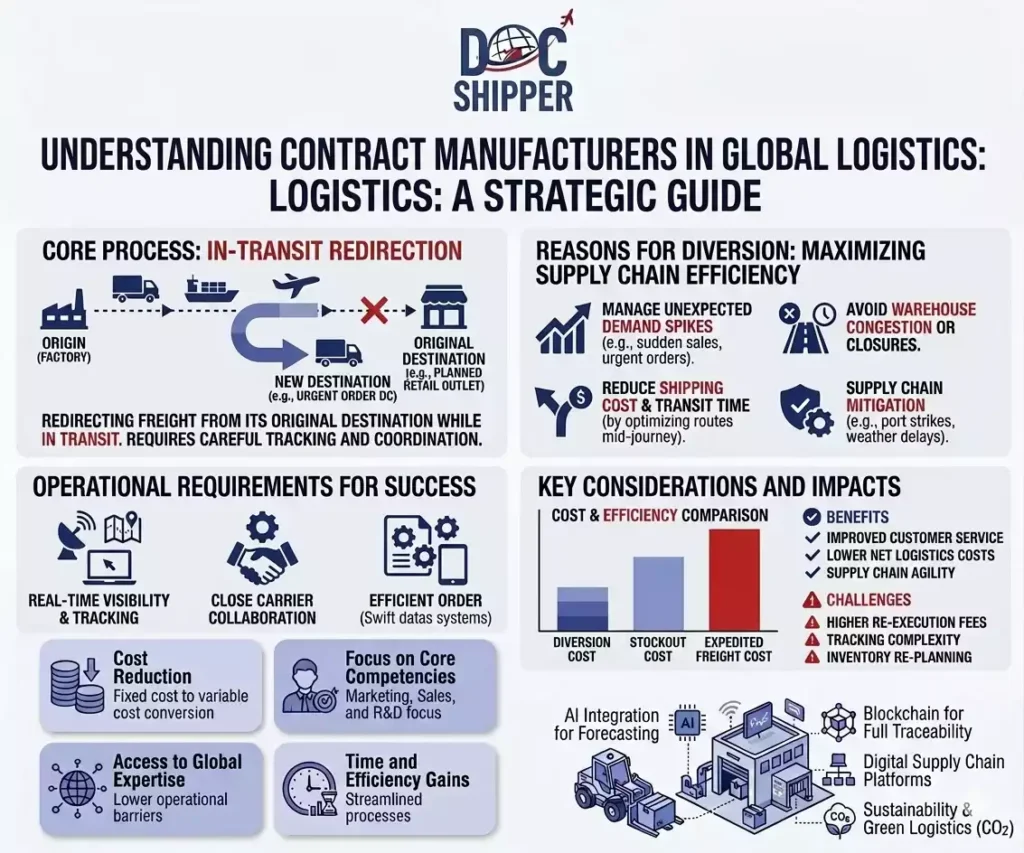
Diversion in international logistics refers to the unauthorized rerouting of goods from their intended destination or distribution channel. This practice occurs when shipments are deliberately redirected—often by intermediaries—to markets where profit margins are higher, violating contractual agreements and potentially infringing trademark rights or regulatory compliance.Introduction
Imagine shipping 10,000 units of premium electronics to your authorized distributor in Germany, only to discover them being sold at discount prices in unauthorized markets across Eastern Europe. This scenario exemplifies diversion—a critical challenge in international trade that undermines brand integrity, disrupts pricing strategies, and exposes companies to legal liabilities.
Diversion threatens the stability of global supply chains by creating parallel markets that operate outside contractual frameworks. Manufacturers lose control over product positioning, authorized distributors face unfair competition, and end consumers may receive goods without proper warranties or support.
Key characteristics of diversion include:
- Contractual breach: Violates exclusive distribution agreements and territorial restrictions
- Price arbitrage: Exploits price differences between markets to generate unauthorized profits
- Gray market creation: Establishes unofficial distribution channels that bypass official networks
- Trademark concerns: May infringe territorial trademark rights depending on jurisdiction
- Regulatory risks: Diverted goods may not comply with destination market regulations
Mechanisms & Legal Implications
Diversion typically occurs through several mechanisms. Intermediary manipulation represents the most common scenario: a distributor purchases goods legitimately but redirects them to unauthorized territories. Transshipment abuse involves declaring false destinations on shipping documents to circumvent distribution controls. Parallel importing exploits price differentials between markets, though its legality varies significantly by jurisdiction.
The legal framework surrounding diversion remains complex and jurisdiction-dependent. Under EU competition law, absolute territorial protection is generally prohibited, allowing parallel trade within the European Economic Area. However, selective distribution systems may restrict sales to authorized dealers when objectively justified. The EU Digital Markets Act further regulates platform-based diversion practices.
In the United States, the first-sale doctrine generally permits resale of legitimately purchased goods. Yet manufacturers can impose contractual restrictions on distributors. The Lanham Act provides trademark protection against material differences in diverted goods that could confuse consumers.
Companies face three primary consequences from diversion. Brand damage occurs when products appear in inappropriate channels without proper support. Financial losses result from price erosion and reduced authorized distributor sales. Regulatory exposure arises when diverted goods lack proper certifications for destination markets.
At DocShipper, we implement multi-layered verification systems to detect diversion patterns early. Our customs compliance team cross-references declared destinations with historical shipping data, flagging anomalies for client review before goods leave origin ports.
Practical Examples & Industry Data
Industry research reveals diversion’s significant economic impact. A 2023 study by the International Trademark Association estimated that gray market diversion costs global brands approximately $63 billion annually across pharmaceutical, electronics, and luxury goods sectors.
Comparative Scenario Analysis
| Scenario | Authorized Channel | Diverted Channel | Impact |
|---|---|---|---|
| Consumer Electronics | $500 retail price in US market | $380 in unauthorized Latin American outlets | 24% price erosion, warranty voidance |
| Pharmaceuticals | $120 per unit in EU with full traceability | $85 per unit through parallel import | Regulatory compliance gaps, safety concerns |
| Luxury Fashion | $2,000 in flagship stores | $1,400 on unauthorized online platforms | Brand dilution, customer experience degradation |
Real-World Case Study
A European automotive parts manufacturer discovered that 18% of its shipments to a Middle Eastern distributor were being diverted to African markets. Investigation revealed the distributor exploited a 35% price differential between regions. The manufacturer implemented serialized tracking and contractual penalties, reducing diversion to below 3% within eight months.
Key indicators of potential diversion include:
- Order pattern anomalies: Unusual volume spikes from specific distributors without corresponding market growth
- Geographic inconsistencies: Products appearing in markets where no authorized distribution exists
- Price monitoring alerts: Significant price deviations in unauthorized channels
- Serial number tracking: Products registered in regions different from shipment destinations
- Customer complaints: Warranty claims from unauthorized purchase locations
Conclusion
Diversion represents a persistent challenge requiring proactive supply chain governance, robust contractual frameworks, and continuous monitoring systems. Companies that implement comprehensive anti-diversion strategies protect brand equity while maintaining healthy distributor relationships.
Need expert guidance on preventing diversion in your international shipments? Contact DocShipper for customized supply chain security solutions tailored to your distribution model.
📚 Quizz
Test Your Knowledge: Diversion in Logistics
Q1 — What is the core definition of "diversion" in international logistics?
Q2 — Are diverted goods the same as counterfeit goods?
Q3 — A European manufacturer ships automotive parts to a Middle Eastern distributor. The distributor then resells 18% of those shipments to African markets at a 35% lower price, without the manufacturer's consent. Which term best describes this situation?
🎯 Your Result
📞 Free Quote in 24hFAQ | Diversion in Logistics: Definition, Causes & Practical Examples
Diversion involves contractual breach where goods are redirected against distribution agreements. Parallel importing refers to legal cross-border trade exploiting price differences, though legality varies by jurisdiction and product category.
Implement serialized product tracking, monitor online marketplaces for unauthorized listings, analyze distributor order patterns for anomalies, and establish customer registration systems that reveal purchase locations.
No. Diverted products are typically genuine items purchased through legitimate channels but resold in unauthorized markets. They differ from counterfeits, which are fake products infringing intellectual property rights.
Yes, if your distribution agreement contains territorial restrictions and anti-diversion clauses. Remedies may include contract termination, financial damages, and injunctive relief depending on jurisdiction and contract terms.
It depends. In the EU, trademark exhaustion allows resale within the EEA. In the US, material differences between diverted and authorized goods may constitute trademark infringement under the Lanham Act.
Pharmaceuticals, consumer electronics, luxury goods, automotive parts, and cosmetics experience elevated diversion due to significant price differentials across markets and high product values.
Manufacturers typically void warranties for diverted products purchased outside authorized channels, leaving consumers without support and creating potential liability issues for unauthorized sellers.
Blockchain-based supply chain tracking creates immutable records of product movement, making diversion more detectable. However, implementation requires ecosystem-wide adoption and integration with physical verification systems.
Effective agreements include territorial exclusivity clauses, minimum advertised price policies, audit rights, serialized tracking requirements, financial penalties for violations, and immediate termination provisions.
Customs focus on regulatory compliance and proper valuation. They typically don't enforce private distribution agreements unless goods violate import regulations, safety standards, or intellectual property rights.
The gray market consists of goods sold through unauthorized channels. Diversion creates gray markets by redirecting products from intended distribution networks into parallel unofficial channels.
Platform liability varies by jurisdiction. EU Digital Services Act and US Section 230 protections generally shield platforms, but they may face obligations to remove listings upon notice of trademark infringement or regulatory violations.
Need Help with
Logistics or Sourcing ?
First, we secure the right products from the right suppliers at the right price by managing the sourcing process from start to finish. Then, we simplify your shipping experience - from pickup to final delivery - ensuring any product, anywhere, is delivered at highly competitive prices.


Fill the Form
Prefer email? Send us your inquiry, and we’ll get back to you as soon as possible.
Contact us




