


In short ⚡
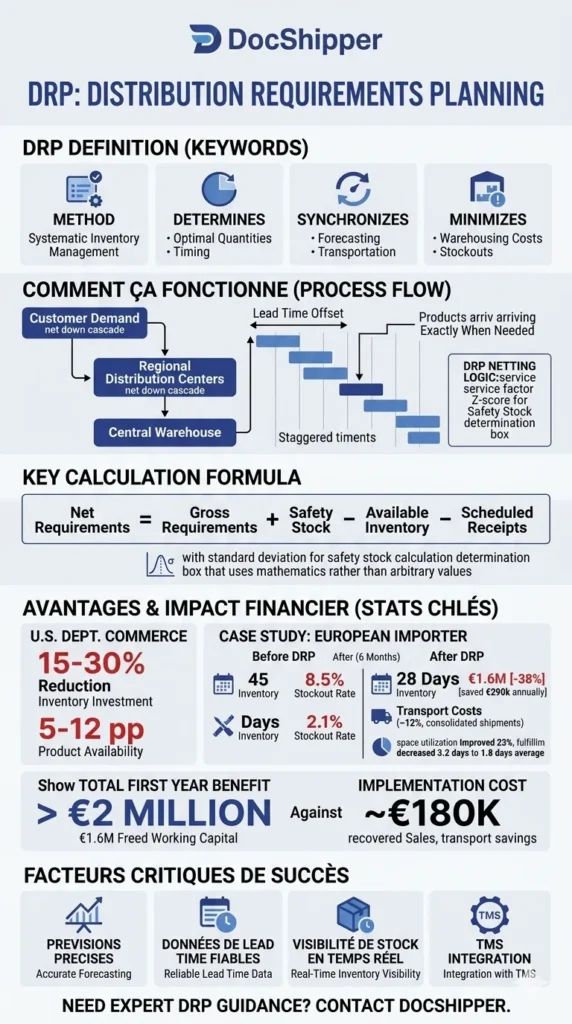
Distribution Requirements Planning (DRP) is a systematic inventory management method that determines optimal quantities and timing for product distribution across supply chain networks. It synchronizes demand forecasting with transportation schedules to ensure product availability while minimizing warehousing costs and stockouts across multiple distribution centers.Introduction
Many import-export businesses struggle with the critical question: how much inventory should each distribution center hold? Overstocking ties up capital and increases storage costs. Understocking leads to lost sales and damaged customer relationships. This perpetual balancing act becomes exponentially complex when managing multiple warehouses across different regions.
Distribution Requirements Planning (DRP) addresses this challenge by creating a time-phased replenishment plan for every location in your distribution network. Unlike reactive inventory management, DRP proactively calculates future needs based on actual demand patterns, lead times, and distribution constraints.
Key characteristics of effective DRP systems include:
- Time-phased planning: Projects inventory needs week-by-week or day-by-day
- Network-wide visibility: Coordinates stock levels across all distribution points
- Demand-driven replenishment: Bases decisions on actual consumption data, not forecasts alone
- Transportation optimization: Aligns shipment schedules with carrier availability and cost structures
- Safety stock calculation: Determines buffer inventory mathematically rather than arbitrarily
DRP Mechanisms & Strategic Implementation
DRP operates through a hierarchical calculation process that starts at the point of consumption and works backward through the supply chain. Each distribution center calculates its gross requirements based on customer demand, then communicates these needs to upstream facilities or suppliers.
The fundamental DRP calculation follows this logic for each planning period:
Net Requirements = Gross Requirements + Safety Stock – Available Inventory – Scheduled Receipts
This calculation runs iteratively across all locations, creating a cascade effect where downstream requirements become upstream gross requirements. A regional distribution center’s replenishment orders become demand signals for the central warehouse, which in turn generates purchase orders or production schedules.
The lead time offset is crucial in DRP. If a distribution center needs 1,000 units in week 5, and transportation takes 2 weeks, the system schedules the shipment for week 3. This time-phasing ensures products arrive exactly when needed, reducing both stockouts and excess inventory.
Safety stock determination in DRP differs from traditional methods. Rather than applying arbitrary percentages, DRP calculates safety stock based on demand variability and desired service levels. The formula typically incorporates standard deviation of demand during lead time multiplied by a service factor (Z-score).
According to the U.S. Department of Commerce Trade Logistics Handbook, companies implementing DRP systems report 15-30% reductions in total inventory investment while simultaneously improving product availability by 5-12 percentage points.
At DocShipper, we integrate DRP principles into our warehouse management services, helping clients optimize their distribution networks across international borders. Our systems account for customs clearance times and international shipping variables that traditional DRP software often overlooks.
Practical Applications & Performance Data
To illustrate DRP’s practical impact, consider a European electronics importer distributing products to five regional warehouses across France, Germany, Spain, Italy, and Poland. Each location serves different market dynamics with varying demand patterns and transportation lead times.
| Distribution Center | Weekly Demand | Lead Time (Days) | Safety Stock | Order Frequency |
|---|---|---|---|---|
| France (Paris) | 2,500 units | 3 days | 1,200 units | Twice weekly |
| Germany (Frankfurt) | 3,200 units | 2 days | 1,000 units | Three times weekly |
| Spain (Madrid) | 1,800 units | 5 days | 1,500 units | Weekly |
| Italy (Milan) | 2,100 units | 4 days | 1,300 units | Twice weekly |
| Poland (Warsaw) | 1,400 units | 6 days | 1,600 units | Weekly |
Use Case: DRP Implementation Results
Before implementing DRP, this company maintained 45 days of inventory across all locations, totaling €4.2 million in working capital. Stockout rate averaged 8.5%, resulting in approximately €380,000 in lost annual sales.
After six months with a DRP system:
- Average inventory reduced to 28 days (€2.6 million) – a 38% reduction
- Stockout rate decreased to 2.1% – saving approximately €290,000 annually
- Transportation costs dropped 12% through consolidated shipments
- Warehouse space utilization improved by 23%, eliminating need for temporary storage
- Order fulfillment time decreased from 3.2 days to 1.8 days average
The financial impact was substantial: €1.6 million in freed working capital, €290,000 in recovered sales, and €85,000 in annual transportation savings. Total first-year benefit exceeded €2 million against implementation costs of approximately €180,000.
Critical success factors included accurate demand forecasting (within 15% variance), reliable lead time data, real-time inventory visibility, and integration with transportation management systems. Companies that neglect data quality typically see only marginal improvements from DRP implementation.
Conclusion
Distribution Requirements Planning transforms inventory management from reactive guesswork into proactive science. By synchronizing demand signals across your entire distribution network, DRP simultaneously reduces costs and improves customer service—the holy grail of supply chain management.
Need expert guidance on implementing DRP in your international distribution network? Contact DocShipper for a customized assessment of your logistics optimization opportunities.
📚 Quiz
Test Your Knowledge: Distribution Requirements Planning (DRP)
Q1 — What is the primary purpose of Distribution Requirements Planning (DRP)?
Q2 — In the DRP formula, Net Requirements = Gross Requirements + Safety Stock − Available Inventory − Scheduled Receipts. What does the "lead time offset" ensure?
Q3 — A European electronics importer implements DRP across five regional warehouses. Which outcome best reflects a realistic result after six months?
🎯 Your Result
📞 Free Quote in 24hFAQ | DRP (Distribution Requirements Planning): Definition, Calculation & Concrete Examples
MRP (Material Requirements Planning) focuses on manufacturing and production scheduling, while DRP manages finished goods distribution across warehouses. MRP answers "what to make," DRP answers "where to send it."
DRP incorporates seasonal forecasting models that adjust safety stock levels and replenishment quantities based on historical patterns. The system automatically increases buffer inventory before peak seasons and reduces it during slow periods.
Absolutely. Even businesses with 2-3 distribution points gain significant benefits. Modern cloud-based DRP solutions offer affordable entry points starting around $200-500 monthly, with ROI typically achieved within 6-9 months through inventory reduction alone.
Inventory accuracy should exceed 95%, demand forecast accuracy should be within 20% variance, and lead time data should be reliable within one day. Below these thresholds, DRP recommendations become unreliable and may increase rather than decrease costs.
Advanced DRP systems incorporate minimum order quantities, truck capacity limits, shipping frequency constraints, and carrier schedules. The system groups orders to maximize container utilization and minimize per-unit transportation costs while meeting service level targets.
Basic DRP implementation takes 3-6 months, including data cleanup, system configuration, user training, and parallel testing. Complex multi-country networks may require 9-12 months for full deployment across all locations and integration with existing systems.
DRP systems should include customs clearance time as part of total lead time. For international shipments, add 2-5 days for customs processing depending on origin/destination countries. Safety stock calculations should also account for customs delay variability.
Yes. Modern DRP solutions integrate with Shopify, Amazon, WooCommerce, and other platforms through APIs. Real-time sales data feeds directly into DRP calculations, ensuring distribution centers receive immediate demand signals from online channels.
DRP systems allow override capabilities and business rule configuration. For example, you can set minimum order quantities, preferred suppliers, or mandatory stock levels. The system flags exceptions when recommendations violate these rules, allowing manual review.
Most companies run DRP calculations daily for high-velocity items and weekly for slower-moving products. Real-time DRP (continuous recalculation) is becoming standard for businesses with volatile demand patterns or short lead times under 7 days.
Yes, with FEFO (First Expired, First Out) logic. DRP systems track batch expiration dates and prioritize shipments to ensure oldest inventory ships first. Safety stock calculations also factor in shelf life, reducing quantities for products with shorter expiration windows.
Typical ROI ranges from 200-400% in the first year through inventory reduction (20-35%), improved service levels (5-15% fewer stockouts), and transportation optimization (10-20% cost reduction). Payback period averages 8-14 months for mid-sized distribution networks.
Need Help with
Logistics or Sourcing ?
First, we secure the right products from the right suppliers at the right price by managing the sourcing process from start to finish. Then, we simplify your shipping experience - from pickup to final delivery - ensuring any product, anywhere, is delivered at highly competitive prices.


Fill the Form
Prefer email? Send us your inquiry, and we’ll get back to you as soon as possible.
Contact us




