


In short ⚡
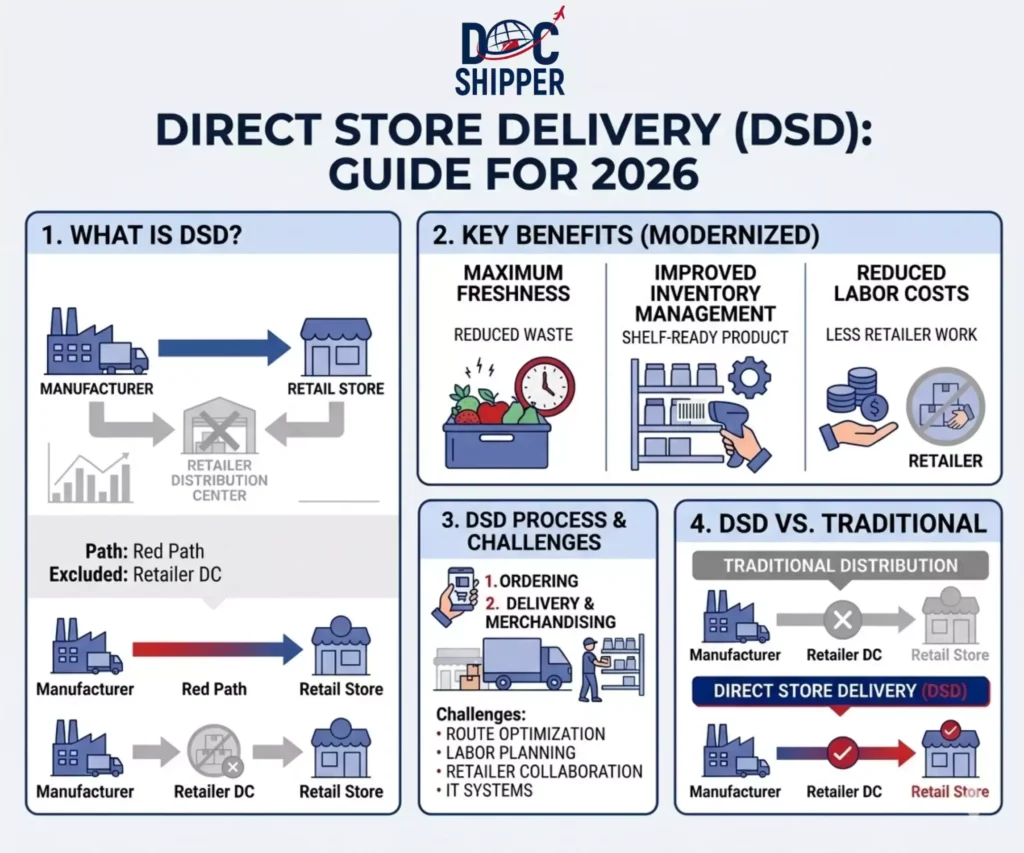
Direct Store Delivery (DSD) is a distribution method where manufacturers or distributors deliver products directly to retail stores, bypassing traditional warehouse networks. This approach reduces handling time, ensures product freshness, and enables rapid inventory replenishment for high-turnover goods.
Introduction
Many businesses struggle with slow inventory turnover and product deterioration in traditional warehouse-based distribution systems. For perishable goods, beverages, and fast-moving consumer products, delays between production and shelf placement directly impact profitability and customer satisfaction.
Direct Store Delivery (DSD) addresses these challenges by creating a streamlined supply chain where products move directly from manufacturing or distribution centers to retail locations. This model has become essential in international logistics for categories requiring freshness guarantees and frequent replenishment.
Key characteristics of DSD include:
- Elimination of intermediary warehouses – Products skip centralized distribution centers
- Supplier-managed merchandising – Delivery personnel often stock shelves and manage displays
- Frequent delivery cycles – Multiple deliveries per week maintain optimal inventory levels
- Real-time inventory visibility – Direct contact enables immediate demand response
- Enhanced product quality control – Shorter transit times preserve freshness and reduce damage
DSD Mechanisms & Strategic Advantages
The operational framework of DSD fundamentally differs from conventional distribution. Manufacturers maintain dedicated delivery fleets or contract specialized logistics providers to execute route-based delivery schedules. Each delivery vehicle follows predetermined routes, visiting multiple retail locations within a geographic territory.
From a regulatory perspective, DSD operations must comply with food safety regulations when handling perishables. In the European Union, the General Food Law Regulation (EC) No 178/2002 establishes traceability requirements that DSD operators must maintain throughout the delivery chain. Temperature-controlled vehicles require certification, and delivery personnel need proper training in handling protocols.
The cost structure of DSD presents unique considerations. While eliminating warehouse storage reduces facility costs, transportation expenses increase due to smaller shipment sizes and more frequent deliveries. Companies must balance route density against delivery frequency to optimize per-unit delivery costs. At DocShipper, we analyze these trade-offs to determine when DSD provides genuine cost advantages over traditional distribution models.
Inventory management benefits represent a critical DSD advantage. Suppliers maintain ownership of products until point-of-sale in many arrangements, shifting inventory carrying costs from retailers to manufacturers. This consignment model improves retailer cash flow while giving suppliers direct control over product presentation and pricing strategies.
The merchandising control inherent in DSD creates competitive advantages. Delivery personnel execute planogram compliance, ensuring products receive optimal shelf placement and visibility. They conduct shelf audits, remove expired items, and implement promotional displays—activities that warehouse-delivered products rely on store staff to perform. This direct engagement strengthens brand presence and accelerates sales velocity.
Practical Implementation & Industry Data
Industry data reveals significant DSD adoption across specific product categories. According to market research, approximately 25-30% of grocery store products arrive through DSD channels in North American markets, with even higher percentages in beverage and bakery categories.
| Product Category | DSD Penetration Rate | Average Delivery Frequency | Primary Driver |
|---|---|---|---|
| Soft Drinks/Beverages | 85-95% | 2-3 times weekly | Product freshness, high turnover |
| Bread & Bakery | 90-98% | Daily | Short shelf life |
| Salty Snacks | 70-80% | Weekly | Merchandising control |
| Dairy Products | 60-70% | 2-4 times weekly | Temperature sensitivity |
| Magazines/Publications | 95-100% | Weekly | Time-sensitive content |
Use Case: International Beverage Manufacturer
A European soft drink producer expanding into Asian markets implemented DSD for their premium product line. Traditional warehouse distribution resulted in 14-day average shelf time before products reached consumers. By establishing DSD networks in major cities, they reduced this to 4 days, improving product freshness perception and enabling rapid response to local taste preferences.
The financial impact included:
- 23% reduction in product waste from expired inventory
- 18% increase in sales velocity due to improved freshness
- 31% improvement in promotional compliance rates
- 12% higher transportation costs offset by eliminated warehouse fees
- Net margin improvement of 7% within 18 months
Technology integration has transformed DSD efficiency. Modern systems utilize route optimization algorithms that reduce delivery miles by 15-25% compared to manual routing. Mobile devices enable real-time inventory updates, electronic proof of delivery, and immediate communication between drivers and dispatch centers. At DocShipper, we integrate these technologies into customized DSD solutions for clients entering new international markets.
Conclusion
Direct Store Delivery represents a strategic distribution choice for products requiring freshness, rapid turnover, or intensive merchandising support. While operational complexity increases compared to warehouse models, the benefits in product quality, inventory control, and market responsiveness justify implementation for appropriate product categories.
Need guidance on implementing DSD in your international logistics strategy? Contact DocShipper for customized distribution solutions.
📚 Quiz
Test Your Knowledge: Direct Store Delivery (DSD)
Q1 — What is the defining characteristic of Direct Store Delivery (DSD)?
Q2 — A common misconception about DSD is that it always reduces transportation costs. What does the article actually state?
Q3 — A small artisan bakery wants to distribute its fresh bread to local supermarkets every day and have its own staff manage shelf displays. Which distribution model best fits their needs?
🎯 Your Result
📞 Free Quote in 24hFAQ | DSD (Direct Store Delivery): Definition, Process & Practical Examples
Perishable goods, beverages, bakery items, dairy products, and high-margin products requiring merchandising control gain maximum advantage from Direct Store Delivery systems.
DSD eliminates intermediate warehousing, with suppliers delivering directly to retail locations. This reduces handling steps, shortens delivery times, and enables supplier-controlled merchandising at the point of sale.
Primary costs include dedicated delivery fleet expenses, route planning systems, and trained delivery personnel. These offset against savings from eliminated warehouse storage, reduced inventory carrying costs, and decreased product spoilage.
Yes, through third-party DSD service providers or cooperative distribution networks. Many logistics companies offer shared DSD routes that allow smaller brands to access direct delivery without maintaining dedicated fleets.
Route optimization software, mobile inventory management apps, electronic proof of delivery systems, and real-time communication platforms form the technological foundation for efficient DSD networks.
Delivery frequency depends on product shelf life and turnover rates. Bakery products typically require daily delivery, beverages need 2-3 weekly deliveries, while shelf-stable snacks may only need weekly replenishment.
Food safety regulations require temperature-controlled vehicles, proper handling certifications, traceability documentation, and compliance with local health department standards. Requirements vary by jurisdiction and product type.
Studies show DSD reduces time-to-shelf by 60-75% compared to warehouse distribution, directly improving freshness for perishable products and reducing waste from expiration by 20-30% on average.
DSD shifts inventory responsibility to suppliers in many arrangements, improving retailer cash flow. Retailers benefit from reduced stockroom space requirements and lower carrying costs while maintaining better shelf availability.
Key challenges include establishing local distribution infrastructure, navigating varied regulatory environments, managing cross-border logistics complexity, and adapting to different retail formats and consumer expectations across markets.
Hybrid models are emerging where DSD networks support both retail store delivery and direct-to-consumer orders. This maximizes route efficiency and enables omnichannel distribution from the same logistics infrastructure.
Critical metrics include on-time delivery percentage, cost per delivery stop, inventory turnover rates, out-of-stock incidents, product waste percentages, and promotional compliance scores. These indicators assess both efficiency and market impact.
Need Help with
Logistics or Sourcing ?
First, we secure the right products from the right suppliers at the right price by managing the sourcing process from start to finish. Then, we simplify your shipping experience - from pickup to final delivery - ensuring any product, anywhere, is delivered at highly competitive prices.


Fill the Form
Prefer email? Send us your inquiry, and we’ll get back to you as soon as possible.
Contact us




:%20Definition,%20Process%20&%20Practical%20Examples)