


In short ⚡
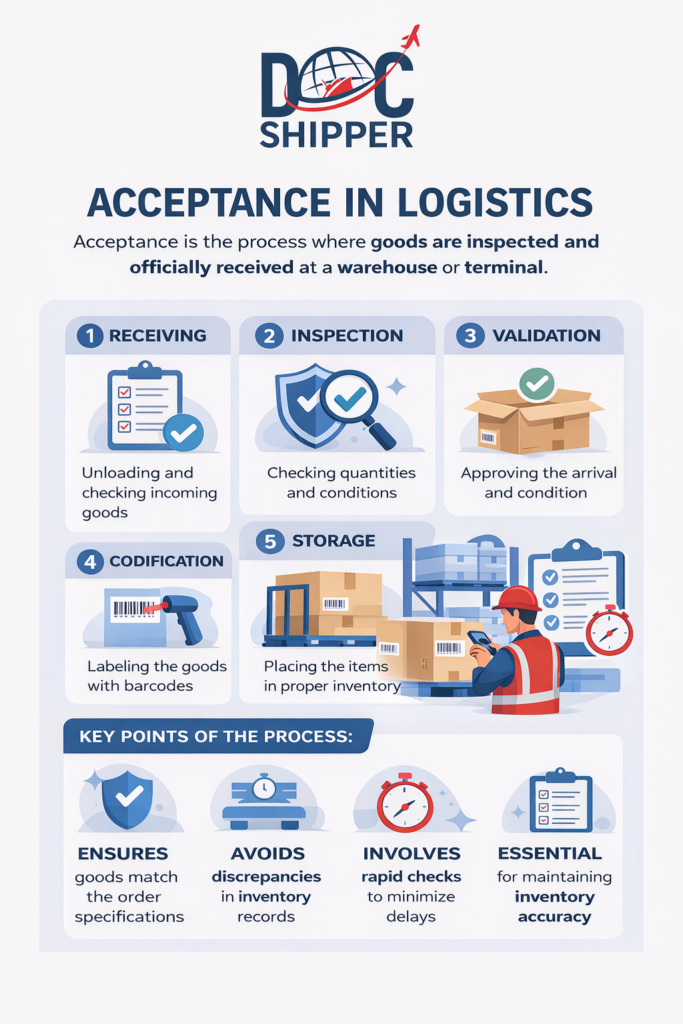
Acceptance is the formal acknowledgment by a consignee or carrier that goods have been received in accordance with the terms specified in the shipping contract. This critical step validates delivery completion, transfers liability, and triggers payment obligations in international trade operations.Introduction
In international shipping, disputes often arise from unclear acceptance procedures. A container arrives damaged, but who bears responsibility? The answer lies in understanding when and how acceptance occurs.
Acceptance marks the pivotal moment when goods transition from seller to buyer responsibility. This process determines liability boundaries, payment triggers, and dispute resolution frameworks across global supply chains.
- Legal transfer point: Establishes when ownership and risk shift between parties
- Payment activation: Triggers payment terms under letters of credit or commercial invoices
- Inspection window: Defines the timeframe for identifying visible damages or discrepancies
- Documentary evidence: Creates proof of delivery for customs, insurance, and contractual purposes
- Liability termination: Releases the carrier from further responsibility once properly executed
Acceptance Mechanisms & Legal Implications
The acceptance process follows strict protocols governed by international conventions. Under the Hague-Visby Rules and Hamburg Rules, carriers must deliver goods in the same condition as received, while consignees must inspect shipments within reasonable timeframes.
Conditional acceptance occurs when goods are received with noted reservations. The consignee signs delivery documents but annotates specific damages, shortages, or discrepancies. This preserves claim rights while acknowledging partial receipt.
Deemed acceptance applies when goods remain unchallenged beyond contractual inspection periods. Most jurisdictions impose 3-7 day windows for visible defects and 30-90 days for latent issues, as outlined in the UNCITRAL Rotterdam Rules.
Electronic acceptance increasingly replaces paper-based systems through blockchain-enabled smart contracts and digital bill of lading platforms. These systems timestamp acceptance events and automate payment releases upon verified delivery.
Rejection protocols require immediate written notice detailing non-conformities. Silence or delayed notification typically constitutes acceptance under the CISG Article 38, which mandates prompt examination of goods.
At DocShipper, we implement systematic acceptance verification procedures, including photographic evidence and third-party inspection reports, to protect our clients from post-delivery disputes and ensure compliance with international trade standards.
Practical Examples & Data Analysis
Understanding acceptance through real-world scenarios clarifies its operational impact. Consider these comparative situations:
| Scenario | Acceptance Type | Liability Outcome | Financial Impact |
|---|---|---|---|
| Container received with visible damage, signed without notation | Unconditional | Buyer assumes full responsibility | $45,000 loss unrecoverable |
| Goods inspected within 48 hours, discrepancies documented | Conditional | Carrier remains liable | $38,000 claim successful |
| Electronic POD with GPS timestamp and photo evidence | Digital | Clear liability chain established | Dispute resolved in 72 hours |
| Goods left unexamined for 15 days post-delivery | Deemed | Buyer forfeits claim rights | $52,000 loss absorbed |
Use Case: A European electronics importer receives 500 laptops from Shenzhen. The shipping container shows no external damage, but internal inspection 10 days later reveals 87 units with cracked screens. Because the buyer signed the delivery receipt without reservation and exceeded the 7-day inspection window, the carrier successfully denies the $34,800 claim, citing deemed acceptance under CMR Convention Article 30.
Industry data reveals that 68% of rejected cargo claims stem from improper acceptance procedures. Companies implementing mandatory photographic documentation at delivery reduce dispute resolution time by 41% and increase successful claim rates by 29%.
Key operational metrics:
- Average inspection window: 5.3 days for containerized cargo
- Conditional acceptance rate: 12% of all international shipments
- Digital POD adoption: 34% annual growth since 2020
- Claim success rate with proper documentation: 76% vs. 31% without
- Average dispute resolution cost: $8,400 per incident
Conclusion
Acceptance represents the critical juncture where logistics documentation meets legal accountability. Proper execution protects all parties and ensures smooth payment flows in international trade.
Need expert guidance on acceptance procedures for your shipments? Contact DocShipper for customized logistics solutions that safeguard your interests throughout the supply chain.
📚 Quizz
Test Your Knowledge: Acceptance
Q1 — What does "acceptance" formally represent in international logistics?
Q2 — A consignee receives a shipment and does not inspect or challenge it for 15 days. What type of acceptance applies, and what is the consequence?
Q3 — A buyer receives 500 laptops and notices the container exterior is undamaged. Ten days later, internal inspection reveals 87 units with cracked screens. The delivery receipt was signed without any notation. Which outcome is most likely?
🎯 Your Result
📞 Free Quote in 24hFAQ | Acceptance: Definition, Process & Practical Examples in Logistics
Delivery is the physical transfer of goods to the destination, while acceptance is the formal acknowledgment that goods meet contractual specifications. Delivery can occur without acceptance if discrepancies are noted.
Inspection periods vary by jurisdiction and contract terms, typically ranging from 3-7 days for visible defects and 30-90 days for hidden issues. Always check your specific Incoterms and purchase agreement.
Yes, you should note all visible damage on the delivery receipt before signing. This creates conditional acceptance and preserves your right to file claims against the carrier or seller.
Signing without inspection typically constitutes unconditional acceptance, making it extremely difficult to pursue claims for visible damages or shortages discovered later. Always inspect before signing.
Yes, electronic signatures are recognized under the UNCITRAL Model Law on Electronic Commerce and most national regulations, provided they meet authentication and non-repudiation requirements.
Generally, the party claiming non-conformity must prove defects existed at delivery. Proper documentation at acceptance (photos, signed notations, third-party inspections) shifts this burden effectively.
Yes, banks require compliant documents including proof of acceptance (delivery receipts, bills of lading) before releasing payment. Discrepancies in acceptance documentation can delay or block payment.
Provisional acceptance allows operational use of delivered equipment or materials while reserving rights to claim for minor defects. Final acceptance occurs after a defect liability period expires.
Revocation is possible only under narrow circumstances: fundamental breach, latent defects discovered within legal timeframes, or fraud. The threshold is high and requires immediate formal notice.
Each partial shipment requires separate acceptance. Accepting one installment doesn't obligate acceptance of subsequent deliveries, allowing quality control for each batch independently.
Maintain signed delivery receipts, inspection reports, photographs, correspondence noting discrepancies, and any third-party survey reports. Digital timestamps and GPS data strengthen evidence chains.
Yes, many cargo insurance policies terminate upon acceptance or delivery to final destination. Transit insurance typically covers until acceptance, while storage insurance begins afterward. Review policy terms carefully.
Need Help with Logistics or Sourcing ?
First, we secure the right products from the right suppliers at the right price by managing the sourcing process from start to finish. Then, we simplify your shipping experience - from pickup to final delivery - ensuring any product, anywhere, is delivered at highly competitive prices.


Fill the Form
Prefer email? Send us your inquiry, and we’ll get back to you as soon as possible.
Contact us


