


In short ⚡
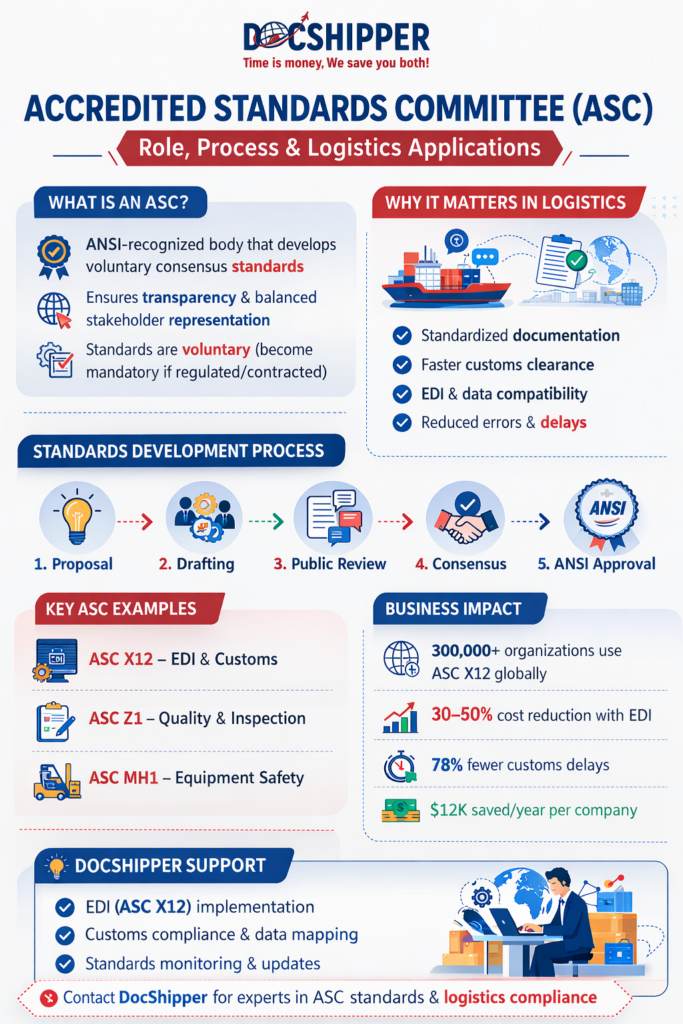
Accredited Standards Committee (ASC) is an ANSI-recognized body that develops and maintains voluntary consensus standards for specific industries or technical domains. ASCs operate under strict procedural rules ensuring balanced stakeholder representation, transparency, and adherence to American National Standards Institute (ANSI) Essential Requirements.
Introduction
International trade relies on standardized documentation, data formats, and technical specifications. Yet many importers struggle with incompatible systems, unclear compliance requirements, and communication barriers across supply chains. Understanding the role of Accredited Standards Committee (ASC) structures helps businesses navigate these challenges effectively.
ASCs serve as the backbone of American standards development, ensuring that industry best practices become formalized, widely adopted protocols. For logistics professionals, these standards directly impact EDI transactions, customs documentation, safety certifications, and quality management systems.
Key characteristics of ASCs include:
- ANSI accreditation – formal recognition ensuring procedural integrity
- Consensus-based development – balanced representation from producers, users, and general interest groups
- Voluntary adoption – standards become mandatory only when referenced in regulations or contracts
- Public review processes – transparent comment periods for proposed standards
- Maintenance cycles – regular updates to reflect technological and market evolution
ASC Governance & Standards Development Process
Each ASC operates under a secretariat – an organization responsible for administrative support, meeting coordination, and document management. The secretariat does not control technical content but ensures procedural compliance with ANSI requirements.
The standards development lifecycle follows five critical phases:
Proposal initiation begins when stakeholders identify a need for new standards or revisions. Any interested party may submit proposals, which the ASC evaluates for scope alignment and resource availability.
Committee drafting involves technical working groups composed of subject matter experts. These groups must maintain balanced representation across interest categories to prevent dominance by any single constituency.
Public comment periods typically last 30-60 days, during which anyone may submit objections or suggestions. The ASC must address all substantive comments before proceeding, demonstrating how concerns were resolved or why they were not incorporated.
Consensus approval requires more than simple majority voting. ANSI defines consensus as substantial agreement reached through processes that consider all viewpoints and objections, with documented attempts to resolve concerns.
ANSI review and designation occurs after ASC approval. ANSI audits the development process to verify compliance with Essential Requirements before granting “American National Standard” status. According to ANSI’s official guidelines, this designation signals that the standard meets rigorous procedural and technical criteria.
At DocShipper, we monitor ASC updates affecting international logistics, particularly ASC X12 standards governing EDI transactions. Our compliance team ensures client documentation aligns with current standards, preventing customs delays caused by format incompatibilities.
Industry Applications & Key ASC Examples
ASCs operate across diverse sectors, with several directly impacting international trade operations. Understanding their specific functions helps logistics professionals anticipate compliance requirements.
| ASC Designation | Primary Focus | Logistics Impact |
|---|---|---|
| ASC X12 | Electronic Data Interchange (EDI) standards | Governs purchase orders, invoices, shipping notices, customs declarations |
| ASC Z1 | Quality assurance and statistical methods | Defines sampling procedures for import inspections and quality control |
| ASC MH1 | Material handling equipment | Sets safety standards for forklifts, conveyors, warehouse automation |
| ASC B93 | Medical device sterilization | Critical for pharmaceutical and medical equipment imports |
Case Study: ASC X12 in Customs Clearance
A European electronics manufacturer ships 500 units monthly to US distributors. Their logistics provider implements ASC X12 standard 856 (Advance Ship Notice) and 810 (Invoice) formats. This standardization enables:
- Automated customs broker data ingestion (reducing processing time from 4 hours to 15 minutes)
- Real-time shipment tracking integration with US Customs ACE system
- Elimination of manual data entry errors causing $12,000 in annual demurrage fees
- Seamless integration with distributor warehouse management systems
The manufacturer initially resisted EDI adoption due to perceived complexity. After implementation, they reduced customs clearance delays by 78% and achieved full supply chain visibility. DocShipper assisted with X12 mapping and testing, ensuring compliance before the first live transmission.
Critical Data Points:
- Over 300,000 organizations globally use ASC X12 standards for business transactions
- ASC X12 version 8020 (current release) contains 315 transaction sets covering virtually all business scenarios
- Companies implementing EDI standards report average 30-50% reduction in order processing costs
- US Customs processes approximately 28 million X12-formatted entries annually
- Non-compliance with required EDI formats can trigger intensive examinations increasing clearance time by 5-10 business days
Conclusion
Accredited Standards Committees provide the technical foundation for efficient, compliant international trade operations. Understanding their governance structures and outputs enables logistics professionals to anticipate regulatory requirements and implement systems that reduce friction across global supply chains.
Need guidance on implementing ASC standards in your logistics operations? Contact DocShipper for expert consultation on EDI integration, customs compliance, and supply chain standardization.
📚 Quiz
Accredited Standards Committee (ASC)
Q1 — What is an Accredited Standards Committee (ASC)?
Q2 — A company tells its supplier: "ASC standards are voluntary, so we don't need to follow them." Is this interpretation correct?
Q3 — A European electronics manufacturer ships goods monthly to US distributors. Which ASC standard would most directly help them automate customs clearance and reduce processing time?
🎯 Your Result
📞 Free Quote in 24hFAQ | Accredited Standards Committee (ASC): Definition, Role & Practical Examples
ASCs must undergo rigorous ANSI accreditation, demonstrating balanced stakeholder representation, transparent processes, and adherence to consensus principles. Non-accredited organizations may develop standards but cannot designate them as American National Standards.
ASC standards are voluntary unless specifically referenced in regulations, contracts, or customs requirements. However, many become de facto mandatory when trading partners or regulatory agencies require their use for system interoperability.
ASC X12 releases new versions biannually, with updates typically published in March and September. Organizations should review release notes to assess impacts on existing implementations and plan migration timelines accordingly.
Yes. ASC membership is open to all interested parties regardless of organization size. Many ASCs offer reduced fees for small businesses and provide remote participation options to lower barriers to engagement.
Trading partners may reject non-current EDI transmissions, causing order processing delays. Customs systems typically support multiple versions but may deprecate older formats, potentially triggering manual review processes that extend clearance times.
Many ASCs coordinate with ISO technical committees to harmonize standards globally. Some ASC standards serve as the US position in ISO development, while others adopt ISO standards with minor modifications for domestic use.
Funding comes from member dues, document sales, training programs, and secretariat sponsorship. ANSI does not fund ASC operations directly but provides oversight and accreditation services.
Access policies vary by ASC. Some provide free public access to current standards, while others sell documents to fund ongoing development. Draft standards under public review are typically available at no cost.
Simple revisions may take 12-18 months, while complex new standards can require 3-5 years. The timeline depends on technical complexity, stakeholder consensus difficulty, and public comment volume.
We provide EDI implementation support, standards gap analysis, customs documentation formatting, and ongoing monitoring of ASC updates affecting client operations. Our compliance specialists translate technical standards into actionable logistics protocols.
False claims of standards conformity may constitute fraudulent misrepresentation, potentially triggering contract disputes, product liability claims, or regulatory enforcement actions depending on the industry and specific standard involved.
While ASC standards provide baseline requirements, implementation guides often allow flexibility for industry-specific or company-specific extensions. However, core mandatory elements must remain unchanged to maintain interoperability.
Need Help with Logistics or Sourcing ?
First, we secure the right products from the right suppliers at the right price by managing the sourcing process from start to finish. Then, we simplify your shipping experience - from pickup to final delivery - ensuring any product, anywhere, is delivered at highly competitive prices.


Fill the Form
Prefer email? Send us your inquiry, and we’ll get back to you as soon as possible.
Contact us


