In short ⚡
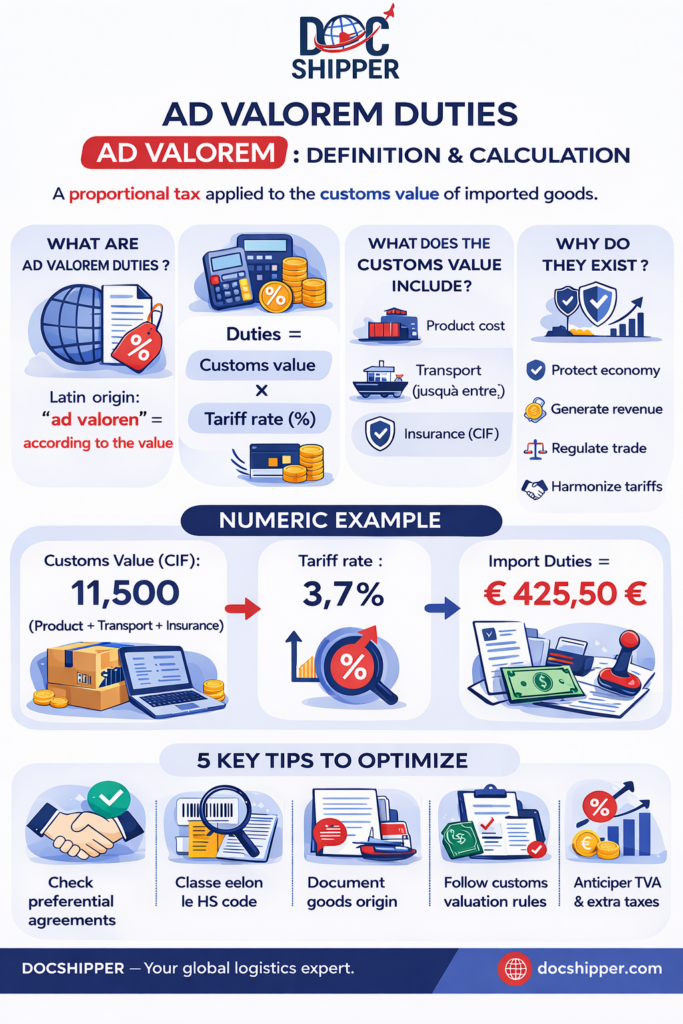
Ad Valorem is a Latin term meaning "according to value." In international trade and logistics, it refers to a tax or duty calculated as a percentage of the assessed value of goods, rather than a fixed amount per unit. This valuation-based taxation method is the most common approach used by customs authorities worldwide for import duties.Introduction
Many importers face unexpected costs when their shipments arrive at customs. The confusion often stems from misunderstanding how ad valorem duties are calculated. Unlike specific duties (fixed per unit), ad valorem taxes fluctuate based on the declared value of your merchandise.
This valuation method directly impacts your landed costs, pricing strategy, and overall profit margins. Understanding ad valorem taxation is essential for accurate cost forecasting in international supply chains.
- Percentage-based calculation: Applied to the customs value of goods
- Variable cost structure: Changes with product value fluctuations
- Most common duty type: Used in over 80% of global tariff classifications
- Valuation dependency: Requires accurate customs valuation methods
- Trade agreement impact: Rates vary based on origin and preferential agreements
In-Depth Analysis & Expertise
The ad valorem system operates on the principle of proportional taxation. Customs authorities assess the transaction value of imported goods—typically the invoice price—and apply a predetermined percentage rate. This rate varies by product classification (HS code), country of origin, and applicable trade agreements.
The customs value determination follows internationally recognized methods established by the WTO Valuation Agreement. The primary method uses the transaction value: the price actually paid or payable for the goods when sold for export. This includes costs up to the port of importation, such as freight and insurance (CIF basis in many countries).
Legal frameworks governing ad valorem duties differ across jurisdictions. The European Union Customs Code provides comprehensive guidelines on valuation methods, while the U.S. Customs and Border Protection enforces specific regulations under Title 19 of the Code of Federal Regulations. For authoritative guidance, consult the World Customs Organization’s valuation resources.
Transfer pricing considerations become critical for multinational corporations. Related-party transactions require additional scrutiny to ensure the declared value reflects fair market conditions. Customs authorities may adjust values if they suspect undervaluation or if the transaction doesn’t meet arm’s-length standards.
The compound duty structure sometimes combines ad valorem rates with specific duties. For example, certain textile products might face a 10% ad valorem duty plus $0.50 per kilogram. At DocShipper, we systematically analyze these hybrid tariff structures to provide accurate landed cost projections for our clients.
Practical Examples & Data
Understanding ad valorem calculation requires practical application. Consider a European importer purchasing electronic components from China valued at €50,000 FOB Shanghai.
| Cost Component | Amount (€) | Calculation Basis |
|---|---|---|
| FOB Value | 50,000 | Invoice price |
| International Freight | 3,500 | Sea transport to Rotterdam |
| Insurance | 650 | 0.65% of FOB + Freight |
| Customs Value (CIF) | 54,150 | Base for duty calculation |
| Ad Valorem Duty (3.7%) | 2,004 | 54,150 × 3.7% |
| VAT (21%) | 11,792 | (54,150 + 2,004) × 21% |
| Total Landed Cost | 67,946 | All-inclusive import cost |
Key insight: The ad valorem duty of 3.7% applies to the CIF value, not the FOB price. This distinction increases the duty base by €4,150 in this example, resulting in an additional €154 in duties compared to FOB-based calculation.
Comparative scenario: If the same product originated from South Korea under the EU-Korea FTA, the ad valorem duty would be 0%, saving €2,004. This demonstrates how preferential trade agreements directly impact ad valorem costs.
Industry data: According to World Bank statistics, the global average ad valorem tariff rate for manufactured goods is approximately 4.2%, though rates vary significantly by sector—automotive products average 8-10%, while electronics typically face 0-5% duties.
Valuation risk: A 10% undervaluation on this shipment would reduce the customs value to €48,735, lowering duties by €200. However, customs penalties for deliberate undervaluation can reach 400% of the evaded duties in many jurisdictions, plus criminal prosecution risks.
At DocShipper, we verify all commercial invoices and supporting documentation to ensure compliant valuation. Our customs brokerage team identifies applicable duty relief programs and preferential tariff schemes to legally minimize your ad valorem costs.
DocShipper Platform
Cut logistics costs. Not corners.
See exactly where your logistics costs are bleeding — and how to fix it. Book your expert demo.

Conclusion
Ad valorem duties represent a fundamental cost component in international trade, directly tied to your product’s declared value. Accurate valuation and tariff classification are essential for cost control and customs compliance.
Need expert guidance on duty optimization and customs valuation? Contact DocShipper for comprehensive support across your entire supply chain.
📚 Quiz
Test Your Knowledge: Ad Valorem
1. What does "Ad Valorem" mean, and how is an ad valorem duty calculated?
2. A European importer buys goods from China at €50,000 FOB. The EU applies ad valorem duties on a CIF basis. Which value is used as the base for calculating the ad valorem duty?
3. An importer deliberately declares a lower value on the commercial invoice to reduce their ad valorem duty bill. Which of the following best describes the consequence of this action?
🎯 Your Result
📞 Free Quote in 24hFAQ | Ad Valorem: Definition, Calculation & Practical Examples
Ad valorem duties are calculated as a percentage of the product's value (e.g., 5% of invoice price), while specific duties are fixed amounts per unit of measurement (e.g., $2 per kilogram). Ad valorem rates fluctuate with price changes; specific duties remain constant regardless of value.
Customs use the transaction value method—the actual price paid for goods—as the primary basis. This includes the FOB price plus international freight, insurance, and certain adjustments. Alternative methods apply when transaction value cannot be determined or verified.
Yes. The applicable rate is determined by the date of entry or withdrawal from customs warehouse, not the shipping date. Tariff changes, trade disputes, or expired preferential agreements can alter rates between shipment and customs clearance.
It depends on the country's valuation method. Most nations use CIF (Cost, Insurance, Freight) as the duty base, including these costs. The United States uses FOB, excluding international freight and insurance from the dutiable value.
FTAs typically reduce or eliminate ad valorem duties for qualifying goods. Products must meet rules of origin requirements and proper documentation (certificate of origin) must be presented to claim preferential rates under trade agreements.
Undervaluation constitutes customs fraud. Penalties include duty reassessment, monetary fines (often 200-400% of evaded duties), shipment seizure, and potential criminal prosecution. Customs authorities use sophisticated risk assessment systems to detect valuation discrepancies.
No. Some products are duty-free, others face specific duties, and many have compound duties (combination of ad valorem and specific). Classification under the Harmonized System (HS code) determines which duty type applies to your product.
Identify your product's 6-digit HS code, determine the destination country's tariff rate for that classification, verify if any trade agreements apply, calculate the customs value (typically CIF), then multiply the customs value by the applicable percentage rate.
Yes. Strategies include utilizing free trade agreements, duty drawback programs, foreign trade zones, tariff engineering (product modification for lower classification), first sale valuation, and temporary import programs. All methods require strict compliance with customs regulations.
Essential documents include commercial invoice, packing list, bill of lading or airway bill, certificate of origin (if claiming preferential rates), and any licenses or permits. Customs may request additional documentation to verify the declared value.
Many countries offer duty drawback programs allowing partial or full refund of ad valorem duties on re-exported goods. Requirements include proving the goods were not consumed domestically, maintaining detailed records, and filing claims within specified timeframes (typically 3-5 years).
Customs authorities convert foreign currency invoices to local currency using official exchange rates on the date of entry. Significant currency movements between invoice date and customs clearance can increase or decrease the effective ad valorem duty burden.
Need Help with
Logistics or Sourcing ?
First, we secure the right products from the right suppliers at the right price by managing the sourcing process from start to finish. Then, we simplify your shipping experience - from pickup to final delivery - ensuring any product, anywhere, is delivered at highly competitive prices.


Fill the Form
Prefer email? Send us your inquiry, and we’ll get back to you as soon as possible.
Contact us