


In short ⚡
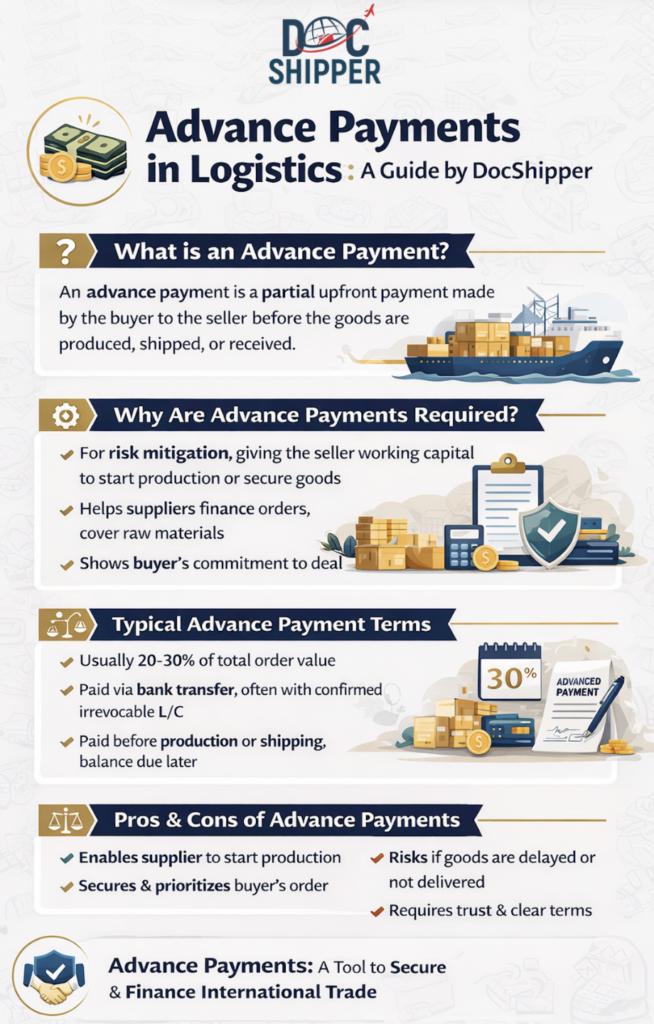
Advance in logistics refers to a prepayment made to freight forwarders, customs brokers, or carriers before services are rendered. This financial mechanism enables service providers to cover upfront costs such as customs duties, port charges, and handling fees, ensuring seamless cargo movement through international supply chains.
Introduction
Many importers face cash flow disruptions when unexpected charges arise during customs clearance. The confusion between advance payments, deposits, and final invoicing creates financial uncertainty in international trade operations.
In global logistics, advances serve as financial bridges that prevent shipment delays. They guarantee that critical services—customs processing, cargo handling, or freight forwarding—proceed without interruption, even before final cost calculations are complete.
- Prepayment structure: Funds transferred before service completion
- Cost coverage: Includes duties, taxes, terminal handling charges
- Settlement mechanism: Final invoice adjusts against advance amount
- Risk mitigation: Protects service providers from non-payment
- Operational continuity: Ensures uninterrupted cargo movement
Understanding Advance Mechanisms & Financial Implications
The advance payment system operates through a three-stage process: estimation, disbursement, and reconciliation. Freight forwarders calculate anticipated costs based on cargo weight, value, and destination regulations, then request prepayment to cover immediate expenses.
Customs duties and taxes represent the largest component of advance payments. Import VAT, excise duties, and anti-dumping fees must be settled before customs release. Service providers advance these amounts to authorities, then recover them from clients through the advance mechanism.
The disbursement account tracks all payments made on behalf of clients. This transparent ledger includes port storage fees, documentation charges, inspection costs, and transportation expenses. At DocShipper, we provide itemized disbursement statements that detail every advance expenditure, ensuring complete financial visibility.
Reconciliation timing varies by service provider and shipment complexity. Standard practice involves issuing a final invoice within 7-14 days after cargo delivery. This document compares actual costs against the advance, resulting in either a refund to the client or a supplementary payment request.
According to World Customs Organization guidelines, advance payment systems must maintain audit trails for cross-border transactions. This regulatory framework protects both parties by documenting fund flows and ensuring compliance with international financial standards.
Practical Examples & Cost Analysis
Consider a European electronics importer receiving a shipment from China valued at €50,000. The freight forwarder requests an advance of €15,000 to cover anticipated costs before customs clearance begins.
| Cost Component | Estimated (Advance) | Actual Cost | Variance |
|---|---|---|---|
| Import VAT (20%) | €10,000 | €10,200 | +€200 |
| Customs Clearance Fee | €800 | €800 | €0 |
| Port Terminal Handling | €2,500 | €2,350 | -€150 |
| Documentation & Inspection | €1,200 | €1,450 | +€250 |
| Inland Transportation | €500 | €500 | €0 |
| Total | €15,000 | €15,300 | +€300 |
In this scenario, the importer receives a supplementary invoice for €300 to cover the variance between estimated and actual costs. The advance system prevented delays—cargo cleared customs immediately rather than waiting for payment authorization.
Key operational advantages:
- Speed: Customs processing begins within hours of cargo arrival
- Predictability: Estimated costs provide budget planning clarity
- Cash flow optimization: Single upfront payment versus multiple transactions
- Reduced demurrage risk: Faster clearance minimizes storage penalties
- Transparent accounting: Detailed reconciliation documents all expenditures
Alternative scenario: A textile importer from Bangladesh requests zero advance payment. The forwarder must wait for payment confirmation before settling customs duties. This 48-hour delay generates €600 in additional port storage fees—doubling the cost compared to the advance payment model.
DocShipper Platform
One platform. Your entire supply chain
Sourcing, freight, customs & documents — all centralised, all visible, 24/7.
Conclusion
Advance payments form the financial backbone of efficient international logistics, enabling service providers to act decisively while protecting importers from operational delays. Understanding this mechanism transforms cost management from reactive problem-solving to proactive supply chain optimization.
Need expert guidance on advance payment structures for your shipments? Contact DocShipper for transparent logistics solutions tailored to your business needs.
📚 Quiz
Test Your Knowledge: Advance Payments in Logistics
Q1 — What is the primary definition of an "advance" in international logistics?
Q2 — A textile importer refuses to pay an advance and asks the forwarder to wait for payment confirmation before filing customs. What is the most likely consequence?
Q3 — A freight forwarder requests a €15,000 advance for a shipment, but actual costs total only €14,700. What happens next according to standard advance payment practice?
🎯 Your Result
📞 Free Quote in 24hFAQ | Advance: Definition, Calculation & Practical Examples
Most forwarders request 70-100% of estimated costs as advance, depending on shipment complexity and client relationship. High-value cargo or first-time clients typically require full advance payment.
Standard payment terms range from immediate (for urgent shipments) to 3 business days. Delayed advance payments directly extend customs clearance timelines and increase storage costs.
Established clients with payment history may negotiate reduced advance percentages. However, mandatory government fees (duties, taxes) always require full prepayment regardless of negotiation.
The forwarder issues a credit note or refund for the difference, typically within 14 days of final invoice reconciliation. Reputable providers maintain transparent disbursement accounts for verification.
Refund policies depend on timing and costs already incurred. Cancellations before customs filing may receive full refunds minus administrative fees. Post-clearance cancellations forfeit non-recoverable expenses.
Advances cover specific anticipated costs and are reconciled against actual expenses. Deposits serve as general security funds, often returned after contract completion regardless of service costs.
Professional forwarders provide detailed cost breakdowns, including duty calculations, handling fee schedules, and estimated disbursement lists. Request itemized estimates before transferring funds.
Yes, but currency conversion fees and exchange rate fluctuations affect final reconciliation. Most forwarders prefer payment in the destination country's currency to minimize conversion discrepancies.
Advance payments do not replace customs bonds, which guarantee duty payment to authorities. Bonds cover potential underpayment risks, while advances fund immediate operational expenses.
Reputable forwarders maintain segregated client accounts and provide auditable disbursement records. Choose licensed providers with industry certifications and transparent accounting practices to minimize risk.
No. Domestic transportation and established account holders may receive credit terms. However, international shipments involving customs duties almost always require advances due to immediate government payment obligations.
Immediate advance payment enables same-day customs filing and clearance initiation. Delayed payments create proportional delays—each 24-hour payment delay typically adds 1-2 days to total clearance time.
Need Help with Logistics or Sourcing ?
First, we secure the right products from the right suppliers at the right price by managing the sourcing process from start to finish. Then, we simplify your shipping experience - from pickup to final delivery - ensuring any product, anywhere, is delivered at highly competitive prices.


Fill the Form
Prefer email? Send us your inquiry, and we’ll get back to you as soon as possible.
Contact us


