


In short ⚡
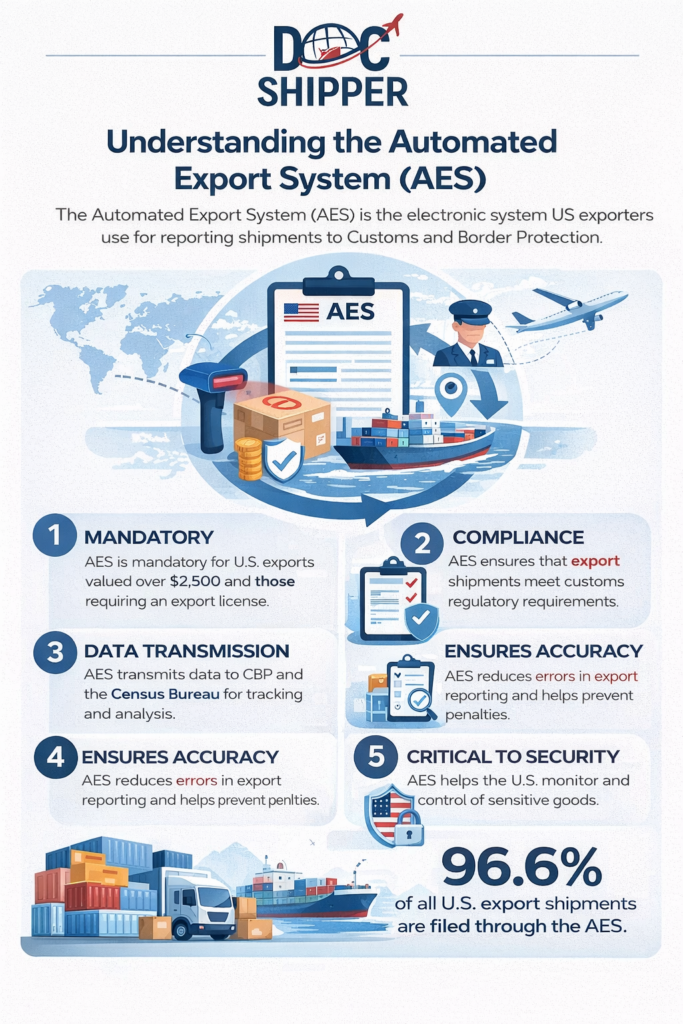
The Automated Export System (AES) is the U.S. government's mandatory electronic filing system for export shipment data. Operated by U.S. Customs and Border Protection (CBP), AES replaces paper-based Shipper's Export Declarations (SED) and enables real-time transmission of export information to regulatory agencies, ensuring compliance with export control laws and accurate trade statistics collection.
Introduction
Many exporters struggle with export documentation compliance, particularly when shipments exceed $2,500 or involve controlled goods. Missing or incorrect AES filings can result in severe penalties, shipment delays, and regulatory audits.
The Automated Export System represents a critical component of U.S. export control infrastructure. Every international shipment from the United States must comply with AES regulations, making understanding this system essential for freight forwarders, manufacturers, and logistics professionals.
- Mandatory electronic filing for most U.S. exports exceeding $2,500 per Schedule B number
- Real-time validation through AESDirect portal or certified software systems
- Internal Transaction Number (ITN) generation as proof of filing compliance
- Integration with export control screening for ITAR, EAR, and OFAC regulations
- Census Bureau data collection for official U.S. trade statistics
Technical Framework & Regulatory Requirements
The AES operates under the Foreign Trade Regulations (FTR) 15 CFR Part 30. The system requires exporters to submit Electronic Export Information (EEI) before goods depart the United States. This information includes commodity classification, value, destination, parties involved, and export license details.
Filing responsibility typically falls on the U.S. Principal Party in Interest (USPPI), though authorized agents such as freight forwarders can file on their behalf with proper authorization. The USPPI retains ultimate legal responsibility for accuracy and compliance.
AES filing methods include AESDirect (free government portal for occasional filers) and AES certified software solutions for high-volume exporters. Certified systems integrate directly with CBP databases, providing automated validation and faster processing. At DocShipper, we utilize certified AES software to ensure seamless compliance for our clients’ export shipments.
The system generates an Internal Transaction Number (ITN) upon successful filing. This 15-character alphanumeric code serves as proof of compliance and must be provided to the carrier before shipment departure. Carriers cannot legally transport goods without a valid ITN, exemption citation, or exclusion code.
Exemptions and exclusions apply to specific shipment types. Common exemptions include shipments under $2,500 per Schedule B number to non-embargoed countries, household goods, and certain diplomatic shipments. However, all exports of items on the Commerce Control List (CCL) or U.S. Munitions List (USML) require AES filing regardless of value.
Regulatory agencies including the Bureau of Industry and Security (BIS), Directorate of Defense Trade Controls (DDTC), and Office of Foreign Assets Control (OFAC) monitor AES data for export control compliance. The system cross-references filings against denied parties lists and license requirements in real-time. For official guidance, refer to the U.S. Customs and Border Protection AES resource center.
Practical Examples & Filing Scenarios
Understanding AES requirements through concrete scenarios helps exporters avoid costly compliance mistakes. Below are common filing situations with specific data requirements.
| Scenario | AES Requirement | Key Considerations |
|---|---|---|
| Commercial machinery valued at $45,000 to Germany | Full AES filing required | Schedule B classification, ECCN determination, ITN to carrier |
| Sample products worth $1,800 to Japan | Exemption NOEEI 30.37(a) | Must cite exemption on commercial invoice and bill of lading |
| Night vision equipment ($3,000) to Canada | AES filing mandatory | ITAR-controlled regardless of value; export license may be required |
| Temporary export for trade show ($25,000) | Full AES with temporary export code | Must indicate intended re-import; bond or carnet documentation |
| Humanitarian donations to Mexico ($8,000) | AES filing required | Special reporting code for donated goods; no commercial value |
Use Case: Electronics Manufacturer Export Compliance
A California-based electronics manufacturer exports 500 circuit boards valued at $75,000 to Singapore. The company must file AES with the following data points: USPPI information (EIN, address), consignee details, Schedule B number 8534.00.0080, ECCN 3A001.b.2, export license number (if applicable), country of ultimate destination, method of transportation, port of export, and shipment value.
The filing generates ITN X20240315987654. This number must appear on the air waybill before the freight forwarder can release the shipment to the airline. At DocShipper, we coordinate this process to ensure all documentation aligns before cargo acceptance, preventing departure delays.
Key compliance metrics:
- AES filing must occur no later than departure time for shipments by vessel
- Air and truck shipments require filing at least 2 hours before departure
- Rail shipments need filing 4 hours prior to arrival at border crossing
- Post-departure corrections allowed within 5 business days for specific data elements
- Civil penalties range from $1,100 to $10,000 per violation for non-compliance
Conclusion
The Automated Export System represents the backbone of U.S. export compliance, transforming complex regulatory requirements into a standardized electronic process. Mastering AES filing prevents costly delays and ensures legal shipment movement across international borders.
Need assistance with AES compliance or export documentation? Contact DocShipper for expert guidance on your international shipments.
📚 Quiz
Test Your Knowledge: Automated Export System (AES)
Q1. What is the primary purpose of the Automated Export System (AES)?
Q2. A U.S. exporter ships night vision equipment valued at $3,000 to Canada. Is an AES filing required?
Q3. A freight forwarder receives an ITN after filing AES for a client's air shipment. What must happen next before the cargo can depart?
🎯 Your Result
📞 Free Quote in 24hFAQ | AES (Automated Export System): Definition, Process & Practical Examples
The U.S. Principal Party in Interest (USPPI) holds ultimate legal responsibility, though authorized agents like freight forwarders can file on their behalf with proper power of attorney documentation.
Carriers are legally prohibited from transporting goods without a valid ITN, exemption citation, or exclusion code. Attempting to ship without proper AES compliance results in shipment rejection and potential civil penalties.
No. While some low-value shipments may qualify for exemptions, most exports to Canada and Mexico require AES filing, particularly controlled items, high-value goods, or license-required products.
Check the Commerce Control List (CCL) for your product's Export Control Classification Number (ECCN). Items classified as EAR99 typically don't require licenses to most destinations, while controlled ECCNs require destination-specific analysis.
No. AES filing must occur before departure. Post-departure corrections are allowed for specific data elements within 5 business days, but initial filing must precede shipment movement.
AES is the overall system, while AESDirect is the free government web portal for filing. High-volume exporters typically use certified commercial software that integrates with AES for automated processing.
Generally no, unless the items are controlled (ITAR/EAR), require an export license, or are destined to embargoed countries. Always verify exemption eligibility before assuming AES is not required.
Electronic filings through certified software typically receive ITN generation within minutes. AESDirect portal submissions may take slightly longer but generally process within 15-30 minutes during normal business hours.
Schedule B is the U.S. Census Bureau's 10-digit commodity classification system for exports. It categorizes products for statistical purposes and is mandatory for AES filing to track trade data accurately.
Yes. Post-departure corrections are permitted for certain data elements within 5 business days. Critical elements like value, quantity, Schedule B number, and license information can be amended through the correction process.
Exporters must retain AES filing confirmations, ITNs, and supporting documentation (invoices, packing lists, licenses) for 5 years from export date. This documentation must be readily available for CBP or regulatory agency audits.
Yes. Providing false or misleading information can result in civil penalties up to $10,000 per violation, criminal prosecution for intentional violations, and suspension of export privileges. Accuracy is critical for compliance.
Need Help with Logistics or Sourcing ?
First, we secure the right products from the right suppliers at the right price by managing the sourcing process from start to finish. Then, we simplify your shipping experience - from pickup to final delivery - ensuring any product, anywhere, is delivered at highly competitive prices.


Fill the Form
Prefer email? Send us your inquiry, and we’ll get back to you as soon as possible.
Contact us


