


In short ⚡
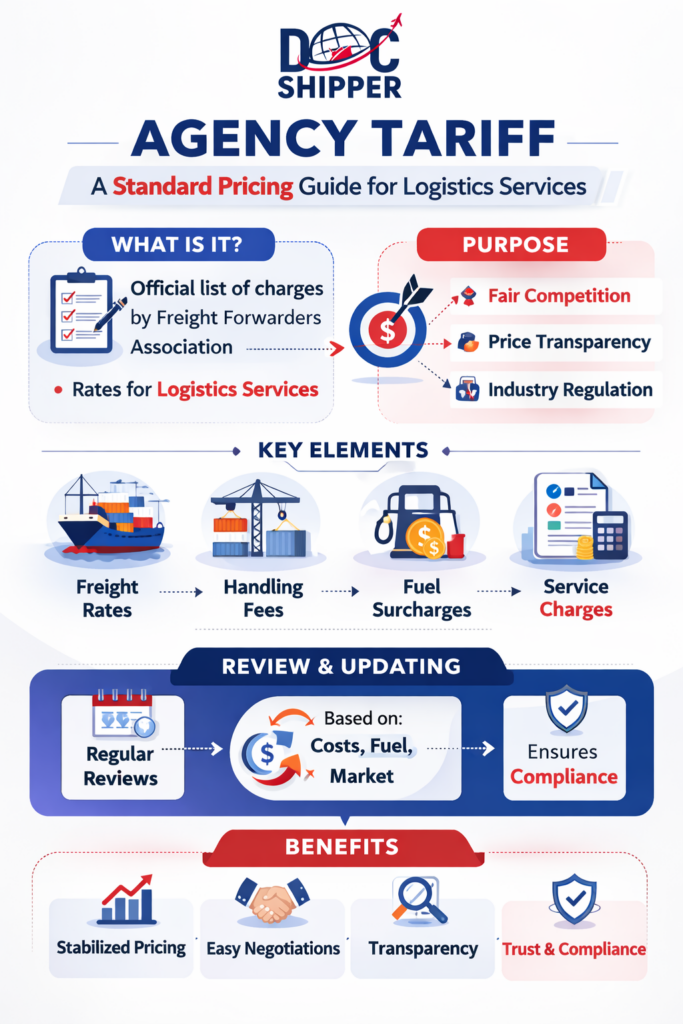
Agency Tariff is a standardized fee structure applied by freight forwarders, customs brokers, or logistics agents for services rendered in international trade operations. It covers documentation, clearance, handling, and administrative tasks essential for cross-border shipments.
Introduction
Many importers and exporters face unexpected costs when their shipment arrives at destination. The confusion often stems from misunderstanding agency tariffs—the fees charged by service providers for handling your cargo through complex international procedures.
In global logistics, agency tariffs represent the compensation structure for intermediaries who bridge regulatory, operational, and administrative gaps. These fees ensure your goods move smoothly from origin to final delivery.
Key characteristics of agency tariffs include:
- Service-based pricing: Fees vary by task complexity and shipment type
- Regulatory compliance: Covers mandatory customs and port authority interactions
- Transparency requirements: Must be disclosed before service execution in most jurisdictions
- Negotiability: Often adjustable based on shipment volume or partnership agreements
- Geographic variation: Rates differ significantly between ports and countries
Understanding Agency Tariff Structure
Agency tariffs operate on a fee-for-service model where each logistical task incurs a specific charge. Unlike freight rates that cover transportation, agency fees compensate for expertise, time, and regulatory navigation.
The structure typically includes base charges for standard services (document preparation, customs declaration filing) and variable fees for additional requirements (inspections, storage, special handling). Understanding this breakdown prevents billing surprises.
Legal frameworks governing agency tariffs vary by jurisdiction. In the European Union, the Union Customs Code mandates transparency in service fees. The United States requires customs brokers to provide itemized invoices under CBP regulations.
Three primary components define agency tariffs:
Documentation fees cover preparation and submission of required paperwork—commercial invoices, packing lists, certificates of origin, and customs declarations. These charges reflect the administrative burden and liability assumed by the agent.
Clearance charges compensate for interaction with customs authorities. This includes classification verification, duty calculation, and compliance checks. At DocShipper, we systematically verify these processes to prevent costly delays or penalties.
Handling and coordination fees address physical cargo management—warehouse transfers, inspection facilitation, and delivery scheduling. These rates often depend on cargo weight, dimensions, and special requirements.
Two additional factors influence final costs: urgency premiums for expedited processing and complexity surcharges for regulated goods (pharmaceuticals, hazardous materials, perishables). Agents assess risk and resource allocation when pricing these services.
The disbursement model means agents often advance payments on your behalf—port fees, storage charges, inspection costs—then recover these through their tariff structure. This creates cash flow considerations for both parties.
Real-World Examples & Cost Breakdown
Understanding agency tariffs becomes clearer through practical scenarios. The following examples illustrate how different shipment types generate specific fee structures.
Comparative Cost Analysis
| Service Component | Standard Cargo | Regulated Goods | Urgent Clearance |
|---|---|---|---|
| Customs Declaration | $75 | $150 | $120 |
| Documentation Prep | $50 | $125 | $85 |
| Port Handling | $60 | $95 | $110 |
| Inspection Coordination | — | $200 | — |
| Urgency Premium | — | — | $175 |
| Total Agency Tariff | $185 | $570 | $490 |
Use Case: Electronics Import from China to Germany
A mid-sized retailer imports 500 units of consumer electronics (total value: €45,000). The shipment requires:
- Customs entry filing: €95 for EORI validation and TARIC code classification
- VAT and duty calculation: €65 for accurate assessment (19% VAT + 2.5% duty)
- Product compliance verification: €180 for CE marking documentation review
- Delivery coordination: €70 for warehouse scheduling and final-mile arrangement
- Disbursements: €8,925 (duties/taxes) advanced by the agent
Total agency tariff: €410. The agent recovers disbursements plus fees, resulting in a final invoice of €9,335. This represents 0.9% of cargo value—a typical ratio for compliant, straightforward shipments.
DocShipper Platform
One platform. Your entire supply chain
Sourcing, freight, customs & documents — all centralised, all visible, 24/7.
Key Cost Drivers
Shipment value indirectly affects fees through complexity. Higher-value goods often require additional insurance documentation and security measures, increasing administrative workload.
Origin and destination pairing creates significant variance. Shipments from non-EU countries to EU ports trigger stricter documentation requirements than intra-EU movements.
Product category determines regulatory depth. Textiles, food products, and electronics each face distinct certification and labeling requirements that inflate agency workload.
Volume commitments enable negotiation leverage. Shippers with consistent monthly volumes often secure 15-30% discounts on standard tariff rates through partnership agreements.
Technology integration reduces costs. Clients who provide digital documentation and use agent portals minimize manual processing, often qualifying for efficiency discounts.
Conclusion
Agency tariffs represent the operational cost of navigating international trade complexity. Understanding their structure empowers shippers to budget accurately and negotiate effectively.
Need expert guidance on optimizing your logistics costs? Contact DocShipper for a transparent breakdown of agency fees tailored to your shipping profile.
📚 Quiz
Test Your Knowledge: Agency Tariff
Q1 — What does an agency tariff primarily represent in international logistics?
Q2 — A shipper receives an invoice from their freight agent that includes customs duties and taxes. Are these part of the agency tariff?
Q3 — A retailer imports electronics from China to Germany. Their agent charges €95 for customs entry filing, €180 for CE marking review, and €70 for delivery coordination. Which factor is most likely to help this retailer reduce their agency tariff costs on future shipments?
🎯 Your Result
📞 Free Quote in 24hFAQ | Agency Tariff: Definition, Calculation & Real-World Examples
Standard agency tariffs cover customs declaration filing, basic documentation preparation, and coordination with port authorities. Additional services like inspections or storage incur separate charges.
Yes. Rates are negotiable, especially for high-volume shippers or long-term contracts. Providing complete documentation upfront and using digital systems often qualifies you for discounts.
Port infrastructure, local labor costs, regulatory complexity, and competition levels create geographic pricing differences. Major hubs typically offer more competitive rates due to economies of scale.
No. Freight charges cover transportation costs (shipping line or airline fees), while agency tariffs compensate intermediaries for administrative, regulatory, and coordination services at origin or destination.
Non-payment results in cargo holds. Customs authorities won't release goods until all fees are settled. Prolonged delays trigger storage charges and potential auction of unclaimed shipments.
Expedited processing requires agents to prioritize your shipment, often working outside standard hours. Urgency premiums typically add 40-100% to base rates depending on timeline compression.
No. Duties and taxes are government charges that agents pay on your behalf (disbursements). These appear separately on invoices and are reimbursed at cost without markup.
The terms are often used interchangeably. Technically, brokerage fees specifically refer to customs clearance services, while agency tariffs encompass broader logistical coordination beyond customs.
Theoretically yes, but it requires obtaining customs broker licenses, bonding, and regulatory expertise. Most businesses find agency fees more cost-effective than maintaining in-house compliance infrastructure.
Consolidations typically charge per house bill of lading rather than per master bill. Each consignee pays individual agency fees based on their portion's complexity, not the total shipment.
No. While platforms may offer transparent pricing, the underlying services still require human expertise for compliance verification. Platforms often embed agency fees into their pricing structure.
Providing complete commercial invoices, packing lists, certificates of origin, and product compliance documents upfront minimizes agent research time. Digital formats with standardized data fields further reduce processing costs.
Need Help with Logistics or Sourcing ?
First, we secure the right products from the right suppliers at the right price by managing the sourcing process from start to finish. Then, we simplify your shipping experience - from pickup to final delivery - ensuring any product, anywhere, is delivered at highly competitive prices.


Fill the Form
Prefer email? Send us your inquiry, and we’ll get back to you as soon as possible.
Contact us


