In short ⚡
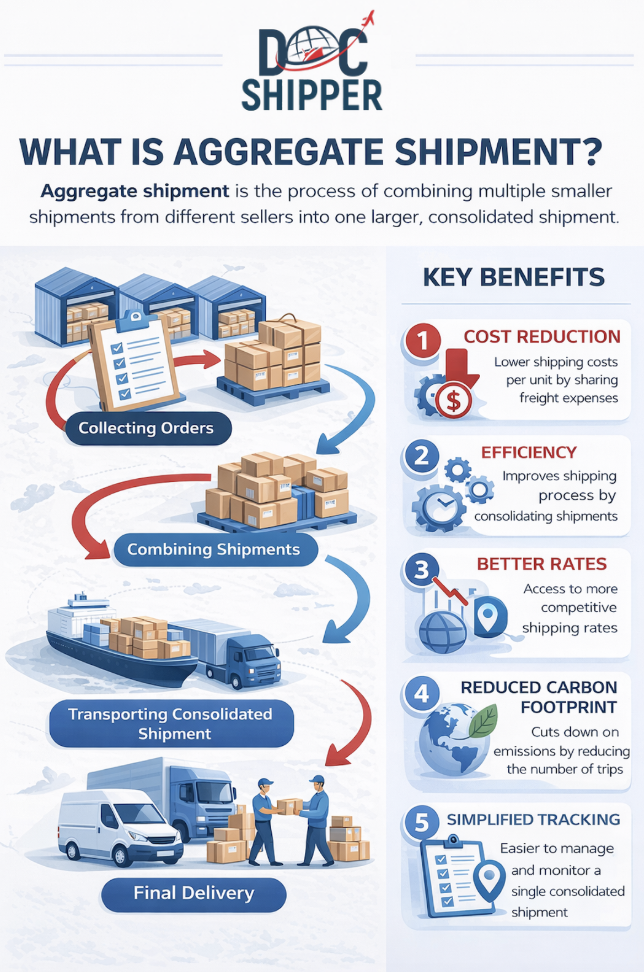
Aggregate shipment is a logistics method that consolidates multiple smaller shipments from different shippers into one larger shipment to optimize transportation costs and efficiency. This technique reduces freight expenses by maximizing container or truck capacity while minimizing empty space during transit.
Introduction
Many importers and exporters face a common dilemma: their shipment volume is too small to fill an entire container, yet individual shipping costs are prohibitively expensive. This gap between Less than Container Load (LCL) inefficiencies and Full Container Load (FCL) requirements creates significant budget challenges.
Aggregate shipment emerges as the strategic solution within the international supply chain. By combining cargo from multiple parties, businesses access wholesale shipping rates previously reserved for high-volume shippers.
Key characteristics of aggregate shipments include:
- Consolidation of cargo from multiple consignors into a single transport unit
- Shared transportation costs distributed proportionally among participants
- Reduced per-unit shipping expenses compared to individual LCL rates
- Optimized container or vehicle utilization maximizing cubic capacity
- Coordinated customs clearance processes for grouped merchandise
In-Depth Analysis & Expertise
The operational mechanics of aggregate shipments involve sophisticated coordination between freight forwarders, consolidation warehouses, and transportation networks. Understanding these mechanisms is essential for optimizing international logistics strategies.
Consolidation warehouse operations serve as the physical hub where individual shipments are received, sorted, and combined. These facilities operate under strict inventory management protocols to ensure accurate tracking and prevent cargo mixing errors.
Freight cost allocation typically follows volumetric or weight-based formulas. Shippers pay proportionally based on their cargo’s cubic meters (CBM) or gross weight, whichever yields higher revenue for the carrier. The calculation considers dimensional weight to prevent space abuse.
Customs documentation complexity increases with aggregate shipments since each consignee requires separate commercial invoices, packing lists, and certificates of origin. The master bill of lading covers the entire consolidated shipment, while house bills identify individual consignments. According to U.S. Customs and Border Protection, proper documentation hierarchy prevents clearance delays.
Transit time considerations may extend slightly compared to direct FCL shipments. Consolidation requires gathering cargo from multiple sources, which adds 2-5 days to the overall timeline. However, cost savings often justify this trade-off for non-urgent shipments.
Risk management protocols become critical when combining cargo from different parties. At DocShipper, we implement segregation strategies and comprehensive insurance coverage to protect each shipper’s interests within the consolidated load, ensuring accountability throughout the journey.
Concrete Examples & Data
Real-world applications demonstrate the tangible benefits of aggregate shipment strategies across various industries and trade routes.
Cost Comparison Analysis
| Shipping Method | Volume (CBM) | Cost (USD) | Cost per CBM |
|---|---|---|---|
| Individual LCL | 8 CBM | $1,200 | $150 |
| Aggregate Shipment | 8 CBM | $720 | $90 |
| Full FCL (20ft) | 33 CBM | $2,500 | $76 |
This comparison reveals a 40% cost reduction when using aggregate shipments versus standard LCL rates for medium-volume cargo.
DocShipper Platform
Cut logistics costs. Not corners.
See exactly where your logistics costs are bleeding — and how to fix it. Book your expert demo.

Practical Use Case: Electronics Importer
A European electronics retailer imports smartphone accessories from Shenzhen, China. Monthly volume averages 12 CBM—too small for dedicated FCL but expensive via traditional LCL.
Solution implemented: The company joined an aggregate shipment program coordinated by their freight forwarder. Their 12 CBM cargo combined with shipments from three other importers (total 45 CBM) filled a 40ft high-cube container.
Results achieved:
- Freight cost reduced from $1,800 to $1,080 per shipment (40% savings)
- Annual logistics budget decreased by $8,640
- Transit time increased by only 3 days compared to direct LCL
- Carbon footprint reduced through optimized container utilization
- Predictable monthly shipping schedule established with regular consolidation departures
Industry data shows that aggregate shipments typically achieve 15-45% cost reductions depending on trade lane, volume, and consolidation frequency. Routes with high shipper density—such as China to North America or Europe—offer the greatest optimization potential.
Conclusion
Aggregate shipment represents a strategic logistics solution that bridges the gap between expensive LCL rates and inaccessible FCL volumes. By leveraging consolidation expertise, businesses unlock wholesale freight pricing while maintaining operational flexibility.
Need guidance on optimizing your shipping strategy through aggregate consolidation? Contact DocShipper for a customized logistics assessment.
📚 Quiz
Test Your Knowledge: Aggregate Shipment
1. What is the primary definition of an aggregate shipment?
2. How does aggregate shipment differ from standard LCL (Less than Container Load) shipping?
3. A European retailer ships 12 CBM of goods monthly from China — too small for FCL but costly via individual LCL. Which approach best fits their situation?
🎯 Your Result
📞 Free Quote in 24hFAQ | Aggregate Shipment: Definition, Calculation & Concrete Examples
Most consolidators accept shipments starting from 1 CBM, though economic benefits become significant above 5 CBM. There is no strict minimum, but smaller volumes may not yield substantial savings over standard LCL rates.
LCL is a broader category where cargo shares container space. Aggregate shipment is a specialized LCL method where a forwarder proactively consolidates multiple shippers' cargo to negotiate better rates, whereas standard LCL simply fills available space without optimization strategy.
Each consignee remains responsible for their own customs clearance. The consolidator provides a master bill of lading, while individual house bills enable separate customs processing. Freight forwarders typically coordinate documentation to streamline the process.
Yes, but with strict segregation requirements. Dangerous goods must comply with IMDG regulations and cannot be mixed with incompatible cargo classes. Most consolidators charge premium rates and require advance notification for hazmat inclusion.
Consolidation schedules operate on fixed departure dates. Late arrivals may miss the planned shipment and wait for the next consolidation cycle, typically 3-7 days later depending on the trade lane frequency.
Insurance coverage follows the same principles, but policies must clearly identify your specific cargo within the consolidated load. Cargo insurance typically costs 0.3-0.5% of declared value regardless of shipment method.
Charges are based on either actual weight or volumetric weight (length × width × height ÷ 6000 for sea freight), whichever is greater. Your proportional share of the total container cost is calculated using this measurement.
Yes, modern freight forwarders provide individual tracking through house bill of lading numbers. While the master shipment moves as one unit, your specific cargo maintains distinct identification throughout the supply chain.
Standard requirements include commercial invoice, packing list, and any product-specific certificates (origin, phytosanitary, etc.). Your forwarder will compile these with other shippers' documents under a consolidated customs entry.
It works best for non-urgent shipments where 3-5 additional days for consolidation is acceptable. For time-critical cargo, direct LCL or air freight may be more appropriate despite higher costs.
Look for freight forwarders with established consolidation programs on your trade lanes. Verify their consolidation frequency, warehouse locations, and track record. DocShipper operates regular consolidation services across major global routes.
Yes, though complexity increases with each border crossing. Consolidated cargo can transit through multiple countries, but each jurisdiction requires separate customs documentation. Experienced forwarders manage these multi-leg consolidations efficiently.
Need Help with
Logistics or Sourcing ?
First, we secure the right products from the right suppliers at the right price by managing the sourcing process from start to finish. Then, we simplify your shipping experience - from pickup to final delivery - ensuring any product, anywhere, is delivered at highly competitive prices.


Fill the Form
Prefer email? Send us your inquiry, and we’ll get back to you as soon as possible.
Contact us