


In short ⚡
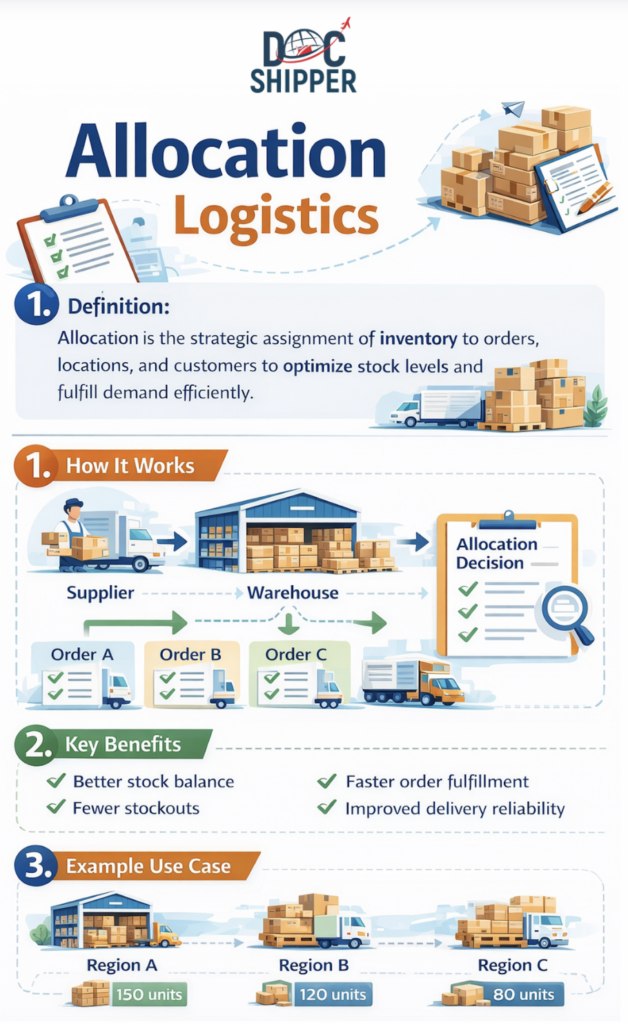
Allocation is the strategic distribution of available inventory, transportation capacity, or resources across multiple orders, customers, or destinations based on predefined business rules, priorities, or contractual obligations. This process optimizes supply chain efficiency by matching limited resources with demand.Introduction
In international trade, one of the most critical challenges importers and exporters face is the mismatch between available inventory or transport capacity and actual customer demand. When supply cannot meet all orders simultaneously, allocation becomes the decision-making framework that determines who receives what, when, and how much.
This concept is particularly crucial during supply chain disruptions, seasonal peaks, or when dealing with high-demand products. Effective allocation prevents conflicts, maintains customer relationships, and maximizes revenue while respecting contractual commitments.
Key characteristics of allocation in logistics include:
- Priority-based distribution: Resources assigned according to customer tiers, contract terms, or profitability.
- Real-time decision-making: Dynamic adjustments based on inventory levels and order urgency.
- Multi-criteria optimization: Balancing service levels, margins, and strategic relationships.
- System integration: Automated allocation through WMS, ERP, or TMS platforms.
- Compliance requirements: Adherence to legal obligations, trade agreements, and contractual SLAs.
Allocation Mechanisms & Strategic Framework
Allocation operates through several methodological approaches, each suited to different business contexts and supply chain configurations. Understanding these mechanisms enables companies to design allocation rules that align with their commercial strategy.
The proportional allocation method distributes available inventory or capacity proportionally to order quantities. If three customers ordered 100, 200, and 300 units respectively, and only 300 units are available, they receive 50, 100, and 150 units. This approach maintains fairness but may not reflect strategic priorities.
Priority-based allocation assigns resources according to predefined hierarchies. Premium customers, contractual commitments, or high-margin orders receive preferential treatment. This method requires clear business rules and transparent communication to avoid disputes. At DocShipper, we help clients establish allocation hierarchies that balance profitability with customer retention.
The first-come-first-served (FCFS) model allocates resources chronologically based on order placement. While simple and transparent, this method can disadvantage strategic customers who order less frequently but in larger volumes. It works best in commodity markets with standardized products.
Constraint-based allocation considers multiple factors simultaneously: geographic proximity, transportation costs, regulatory requirements, and delivery deadlines. Advanced algorithms evaluate these variables to optimize total supply chain cost while meeting service commitments. According to the World Trade Organization, efficient allocation can reduce logistics costs by 15-25% in complex international operations.
Finally, dynamic allocation continuously adjusts distribution based on real-time data: inventory updates, production delays, transportation disruptions, or demand fluctuations. This requires integrated systems that connect sales, warehousing, and transportation functions. Modern TMS platforms enable this level of responsiveness, critical in volatile markets.
Practical Examples & Data-Driven Scenarios
To illustrate allocation’s practical impact, consider a European electronics distributor managing inventory for three major retail chains during a product launch with limited initial stock.
Scenario: Limited Inventory Allocation
| Customer | Order Quantity | Priority Level | Allocated Units | Fulfillment % |
|---|---|---|---|---|
| Retailer A (Premium) | 5,000 | 1 | 4,500 | 90% |
| Retailer B (Standard) | 3,000 | 2 | 2,000 | 67% |
| Retailer C (New) | 2,000 | 3 | 500 | 25% |
| Total | 10,000 | — | 7,000 | 70% |
In this case, the distributor had only 7,000 units available against 10,000 units ordered. By applying priority-based allocation, they maintained their most valuable relationship (Retailer A) at 90% fulfillment, while partially serving others. This strategic decision preserved revenue from high-margin accounts while managing expectations with newer partners.
DocShipper Platform
Cut logistics costs. Not corners.
See exactly where your logistics costs are bleeding — and how to fix it. Book your expert demo.

Container Space Allocation: Real Use Case
A freight forwarder manages container space allocation for multiple shippers on a Shanghai-Rotterdam route. With limited weekly capacity (20 TEUs) and demand exceeding 35 TEUs, allocation becomes critical.
Five key allocation factors considered:
- Contractual commitments: Long-term customers with guaranteed space agreements receive priority (8 TEUs allocated).
- Cargo profitability: High-value shipments or specialized cargo with premium rates (6 TEUs allocated).
- Destination consolidation: Shipments that optimize inland distribution at destination port (3 TEUs allocated).
- Time sensitivity: Perishable goods or time-critical deliveries (2 TEUs allocated).
- Spot market orders: Remaining capacity offered at higher rates (1 TEU allocated).
This allocation strategy generated 18% higher revenue per container compared to FCFS allocation, while maintaining 95% customer satisfaction among priority accounts. DocShipper implements similar allocation logic for clients managing multi-modal transport across Asia-Europe corridors, ensuring optimal capacity utilization.
Industry data shows that companies using advanced allocation algorithms reduce stockouts by 30-40% while decreasing excess inventory by 20-25%. These improvements directly impact working capital efficiency and customer service levels, making allocation a strategic lever rather than merely an operational necessity.
Conclusion
Allocation represents the intersection of supply chain strategy, customer relationship management, and operational efficiency. Mastering allocation methodologies enables businesses to navigate supply constraints while maximizing profitability and service quality.
Need expert guidance on implementing allocation strategies for your international shipments? Contact DocShipper for tailored logistics solutions that optimize your supply chain performance.
📚 Quiz
Test Your Knowledge: Allocation in Logistics
Q1 — What does "allocation" mean in a logistics context?
Q2 — What is the key difference between "allocation" and "reservation" in inventory management?
Q3 — A freight forwarder has 20 TEUs available on a Shanghai–Rotterdam route but receives requests for 35 TEUs. Which allocation approach generates the highest revenue while maintaining customer satisfaction?
🎯 Your Result
📞 Free Quote in 24hFAQ | Allocation in Logistics: Definition, Calculation & Practical Examples
Allocation assigns available inventory to specific orders or customers, while reservation holds inventory for future orders without immediate commitment. Allocation is binding; reservation is provisional and can be cancelled.
Advanced WMS and ERP systems use predefined business rules and AI algorithms to reallocate inventory dynamically based on real-time data, prioritizing critical orders and minimizing service impact across the customer base.
Yes, discriminatory allocation that creates artificial scarcity or favors related entities without legitimate business justification may breach competition regulations. Transparent, objective criteria protect against legal challenges.
Key metrics include fill rate by customer tier, allocation accuracy, order fulfillment cycle time, revenue per allocated unit, and customer satisfaction scores segmented by allocation priority level.
B2B allocation emphasizes contractual commitments and relationship value, while B2C focuses on speed, geographic proximity, and order profitability. B2B typically involves larger volumes with longer planning horizons.
Accurate forecasting reduces allocation conflicts by aligning inventory levels with expected demand. Predictive analytics enable proactive allocation planning rather than reactive crisis management during shortages.
Regulatory requirements like import quotas, licensing restrictions, or preferential trade agreements influence allocation by limiting which customers or destinations can receive certain products, requiring compliance-aware allocation logic.
Yes, 3PLs often manage allocation for clients using shared warehouse networks. However, strategic allocation rules must be clearly defined by the shipper to ensure alignment with business priorities and customer commitments.
Fair-share allocation distributes scarce resources proportionally based on historical purchase volumes or contractual agreements. It's commonly used in commodity markets or during industry-wide supply shortages to maintain equitable distribution.
JIT systems require precise allocation to ensure components arrive exactly when needed. Any allocation error disrupts production schedules, making accuracy and real-time visibility critical in JIT supply chains.
Cloud-based WMS, AI-powered decision engines, IoT sensors for inventory tracking, and integrated TMS platforms enable dynamic allocation by processing real-time data across the entire supply chain network.
Seasonal peaks require pre-allocation based on historical patterns and customer commitments. Companies often implement tiered allocation models that adjust priorities and quantities as peak periods approach, balancing risk and service levels.
Need Help with Logistics or Sourcing ?
First, we secure the right products from the right suppliers at the right price by managing the sourcing process from start to finish. Then, we simplify your shipping experience - from pickup to final delivery - ensuring any product, anywhere, is delivered at highly competitive prices.


Fill the Form
Prefer email? Send us your inquiry, and we’ll get back to you as soon as possible.
Contact us


