


In short ⚡
Arbitrary refers to decisions, charges, or rules determined by individual discretion rather than fixed standards or regulations. In international logistics, arbitrary fees or classifications can significantly impact shipping costs and compliance, often leading to disputes between carriers, freight forwarders, and shippers.
Introduction
Why do two identical shipments sometimes receive different charges from the same carrier? The answer often lies in arbitrary decisions—those discretionary judgments made without transparent criteria or standardized methodology.
In global trade, arbitrary elements create unpredictability. They affect freight rates, customs classifications, detention charges, and handling fees. Understanding where arbitrariness enters the supply chain helps importers and exporters protect their margins and negotiate better terms.
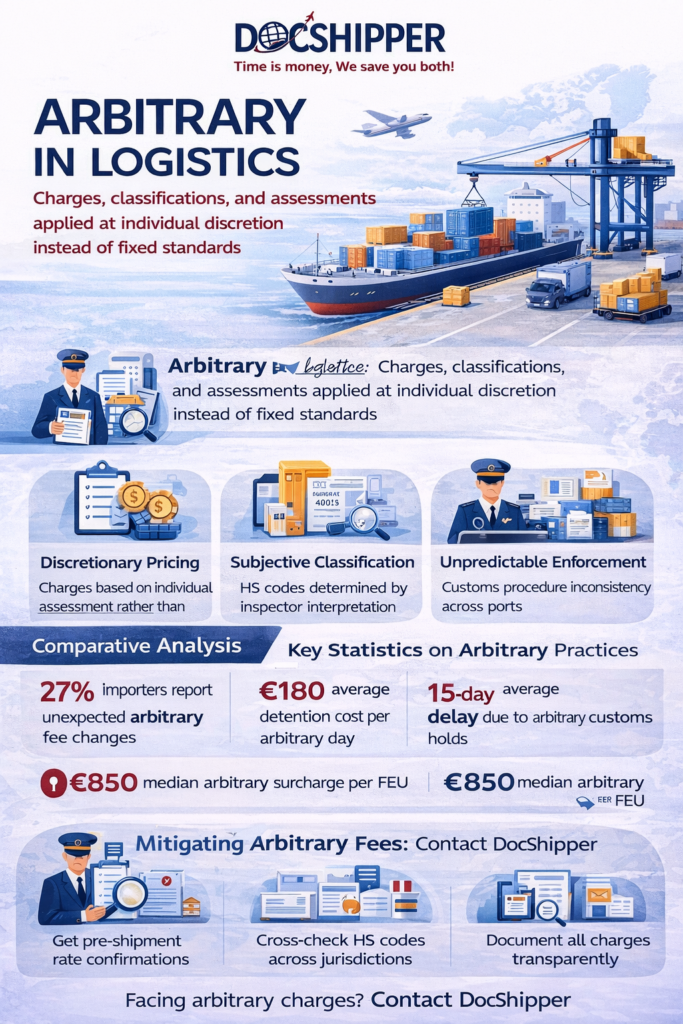
- Discretionary pricing: Charges applied based on individual assessment rather than published tariffs
- Subjective classification: HS code determination influenced by inspector interpretation
- Variable enforcement: Customs procedures applied inconsistently across ports
- Unilateral changes: Carrier surcharges imposed without prior notice or justification
- Negotiable penalties: Demurrage or detention fees subject to case-by-case review
Understanding Arbitrary Decisions in Logistics
Arbitrary decisions emerge when rules lack precision or when human judgment replaces standardized processes. In shipping, this occurs across multiple touchpoints—from rate negotiations to customs clearance.
Arbitrary freight charges represent one of the most common frustrations. Ocean carriers may apply “general rate increases” (GRI) or peak season surcharges that vary by customer relationship rather than shipment characteristics. Two shippers moving identical containers on the same vessel may pay different rates based on negotiating power or historical volume.
Customs classification disputes often stem from arbitrary interpretation. The Harmonized System (HS) provides product codes, but complex goods may fit multiple categories. Customs officers exercise discretion when assigning codes, directly affecting duty rates. A product classified as “textile” versus “industrial fabric” can shift tariffs by 15% or more.
Detention and demurrage policies contain arbitrary elements despite published schedules. Carriers may waive fees for preferred clients while strictly enforcing them on others. Weather delays, port congestion, or equipment shortages—all subject to interpretation—determine whether charges apply.
The lack of standardized damage assessment creates another arbitrary zone. Container damage claims depend on surveyor judgment. What constitutes “normal wear” versus “negligence” varies by inspector, leading to inconsistent liability determinations.
At DocShipper, we systematically document all charges and classifications to identify arbitrary elements early. Our customs specialists cross-reference HS codes with precedents from multiple jurisdictions, reducing exposure to discretionary penalties. For more information, visit the World Customs Organization.
Concrete Examples & Data
Real-world scenarios illustrate how arbitrary decisions impact logistics costs and timelines. These examples demonstrate the financial consequences of discretionary practices.
Case Study: Arbitrary Surcharge Application
A European electronics importer ships 40 containers monthly from Shenzhen to Rotterdam. In Q3 2023, the carrier imposed a “port congestion surcharge” of €250 per TEU—but only on 60% of shipments. The remaining 40% traveled surcharge-free despite identical routing and timing. Investigation revealed the arbitrary nature: charges applied based on booking channel (direct versus freight forwarder) rather than actual congestion impact. Total arbitrary cost: €6,000 monthly.
Comparative Analysis: HS Code Discretion
| Product | Port A Classification | Port B Classification | Duty Difference |
|---|---|---|---|
| Multi-function printer | 8443.32 (Printing machinery) | 8471.60 (Computer peripherals) | 4.2% vs 0% |
| LED grow light | 8543.70 (Electrical machines) | 9405.40 (Lighting fixtures) | 2.6% vs 3.9% |
| Bamboo cutting board | 4419.19 (Bamboo tableware) | 1520.10 (Kitchen articles) | 3.2% vs 7.0% |
This table demonstrates how arbitrary classification at different customs offices creates duty variance on identical goods—a direct cost unpredictability that complicates landed cost calculations.
DocShipper Platform
Optimize Your Global Logistics with Cutting-Edge Solutions
Enhance efficiency, cut costs, and gain 24/7 visibility  over your entire supply chain.
- Cut your shipping costs and maximize your margins
- Manage sourcing, freight, & customs on one platform
- Get real-time tracking and analytics
Key Data Points on Arbitrary Practices
- 27% of surveyed importers report experiencing arbitrary fee changes without advance notice (Freightos 2023 Survey)
- €180 average cost per arbitrary detention day when carriers selectively enforce free time policies
- 15-day average delay caused by arbitrary customs holds requiring additional documentation not listed in regulations
- 42% variance in damage assessment values for identical container conditions across different surveyors
- $850 median arbitrary surcharge applied per FEU during peak season, with inconsistent application criteria
DocShipper mitigates arbitrary cost exposure through pre-shipment rate confirmations, multi-port customs precedent analysis, and carrier relationship management. Our clients receive detailed cost breakdowns highlighting any discretionary elements before commitment.
Conclusion
Arbitrary decisions in logistics create cost unpredictability and operational friction. Recognizing where discretion replaces standardization enables proactive negotiation and documentation strategies that protect your bottom line.
Need expert guidance navigating arbitrary charges or classifications? Contact DocShipper for customized logistics solutions that minimize discretionary cost exposure.
📚 Quiz
Test Your Knowledge: Arbitrary in Logistics
Q1 — What best defines an "arbitrary" charge in international logistics?
Q2 — A carrier waives detention fees for one client but strictly enforces them for another on identical shipments. Is this an example of arbitrary practice?
Q3 — A customs officer classifies your multi-function printer under "Computer peripherals" (0% duty) at Port A, but a colleague at Port B classifies the same product under "Printing machinery" (4.2% duty). What is the most accurate interpretation of this situation?
🎯 Your Result
📞 Free Quote in 24hFAQ | Arbitrary: Definition, Application & Concrete Examples in Logistics
A charge is arbitrary when applied based on individual discretion rather than published tariffs or transparent criteria. Standard charges appear in rate schedules with clear application rules, while arbitrary fees vary by relationship, negotiation, or subjective assessment.
Yes. You may request a binding ruling from customs authorities before shipment, or appeal classifications through formal review processes. Documentation showing industry precedents strengthens your position. Professional customs brokers expedite this process significantly.
Carriers cite "market conditions," "operational costs," or "service adjustments" without providing specific cost data. These vague justifications mask discretionary pricing. Requesting itemized breakdowns and comparing against published tariff amendments reveals arbitrary elements.
Not always. Published demurrage/detention schedules exist, but enforcement varies. Arbitrary application occurs when carriers waive fees selectively, apply different free-time allowances to similar customers, or charge for delays beyond shipper control without case review.
Maintain booking confirmations, rate agreements, email correspondence, and timestamped delivery/pickup records. Photographic evidence of container conditions and gate receipts prove actual circumstances versus arbitrary assessments during disputes.
Experienced forwarders leverage volume relationships and regulatory knowledge to challenge arbitrary charges. They identify discretionary fees early, negotiate removals, and provide alternative routing when carriers apply inconsistent pricing. Their expertise converts arbitrary elements into predictable costs.
HS code assignment directly determines tariff rates. Arbitrary classification into higher-duty categories increases landed costs. A 5% duty difference on a $100,000 shipment equals $5,000—significant enough to erode margins or price competitiveness.
Service contracts reduce but don't eliminate arbitrariness. They lock base rates but often permit "accessorial charges" subject to carrier discretion. Review contract language for surcharge clauses, amendment procedures, and dispute resolution mechanisms to minimize arbitrary additions.
Different ports exhibit varying levels of enforcement consistency. Some customs offices apply stricter interpretations, while others follow more standardized procedures. Strategic port selection based on classification precedent data reduces arbitrary risk.
Legality depends on contract terms and regulatory frameworks. While carriers have pricing discretion, arbitrary discrimination violates common carrier obligations in many jurisdictions. Customs must follow WTO agreements, but interpretation latitude exists within legal bounds.
Analyze historical shipment data for unexplained charge variations. Calculate the range between lowest and highest fees for identical services. This variance represents potential arbitrary exposure. Multiply by shipment frequency to estimate annual risk.
Request independent surveys from recognized organizations like SGS or Bureau Veritas. Compare multiple assessments to identify outliers. Insurance policies often specify acceptable surveyor lists, reducing arbitrary valuation disputes through pre-agreed standards.
Need Help with
Logistics or Sourcing ?
First, we secure the right products from the right suppliers at the right price by managing the sourcing process from start to finish. Then, we simplify your shipping experience - from pickup to final delivery - ensuring any product, anywhere, is delivered at highly competitive prices.


Fill the Form
Prefer email? Send us your inquiry, and we’ll get back to you as soon as possible.
Contact us


