Average Cost: Definition, Formula & Guide for 2026

  • admin 8 Min
  • Published on March 3, 2026
img

In short ⚡

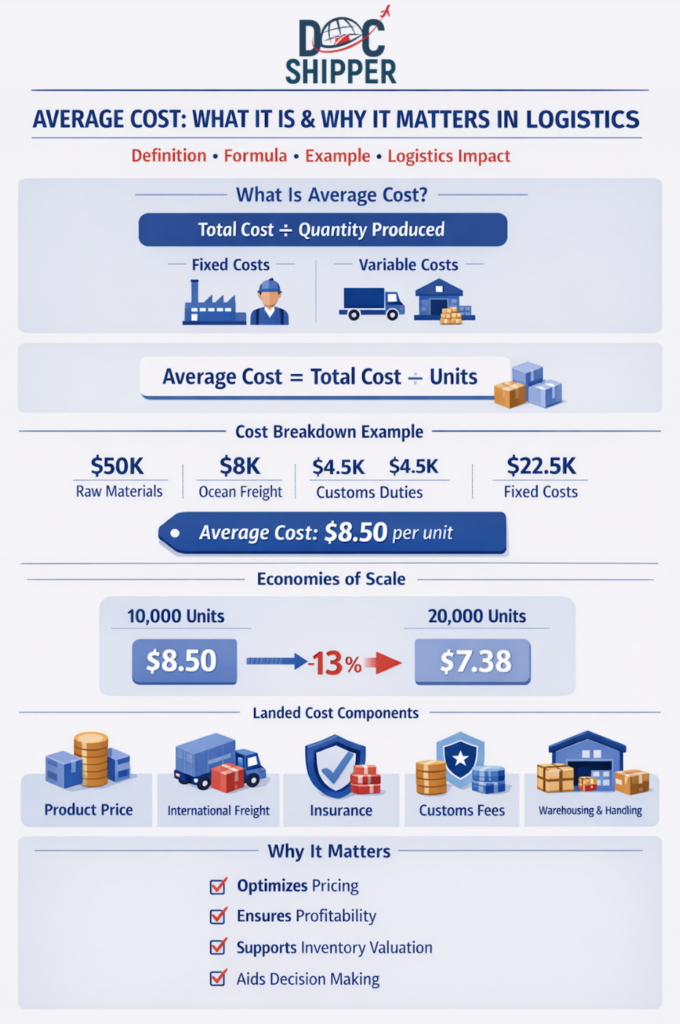
Average Cost is the total cost of production divided by the quantity of units produced. It represents the per-unit expense incurred in manufacturing or acquiring goods, combining both fixed and variable costs. This metric is essential for pricing strategies, profitability analysis, and inventory valuation in international trade.

Introduction

Many businesses struggle to accurately determine their true cost per unit, leading to pricing errors that erode profit margins or make products uncompetitive. Understanding Average Cost is critical for importers, exporters, and manufacturers who need precise financial data to make informed decisions about production volumes, supplier negotiations, and market positioning.

In international logistics, Average Cost calculation becomes particularly complex due to fluctuating freight rates, currency exchange variations, customs duties, and economies of scale. Mastering this concept enables companies to optimize their supply chain investments and maintain competitive pricing across global markets.

  • Combines fixed costs (rent, equipment, salaries) with variable costs (materials, labor per unit)
  • Changes with production volume due to economies or diseconomies of scale
  • Critical for inventory accounting under methods like weighted average cost
  • Influences pricing strategies to ensure profitability above the cost threshold
  • Impacts international competitiveness by determining market entry viability

In-Depth Analysis & Expert Insights

The Average Cost formula is straightforward: Total Cost ÷ Quantity Produced. However, its application in international trade requires understanding the distinction between Average Fixed Cost (AFC) and Average Variable Cost (AVC). AFC decreases as production volume increases, since fixed expenses are spread over more units. Conversely, AVC may increase at higher volumes if inefficiencies emerge or premium rates apply for rush production.

In logistics contexts, Average Total Cost (ATC) must include all landed costs: product cost, international freight, insurance, customs duties, warehousing, and handling fees. According to World Customs Organization guidelines, accurate cost allocation is essential for customs valuation compliance, as underreporting can trigger penalties and shipment delays.

The concept of marginal cost intersects with Average Cost analysis. When marginal cost (the cost of producing one additional unit) falls below Average Cost, producing more units reduces the overall average. This principle drives decisions about production scaling and order consolidation in freight forwarding.

Inventory valuation methods directly depend on Average Cost calculations. The weighted average cost method smooths price fluctuations by recalculating the average after each purchase, providing stable cost figures for financial reporting. This approach is particularly valuable for businesses importing goods with volatile commodity prices or frequent currency exchange rate changes.

At DocShipper, we systematically calculate Average Cost for our clients’ shipments, incorporating all logistics variables to provide transparent pricing. This comprehensive approach helps businesses avoid hidden costs and budget accurately for their international operations.

Average cost in logistics

Practical Examples & Data

Consider a manufacturer importing electronic components from Asia. Their cost structure for producing 10,000 units includes:

Cost CategoryAmount (USD)Per Unit
Raw Materials (Variable)$50,000$5.00
Ocean Freight (Variable)$8,000$0.80
Customs Duties (Variable)$4,500$0.45
Factory Overhead (Fixed)$15,000$1.50
Equipment Depreciation (Fixed)$7,500$0.75
Total Cost$85,000$8.50

Average Cost = $85,000 ÷ 10,000 = $8.50 per unit

Now examine how production volume affects Average Cost. If the same company increases production to 20,000 units while fixed costs remain constant:

  • Variable costs double: ($50,000 + $8,000 + $4,500) × 2 = $125,000
  • Fixed costs remain: $15,000 + $7,500 = $22,500
  • New Total Cost: $147,500
  • New Average Cost: $147,500 ÷ 20,000 = $7.38 per unit
  • Cost reduction: $1.12 per unit (13% decrease)

This demonstrates the economies of scale principle: higher production volumes spread fixed costs more efficiently, reducing Average Cost. However, beyond certain thresholds, diseconomies may emerge if overtime premiums apply or expedited shipping becomes necessary.

For inventory management, consider a retailer using the weighted average method. After purchasing 500 units at $10 each, then 300 units at $12 each, the new average cost becomes: [(500 × $10) + (300 × $12)] ÷ 800 = $10.75 per unit. This recalculated average applies to all subsequent sales until the next purchase adjusts it again.

Conclusion

Average Cost is fundamental to profitable international trade operations, directly impacting pricing decisions, inventory valuation, and supply chain optimization. Accurate calculation requires incorporating all landed costs and understanding how production volumes influence per-unit expenses.

Need expert guidance on cost optimization for your international shipments? Contact DocShipper for comprehensive logistics support that maximizes your cost efficiency.

📚 Quiz
Test Your Knowledge: Average Cost

FAQ | Average Cost: Definition, Calculation & Real-World Examples

Average Cost is total cost divided by quantity produced, while Marginal Cost is the cost of producing one additional unit. Marginal Cost influences whether increasing production will raise or lower Average Cost.

Ask us anything!

Need Help with Logistics or Sourcing ?

First, we secure the right products from the right suppliers at the right price by managing the sourcing process from start to finish. Then, we simplify your shipping experience - from pickup to final delivery - ensuring any product, anywhere, is delivered at highly competitive prices.

Live Chat

Get instant assistance from our team—just click and start chatting!

Live Chat Now
image

Fill the Form

Prefer email? Send us your inquiry, and we’ll get back to you as soon as possible.

Contact us
image

Call us

Reach out to us on WhatsApp for quick, convenient, and personal support.

Call us
image