


In short ⚡
Backhaul carrier refers to a transportation service provider that moves freight on return trips after completing primary deliveries, optimizing empty leg capacity. This logistics strategy reduces operational costs by filling vehicles that would otherwise travel empty, creating cost-effective shipping opportunities for businesses while maximizing carrier asset utilization and reducing carbon emissions.
Introduction
International freight transportation faces a persistent challenge: empty return journeys. After delivering goods to a destination, carriers often return with empty containers or trucks, generating zero revenue while incurring fuel, labor, and maintenance costs. This inefficiency directly impacts shipping rates and environmental sustainability.
The backhaul carrier concept addresses this fundamental logistics problem. By securing freight for return trips, carriers transform dead mileage into profitable operations. For shippers, this creates opportunities to access discounted transportation rates, sometimes 30-50% below standard pricing.
Understanding backhaul dynamics is essential for businesses engaged in international trade. Key characteristics include:
- Directional imbalance: Trade lanes with unequal import/export volumes create backhaul opportunities
- Flexible scheduling: Backhaul shipments typically offer lower priority but significant cost savings
- Asset optimization: Carriers maximize equipment utilization and revenue per mile
- Rate variability: Pricing fluctuates based on lane balance and seasonal demand patterns
- Sustainability benefits: Reduced empty miles lower carbon footprint across supply chains
Backhaul Mechanics & Strategic Importance
Backhaul operations function within the broader context of lane balancing. Transportation networks rarely achieve perfect equilibrium. Manufacturing hubs export more than they import, while consumption centers show the opposite pattern. These structural imbalances create systematic backhaul opportunities.
Carriers categorize routes as headhaul (primary, high-demand direction) or backhaul (return direction with lower demand). A classic example: containers flowing from Asian manufacturing centers to North American ports represent headhaul. The return journey often struggles to find cargo, creating backhaul capacity.
The pricing mechanism reflects supply-demand dynamics. When carriers face 60% empty return capacity on a specific route, they offer aggressive discounts to cover marginal costs. Fixed costs (equipment depreciation, insurance) are already absorbed by headhaul revenue. Backhaul pricing only needs to exceed variable costs (fuel, driver wages, port fees) to generate profit.
Modern freight matching technology has revolutionized backhaul optimization. Digital platforms connect shippers with available carrier capacity in real-time, reducing the traditional reliance on freight brokers. According to the International Chamber of Commerce, technology-enabled backhaul matching has improved carrier utilization rates by 15-20% since 2020.
Contract structures vary significantly. Spot market backhaul offers maximum flexibility but variable pricing. Contract backhaul provides rate stability through volume commitments. Dedicated backhaul programs establish ongoing partnerships where shippers guarantee minimum volumes on specific return lanes.
At DocShipper, we systematically analyze backhaul opportunities across our client shipments, leveraging our carrier network to identify cost-saving routes without compromising delivery reliability. Our procurement team monitors lane imbalances to secure optimal backhaul rates for qualifying shipments.
Concrete Examples & Cost Analysis
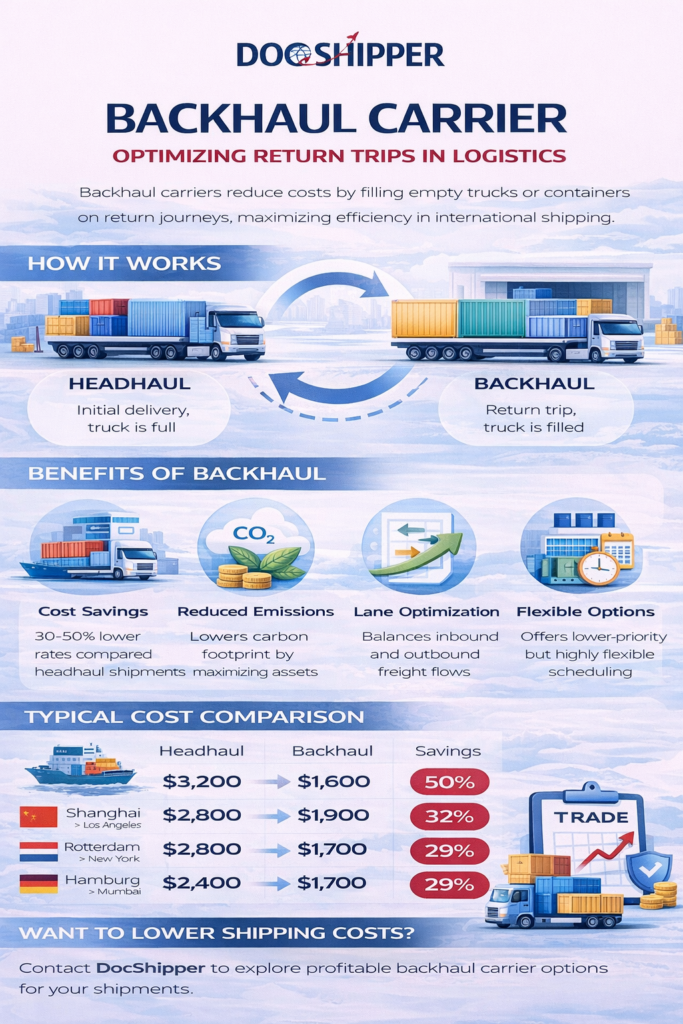
Understanding backhaul economics requires examining real-world scenarios. The following comparative analysis demonstrates typical cost differentials across major trade lanes:
| Trade Lane | Direction | Type | 40′ Container Rate | Savings |
|---|---|---|---|---|
| Shanghai → Los Angeles | Eastbound | Headhaul | $3,200 | — |
| Los Angeles → Shanghai | Westbound | Backhaul | $1,600 | 50% |
| Rotterdam → New York | Westbound | Headhaul | $2,800 | — |
| New York → Rotterdam | Eastbound | Backhaul | $1,900 | 32% |
| Hamburg → Mumbai | Eastbound | Headhaul | $2,400 | — |
| Mumbai → Hamburg | Westbound | Backhaul | $1,700 | 29% |
Use Case: Electronics Manufacturer
A European electronics company imports components from Shenzhen and exports finished products back to Asian markets. By structuring their logistics around backhaul opportunities, they achieved:
- Annual freight savings: €180,000 on 120 container shipments
- Transit time trade-off: Additional 3-5 days accepted for non-urgent returns
- Carrier partnership: Volume commitment secured priority backhaul allocation
- Carbon reduction: 240 tons CO₂ avoided through optimized container utilization
- Operational adjustment: Production scheduling aligned with backhaul availability windows
Critical considerations when leveraging backhaul carriers include transit time flexibility, cargo insurance verification, carrier financial stability, and documentation accuracy. Backhaul shipments may experience longer port dwell times as carriers prioritize headhaul cargo during peak congestion periods.
Seasonal variations dramatically impact backhaul economics. Pre-holiday peak seasons (August-October for trans-Pacific eastbound) eliminate most backhaul discounts as demand balances. Post-peak periods (January-March) offer maximum backhaul opportunities with discounts reaching 60% on select lanes.
Conclusion
Backhaul carriers represent a strategic logistics tool for cost-conscious businesses willing to accept moderate flexibility in exchange for substantial freight savings. Understanding lane dynamics and seasonal patterns enables shippers to optimize transportation spend while supporting sustainable supply chain practices.
Need expert guidance on identifying backhaul opportunities for your specific trade lanes? Contact DocShipper for customized freight optimization strategies.
DocShipper Platform
Optimize Your Global Logistics with Cutting-Edge Solutions
Enhance efficiency, cut costs, and gain 24/7 visibility  over your entire supply chain.
- Cut your shipping costs and maximize your margins
- Manage sourcing, freight, & customs on one platform
- Get real-time tracking and analytics
📚 Quiz
Test Your Knowledge: Backhaul Carrier
Q1 — What best defines a backhaul carrier?
Q2 — Why can backhaul carriers offer discounts of 30–50% compared to standard headhaul rates?
Q3 — A company needs to ship fresh produce from Los Angeles to Shanghai with a guaranteed 5-day transit. Should they use a backhaul carrier?
🎯 Your Result
📞 Free Quote in 24hFAQ | Backhaul Carrier: Definition, Optimization & Concrete Examples
Backhaul discounts typically range from 25% to 50% below headhaul rates, depending on lane imbalance severity, seasonal demand, and carrier capacity. Highly imbalanced routes during off-peak periods offer maximum savings.
Backhaul shipments generally experience 3-7 days longer transit times due to lower scheduling priority. Reliability depends on carrier selection and contract terms. Established carriers maintain acceptable service levels for backhaul freight.
Trans-Pacific westbound (North America to Asia), transatlantic eastbound (North America to Europe), and routes from consumption markets to manufacturing hubs consistently offer strong backhaul opportunities due to structural trade imbalances.
Backhaul is unsuitable for perishable goods or time-critical shipments requiring guaranteed transit times. It works best for durable goods, raw materials, and inventory replenishment with flexible delivery windows.
Forwarders leverage carrier partnerships, digital freight platforms, and historical lane data to identify backhaul opportunities. Advanced providers use predictive analytics to forecast capacity availability and optimize booking timing.
Spot market backhaul rates fluctuate based on real-time supply-demand. Contract backhaul offers fixed pricing in exchange for volume commitments. Negotiation leverage increases with shipment frequency and flexibility.
Documentation requirements remain identical to standard shipments. However, backhaul bookings may require additional lead time for carrier confirmation and may include specific clauses regarding transit time variability in the bill of lading.
Insurance coverage should match standard shipments, but shippers must verify policy terms. Some carriers offer reduced coverage for discounted backhaul rates. Always confirm cargo insurance limits before booking.
Utilizing backhaul capacity significantly reduces per-shipment carbon emissions by eliminating empty container movements. Companies tracking Scope 3 emissions can claim reduced environmental impact when optimizing backhaul opportunities.
Yes, less-than-container-load shipments can access backhaul benefits through consolidation services. Freight forwarders combine multiple LCL shipments into backhaul containers, passing savings to individual shippers proportionally.
Shippers using backhaul should maintain contingency arrangements. When backhaul capacity fills unexpectedly, alternative options include accepting headhaul rates, delaying shipment, or switching to different carriers with available backhaul space.
Modern platforms use algorithms analyzing historical data, real-time capacity, and predictive demand models to match shipper requirements with carrier backhaul availability, reducing empty miles while providing transparent pricing and booking automation.
Need Help with Logistics or Sourcing ?
First, we secure the right products from the right suppliers at the right price by managing the sourcing process from start to finish. Then, we simplify your shipping experience - from pickup to final delivery - ensuring any product, anywhere, is delivered at highly competitive prices.


Fill the Form
Prefer email? Send us your inquiry, and we’ll get back to you as soon as possible.
Contact us


