In short ⚡
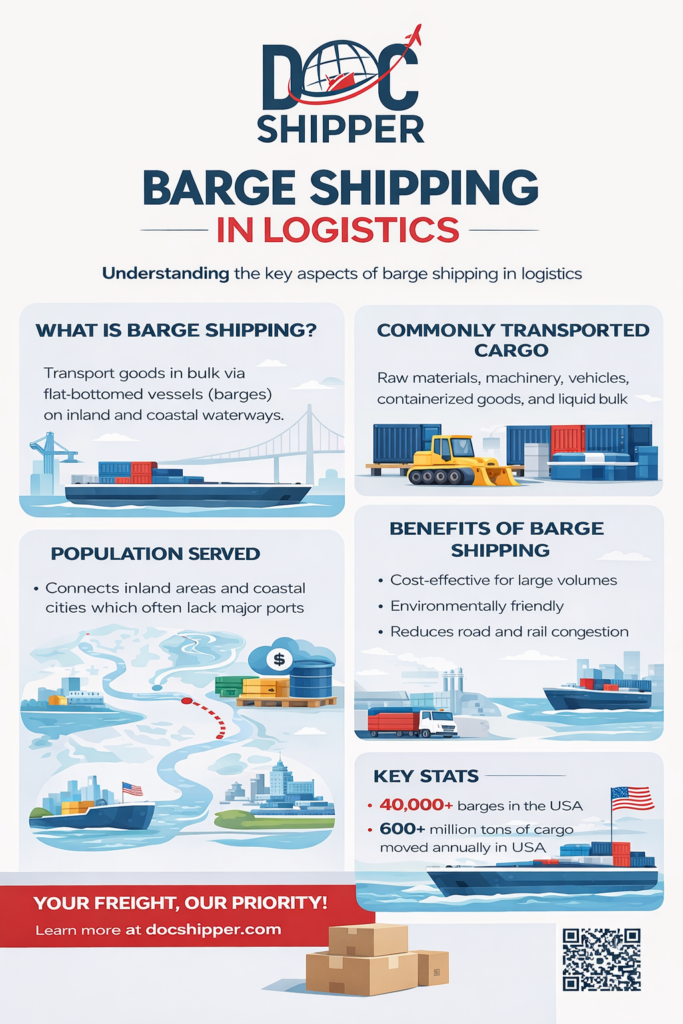
A barge is a flat-bottomed vessel designed to transport heavy or bulk cargo through inland waterways, rivers, and coastal areas. Unlike ocean-going ships, barges have no self-propulsion system and must be towed or pushed by tugboats. They represent a cost-effective and eco-friendly solution for moving large volumes of goods over short to medium distances.Introduction
Many importers and logistics managers overlook barges when planning multimodal transport strategies. This oversight often leads to missed opportunities for cost reduction and carbon footprint optimization. In international trade, especially for bulk commodities and oversized cargo, barges serve as critical connectors between ocean ports and inland distribution centers.
Understanding barge logistics becomes essential when dealing with:
- High-volume, low-value cargo requiring economical transportation solutions
- Heavy industrial equipment exceeding road or rail weight limits
- Bulk commodities like grain, coal, petroleum products, and construction materials
- Environmental compliance mandates favoring lower-emission transport modes
- Port congestion challenges where inland waterways offer alternative routing
The global barge industry handles approximately 2.3 billion tons of cargo annually, with the Rhine-Danube corridor in Europe and the Mississippi River system in the United States representing the world’s busiest inland waterway networks.
Technical Characteristics & Operational Framework
Barges operate within a specialized regulatory and technical ecosystem that differs fundamentally from ocean shipping. The International Convention for the Safety of Inland Navigation governs most European waterways, while the U.S. Coast Guard regulates American inland waters through specific CFR provisions.
Barge classification depends on construction, cargo type, and operational environment. The primary categories include:
- Dry cargo barges: Open or covered vessels for grain, coal, aggregates, and containers
- Liquid cargo barges: Tank barges for petroleum, chemicals, and liquid bulk products
- Deck barges: Flat platforms for heavy machinery, project cargo, and oversized equipment
- Hopper barges: Self-unloading vessels with bottom doors for rapid discharge
- Specialized barges: Purpose-built for unique cargo like livestock, vehicles, or hazardous materials
The loading capacity varies dramatically. Standard European Rhine barges carry 1,500 to 3,000 tons, while American jumbo barges on the Mississippi can handle up to 3,500 tons. Pusher tugs typically move multiple barges simultaneously—a configuration called a “tow”—with some Mississippi tows comprising 40+ barges totaling 60,000+ tons.
Draft limitations represent the critical operational constraint. Most inland waterways restrict draft to 2-4 meters, requiring precise cargo weight calculations. Seasonal water level fluctuations can reduce capacity by 30-50% during low-water periods, directly impacting logistics planning.
At DocShipper, we coordinate barge movements as part of integrated multimodal solutions, ensuring seamless transitions between ocean vessels, barges, and land transport. Our network includes partnerships with major inland waterway operators across Europe, North America, and Asia.
The environmental advantage remains compelling: barges emit 80% less CO2 per ton-kilometer than trucks and 35% less than rail, according to European Commission transport data. This efficiency stems from minimal friction resistance in water and the ability to move massive loads with relatively small propulsion power.
Practical Applications & Industry Data
Real-world barge logistics demonstrate significant cost and efficiency advantages in specific scenarios. Consider these comparative analyses:
| Transport Mode | Cost per Ton (500km) | CO2 Emissions (g/ton-km) | Capacity per Unit |
|---|---|---|---|
| Barge | €12-18 | 31 | 1,500-3,500 tons |
| Rail | €22-32 | 48 | 1,200-2,000 tons |
| Truck | €75-95 | 158 | 24-28 tons |
Use Case: Agricultural Export from Rotterdam to Germany
A grain exporter needs to move 15,000 tons of wheat from Rotterdam port to Mannheim (450 km inland). The comparison reveals:
- Barge option: 5 barges (3,000 tons each), total cost €210,000, transit time 48 hours, CO2 emissions 209 tons
- Rail option: 12 trains (1,250 tons each), total cost €396,000, transit time 36 hours, CO2 emissions 324 tons
- Truck option: 600 trucks (25 tons each), total cost €1,267,500, transit time 24-72 hours (staggered), CO2 emissions 1,066 tons
The barge solution saves €186,000 compared to rail and €1,057,500 versus trucking, while reducing emissions by 80% compared to road transport.
Project Cargo Scenario: A 450-ton transformer unit requires transport from Antwerp to Basel. Standard road transport would need special permits, route surveys, and infrastructure reinforcement costing €380,000. A specialized deck barge completes the journey for €145,000 with minimal regulatory complexity.
Key industry statistics:
- The Rhine River handles 300+ million tons annually, equivalent to 15 million truck journeys
- U.S. inland waterways move 600+ million tons yearly, supporting $230 billion in economic activity
- Barge transport costs average 40-60% less than rail and 75-85% less than trucking for bulk commodities
- One standard barge replaces 58 trucks or 15 rail cars, significantly reducing road congestion
- The global inland waterway transport market is projected to reach $265 billion by 2028
At DocShipper, we leverage these efficiencies by integrating barge transport into comprehensive supply chain solutions, particularly for clients moving bulk commodities, construction materials, and oversized industrial equipment across Europe and North America.
DocShipper Platform
Cut logistics costs. Not corners.
See exactly where your logistics costs are bleeding — and how to fix it. Book your expert demo.

Conclusion
Barges represent an underutilized yet highly efficient transport mode for specific cargo types and routes. Their unmatched cost-effectiveness for bulk goods, combined with superior environmental performance, makes them essential components of modern multimodal logistics strategies.
Need expert guidance on incorporating barge transport into your supply chain? Contact DocShipper for customized multimodal solutions tailored to your cargo requirements.
📚 Quiz
Barge in Shipping
Q1 — Which of the following best defines a barge in shipping?
Q2 — A logistics manager argues that barges are impractical because seasonal water levels have no real impact on their operations. Is this correct?
Q3 — A company needs to move 15,000 tons of grain 450 km inland at the lowest possible cost and carbon footprint. Which transport mode is the most appropriate?
🎯 Your Result
📞 Free Quote in 24hFAQ | Barge in Shipping: Definition, Types & Practical Applications
Barges lack self-propulsion systems and operate primarily in inland waterways with shallow drafts, while ships have engines and navigate deep-sea routes. Barges must be towed or pushed by tugboats.
Capacity varies by type and region. European Rhine barges carry 1,500-3,000 tons, while American Mississippi barges handle up to 3,500 tons. A single barge replaces approximately 58 trucks or 15 rail cars.
Yes, container barges are common on major waterways. A standard European barge can carry 100-208 TEUs, making them effective for feeder services between ports and inland container terminals.
Barges typically travel at 8-12 km/h (5-7.5 mph) on inland waterways. While slower than trucks or trains, the cost savings and large capacity offset the longer transit times for non-urgent bulk cargo.
The Rhine-Main-Danube corridor in Europe, the Mississippi River system in the U.S., the Yangtze River in China, and the Paraná-Paraguay waterway in South America represent the world's busiest barge routes.
Low water periods can reduce loading capacity by 30-50%, as barges must maintain safe draft clearances. Operators adjust cargo volumes accordingly, which can increase per-ton costs during drought conditions.
Restrictions vary by waterway and vessel type. Generally, extremely hazardous materials, radioactive substances, and certain explosives face limitations. Liquid cargo barges require specialized certifications for chemical transport.
Methods depend on cargo type: cranes for containers and heavy equipment, conveyor systems for grain and coal, pumps for liquids, and gravity discharge through bottom hatches for hopper barges.
Cargo requires inland marine insurance covering transit risks. Liability insurance protects against environmental damage, particularly for liquid cargo. Coverage terms differ from ocean cargo insurance due to different risk profiles.
Northern waterways may freeze in winter, suspending operations for 2-4 months. Tropical and temperate regions generally allow year-round navigation, though monsoon seasons can temporarily disrupt schedules.
Barge rates average €0.015-0.025 per ton-kilometer for bulk cargo, compared to €0.035-0.055 for rail and €0.12-0.18 for trucking. The cost advantage increases with distance and cargo volume.
Standard documents include the bill of lading, cargo manifest, dangerous goods declarations (if applicable), and waterway transit permits. Cross-border movements require customs documentation similar to other transport modes.
Need Help with
Logistics or Sourcing ?
First, we secure the right products from the right suppliers at the right price by managing the sourcing process from start to finish. Then, we simplify your shipping experience - from pickup to final delivery - ensuring any product, anywhere, is delivered at highly competitive prices.


Fill the Form
Prefer email? Send us your inquiry, and we’ll get back to you as soon as possible.
Contact us