In short ⚡
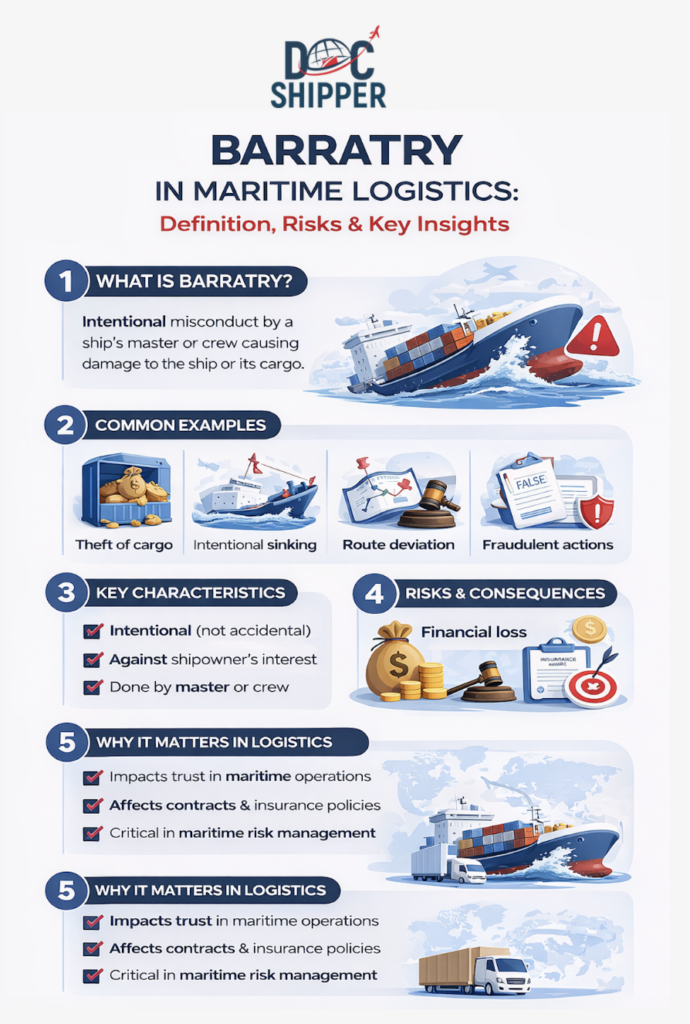
Barratry is a maritime legal term designating fraudulent or criminal conduct by a ship's master or crew against the vessel owner's interests, including deliberate scuttling, cargo theft, or unauthorized route deviations. This breach of trust constitutes a serious maritime offense covered under marine insurance policies.Introduction
International shipping relies on absolute trust between vessel owners and maritime crews. When this trust breaks down through intentional misconduct, the consequences can devastate entire supply chains. Barratry represents one of the most serious violations in maritime law—deliberate acts by ship personnel that betray their duty to protect cargo and vessel integrity.
In global logistics, understanding barratry becomes critical for risk assessment and insurance coverage. This offense directly impacts freight security, cargo insurance premiums, and contractual obligations throughout the shipping chain.
Key characteristics of barratry include:
- Intentional misconduct by master or crew members
- Acts contrary to owner’s interests without authorization
- Criminal or fraudulent nature of the conduct
- Material damage or loss resulting from the actions
- Coverage under marine insurance as a specific peril
Legal Framework & Maritime Expertise
Barratry originates from ancient maritime law and remains codified in modern shipping regulations. The term derives from the legal concept of “barrator”—one who frequently instigates lawsuits or quarrels. In maritime context, it evolved to describe crew members who deliberately harm their employer’s interests.
Under the Marine Insurance Act 1906 (still referenced globally), barratry includes any wrongful act willfully committed by the master or crew to the prejudice of the owner. This encompasses scuttling vessels for insurance fraud, stealing cargo, or deliberately running ships aground. The International Maritime Organization recognizes barratry as a distinct category of maritime crime requiring specific legal remedies.
Modern marine insurance policies typically cover barratry losses under Institute Cargo Clauses (A), providing protection when crew misconduct causes cargo damage or total loss. However, proving barratry requires demonstrating intentional wrongdoing—not mere negligence or incompetence.
The legal burden involves establishing three elements: willful misconduct by crew, absence of owner knowledge or consent, and resulting financial harm. Criminal prosecution may follow under flag state jurisdiction, while civil remedies address insurance claims and contractual breaches.
At DocShipper, we systematically verify crew credentials and vessel compliance records to minimize barratry exposure for our clients’ international shipments, ensuring comprehensive risk mitigation throughout the logistics chain.
Concrete Examples & Data Analysis
Historical and contemporary cases illustrate barratry’s devastating impact on maritime commerce. Understanding real-world scenarios helps logistics professionals recognize warning signs and implement preventive measures.
| Type of Barratry | Common Scenario | Typical Loss Range | Insurance Coverage |
|---|---|---|---|
| Cargo Theft | Crew diverts high-value containers to unauthorized ports | $500K – $5M | Covered under ICC(A) |
| Vessel Scuttling | Master deliberately sinks ship for insurance fraud | $10M – $100M+ | Hull insurance claim |
| Route Deviation | Unauthorized detours for smuggling operations | $200K – $2M | May void coverage |
| Fuel Theft | Crew siphons bunker fuel for resale | $50K – $500K | Typically covered |
| Piracy Collusion | Crew collaborates with pirates for ransom sharing | $1M – $20M | Complex claim process |
Case Study: In 2019, a container vessel master deliberately diverted from Singapore to an Indonesian port, where crew members offloaded 47 containers of electronics worth $3.2 million. Investigation revealed the master had coordinated with local receivers months in advance. The shipowner’s marine insurance covered the cargo loss under barratry provisions, while criminal proceedings led to 8-year prison sentences.
Industry data reveals barratry claims represent approximately 2-4% of total marine insurance losses annually, with average claim values exceeding $1.8 million. High-risk routes include Southeast Asian waters, West African coastlines, and certain Caribbean passages where crew vetting standards may be inconsistent.
Prevention strategies include comprehensive crew background verification, real-time vessel tracking systems, cargo seal integrity monitoring, and regular third-party audits. DocShipper implements multi-layer security protocols for high-value shipments, including GPS monitoring and periodic crew rotation assessments.
DocShipper Platform
Cut logistics costs. Not corners.
See exactly where your logistics costs are bleeding — and how to fix it. Book your expert demo.

Conclusion
Barratry remains a persistent threat in international maritime logistics, requiring vigilant risk management and comprehensive insurance coverage. Understanding the legal framework and implementing preventive measures protects cargo integrity throughout the supply chain.
Need expert guidance on maritime risk mitigation or cargo insurance optimization? Contact DocShipper for specialized logistics consulting tailored to your shipping requirements.
📚 Quiz
Test Your Knowledge: Barratry
Q1 — What is the correct definition of barratry in maritime law?
Q2 — A vessel master runs the ship aground due to poor visibility and exhaustion. Does this constitute barratry?
Q3 — A shipper discovers that 47 containers of electronics were diverted to an unauthorized port by the vessel's crew, who had coordinated with local receivers in advance. Which insurance clause most likely covers this barratry loss?
🎯 Your Result
📞 Free Quote in 24hFAQ | Barratry: Definition, Legal Implications & Concrete Examples
Barratry requires intentional wrongdoing with criminal or fraudulent intent, while negligence involves unintentional errors or incompetence. Insurance coverage and legal consequences differ significantly between these categories.
Coverage depends on policy terms. Institute Cargo Clauses (A) typically include barratry, while ICC(B) and ICC(C) may exclude it. Always verify specific policy provisions before shipment.
Warning signs include unexplained route deviations, communication blackouts, crew background inconsistencies, and vessel tracking anomalies. Real-time monitoring systems provide critical early detection capabilities.
Essential evidence includes vessel tracking records, crew employment histories, witness statements, police reports, forensic investigations, and expert maritime analysis demonstrating intentional misconduct versus accidental damage.
Generally no, if owners had no knowledge or involvement. However, inadequate crew vetting or ignoring warning signs may establish negligent hiring liability under certain jurisdictions.
Southeast Asian straits, West African ports, certain Caribbean routes, and areas with weak regulatory enforcement show elevated barratry incidents. Regional crew employment practices significantly influence risk levels.
Forwarders must exercise due diligence in carrier selection, verify marine insurance adequacy, and maintain documentation chains. Failure to address known barratry risks may create professional liability exposure.
Flag state jurisdiction typically applies, though port states where offenses occur may also prosecute. International maritime law provides framework, but enforcement varies significantly by national legal systems.
Barratry coverage typically adds 0.02-0.15% to premium rates depending on route, cargo value, and vessel vetting standards. High-risk routes may see premiums increase 0.3-0.5% when barratry coverage is included.
Complex investigations often require 6-18 months for full resolution. Criminal proceedings, forensic analysis, and multi-jurisdictional coordination extend timelines compared to standard marine insurance claims.
While blockchain cargo tracking, AI monitoring, and satellite surveillance significantly reduce opportunities, human factors mean complete elimination remains impossible. Technology enhances detection and prevention but cannot replace comprehensive crew vetting.
Legal options include criminal prosecution of perpetrators, civil lawsuits against crew members, vessel liens, and contractual claims against carriers. Recovery rates without insurance typically remain below 30% of actual losses.
Need Help with
Logistics or Sourcing ?
First, we secure the right products from the right suppliers at the right price by managing the sourcing process from start to finish. Then, we simplify your shipping experience - from pickup to final delivery - ensuring any product, anywhere, is delivered at highly competitive prices.


Fill the Form
Prefer email? Send us your inquiry, and we’ll get back to you as soon as possible.
Contact us