Base Stock Level: Definition & Calculation in 2026

  • admin 8 Min
  • Published on March 23, 2026 Updated on March 23, 2026
img

In short ⚡

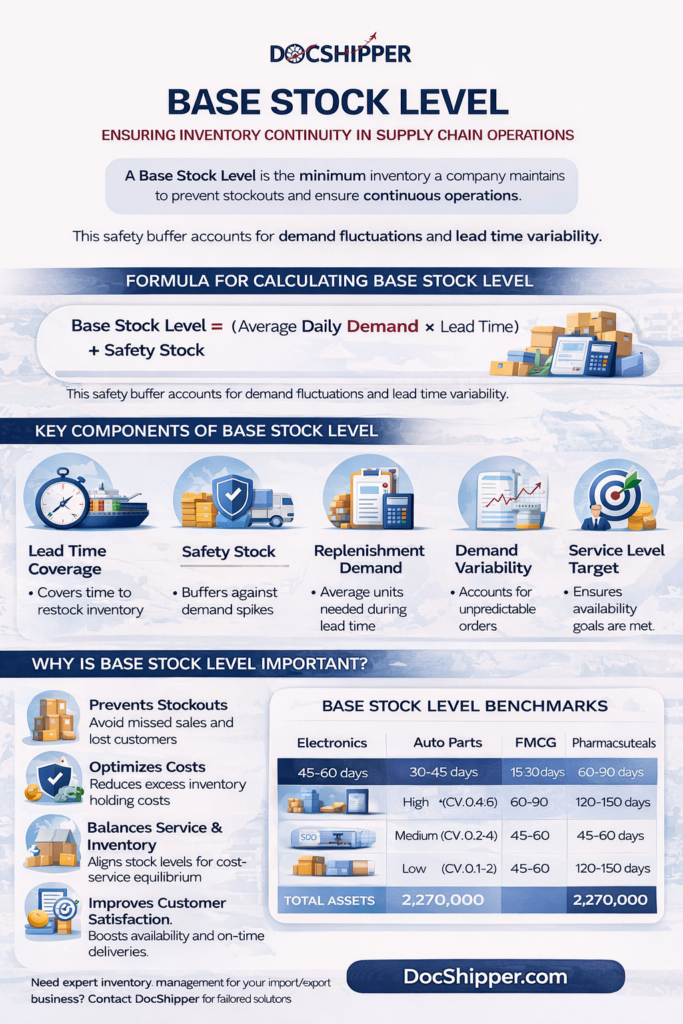
Base Stock Level is the minimum inventory quantity a company maintains to ensure continuous operations and meet customer demand without stockouts. This critical inventory parameter acts as a safety buffer, accounting for lead time variability and demand fluctuations in supply chain management.

Introduction

Many businesses struggle with the delicate balance between overstocking and stockouts. Setting an appropriate Base Stock Level addresses this challenge by establishing a strategic inventory threshold that protects against supply chain disruptions while minimizing carrying costs.

In international logistics and import/export operations, this concept becomes even more critical. Extended lead times, customs delays, and transportation uncertainties make proper inventory planning essential for business continuity.

  • Safety buffer: Protects against demand spikes and supply delays
  • Service level optimization: Ensures product availability for customers
  • Cost management: Balances holding costs with stockout risks
  • Lead time coverage: Accounts for replenishment cycle duration
  • Demand variability: Absorbs fluctuations in customer orders

In-Depth Analysis & Expert Insights

The Base Stock Level represents a fundamental inventory policy where stock is replenished to a predetermined level after each demand occurrence. This differs from reorder point systems by maintaining a constant target inventory position rather than triggering orders at specific thresholds.

Calculation methodology typically incorporates several variables: average demand during lead time, safety stock requirements, and service level targets. The formula generally follows: Base Stock Level = (Average Daily Demand × Lead Time) + Safety Stock.

The safety stock component deserves particular attention. It protects against two primary uncertainties: demand variability and supply lead time fluctuations. Statistical methods often use standard deviation calculations to determine appropriate safety stock levels based on desired service levels.

Regulatory compliance in international trade adds complexity. Certain products require minimum stock levels for customs bonded warehouses or regulatory inspections. The World Customs Organization provides guidelines on inventory requirements for various trade facilitation programs.

Dynamic adjustment is crucial for optimal performance. Seasonal demand patterns, promotional activities, and market trends necessitate regular review and modification of base stock levels. At DocShipper, we help clients implement automated systems that adjust these parameters based on real-time demand signals and supply chain conditions.

The cost-service trade-off remains central to base stock optimization. Higher levels improve service but increase holding costs, insurance, and obsolescence risks. Advanced inventory models use economic optimization to balance these competing objectives, considering factors like storage costs, stockout penalties, and capital opportunity costs.

Base Stock Level

Practical Examples & Data-Driven Scenarios

Understanding base stock levels requires examining real-world applications across different industries and scenarios. The following comparisons illustrate how various factors influence optimal inventory positioning.

Industry Average Lead Time Demand Variability Base Stock Coverage
Electronics 45-60 days High (CV: 0.4-0.6) 90-120 days
Automotive Parts 30-45 days Medium (CV: 0.2-0.4) 60-90 days
FMCG 15-30 days Low (CV: 0.1-0.2) 45-60 days
Pharmaceuticals 60-90 days Low (CV: 0.15-0.25) 120-150 days

Use Case: Electronics Importer Optimization

A European electronics distributor imports smartphones from Asia with a 50-day average lead time. Historical data shows average daily demand of 200 units with a standard deviation of 80 units. Targeting a 95% service level (Z-score: 1.65):

  • Lead time demand: 200 units/day × 50 days = 10,000 units
  • Safety stock calculation: 1.65 × 80 × √50 = 933 units
  • Base Stock Level: 10,000 + 933 = 10,933 units
  • Inventory investment: At €300/unit = €3,279,900
  • Annual holding cost: At 25% carrying cost = €819,975

This calculation demonstrates the financial implications of base stock decisions. DocShipper assists clients in optimizing these parameters by analyzing historical shipment data, supplier reliability metrics, and seasonal demand patterns to minimize total inventory costs while maintaining service commitments.

Key Performance Metrics

  • Inventory turnover: Base stock policies typically achieve 6-12 turns annually depending on lead time
  • Fill rate impact: Proper base stock levels improve fill rates from 85% to 95%+
  • Stockout reduction: Well-calibrated systems reduce stockout incidents by 60-80%
  • Working capital efficiency: Optimized levels reduce excess inventory by 20-30%
  • Customer satisfaction: Consistent availability increases customer retention by 15-25%

DocShipper Platform

Optimize Your Global Logistics with Cutting-Edge Solutions

Enhance efficiency, cut costs, and gain 24/7 visibility  over your entire supply chain.
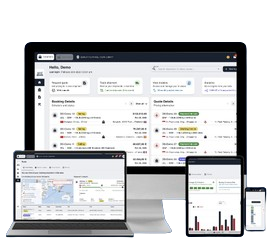
  • Cut your shipping costs and maximize your margins
  • Manage sourcing, freight, & customs on one platform
  • Get real-time tracking and analytics

Conclusion

Establishing optimal Base Stock Levels requires balancing service objectives with inventory costs while accounting for supply chain uncertainties. This strategic parameter directly impacts customer satisfaction, working capital efficiency, and operational resilience in international logistics.

Need expert guidance on inventory optimization for your import/export operations? Contact DocShipper for tailored supply chain solutions that align inventory policies with your business objectives.

📚 Quiz
Test Your Knowledge: Base Stock Level

FAQ | Base Stock Level: Definition, Calculation & Practical Examples

Base stock level maintains a constant target inventory position, replenishing after each demand. Reorder point triggers orders only when inventory drops to a specific threshold, allowing stock to fluctuate between maximum and minimum levels.

Ask us anything!

Need Help with Logistics or Sourcing ?

First, we secure the right products from the right suppliers at the right price by managing the sourcing process from start to finish. Then, we simplify your shipping experience - from pickup to final delivery - ensuring any product, anywhere, is delivered at highly competitive prices.

Live Chat

Get instant assistance from our team—just click and start chatting!

Live Chat Now
image

Fill the Form

Prefer email? Send us your inquiry, and we’ll get back to you as soon as possible.

Contact us
image

Call us

Reach out to us on WhatsApp for quick, convenient, and personal support.

Call us
image
