


In short ⚡
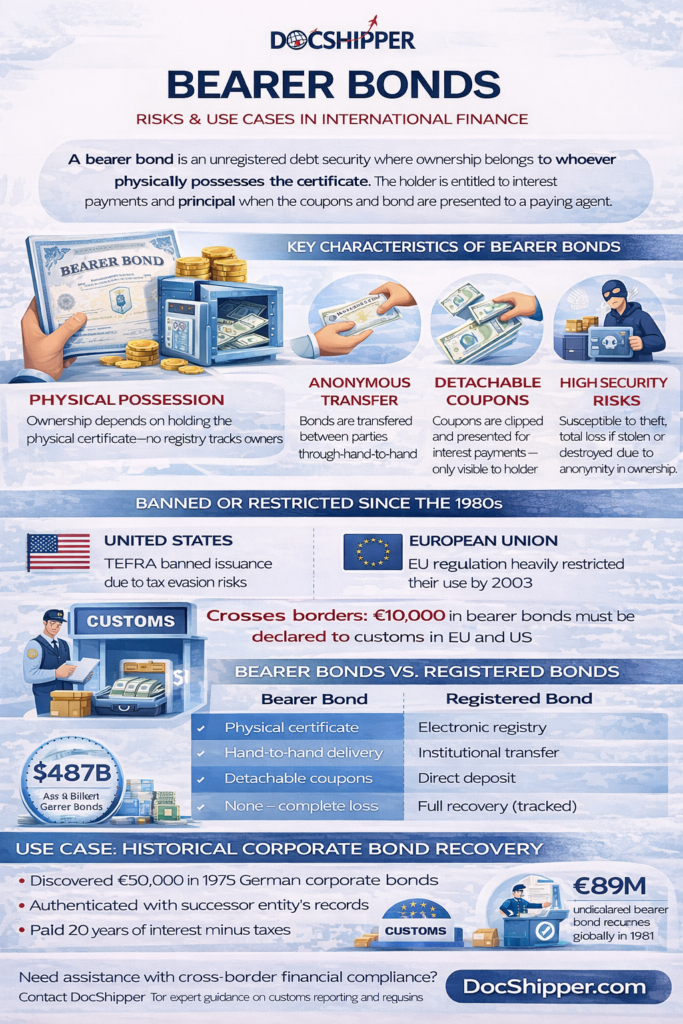
A bearer bond is an unregistered debt security where ownership belongs to whoever physically possesses the certificate. Unlike registered bonds, no records exist identifying the owner, making the physical document itself proof of ownership and entitlement to interest payments and principal redemption.
Introduction
Bearer bonds represent one of international finance’s most misunderstood instruments. Many importers and exporters confuse them with modern digital securities, unaware that these physical certificates carry unique risks and regulatory implications.
In cross-border trade finance, understanding bearer bonds matters because they occasionally appear in legacy payment structures, collateral arrangements, or historical debt instruments requiring customs declaration.
Key characteristics include:
- Physical possession equals ownership – no central registry tracks holders
- Anonymous transfer – bonds change hands without documentation
- Coupon-based interest – physical coupons must be detached and presented for payment
- High theft and loss risk – destruction or theft means total capital loss
- Declining issuance – most jurisdictions have banned or restricted new issues since the 1980s
Legal Framework & Risk Mechanisms
Bearer bonds operate under fundamentally different legal principles than registered securities. The negotiable instrument doctrine treats these bonds like cash – whoever holds the certificate owns the debt claim. This creates immediate complications for anti-money laundering compliance and tax enforcement.
The Tax Equity and Fiscal Responsibility Act (TEFRA) of 1982 effectively ended new bearer bond issuance in the United States. The law imposed severe tax penalties on issuers and removed tax deductions for interest payments on bearer instruments. The European Union followed with Directive 2003/48/EC requiring information exchange on savings income, making bearer bonds impractical for legitimate purposes.
From a customs perspective, bearer bonds exceeding €10,000 must be declared when crossing EU borders under Regulation (EU) 2018/1672 on controls of cash entering or leaving the Union. Failure to declare can result in confiscation and criminal prosecution. The U.S. requires FinCEN Form 105 for similar movements exceeding $10,000.
The settlement risk differs dramatically from modern securities. While registered bonds settle through electronic book-entry systems, bearer bonds require physical delivery. This creates counterparty risk during transit, requires secure custody arrangements, and complicates cross-border transactions.
At DocShipper, we advise clients transporting financial instruments to obtain proper customs broker certification and legal documentation proving legitimate ownership before attempting international movement. Undeclared bearer bonds trigger immediate red flags in customs inspections.
For further regulatory context, consult the European Central Bank’s securities regulations or the U.S. Securities and Exchange Commission guidelines.
Practical Cases & Market Data
Understanding bearer bonds requires examining real-world scenarios and historical data. Below we compare bearer bonds against modern registered securities to illustrate practical differences:
| Characteristic | Bearer Bond | Registered Bond |
|---|---|---|
| Ownership Record | Physical certificate only | Electronic registry maintained by issuer |
| Transfer Method | Hand-to-hand delivery | Book-entry transfer through clearinghouse |
| Interest Payment | Detach physical coupon, present to paying agent | Automatic deposit to registered account |
| Loss/Theft Protection | None – total loss of investment | Full recovery through registry records |
| Tax Reporting | No automatic reporting (anonymous) | Automatic 1099/1042-S reporting |
Use Case: Historical Corporate Bond Recovery
A European importer discovered €50,000 in bearer bonds issued by a German corporation in 1975 among inherited assets. The bonds matured in 2005 but were never redeemed. Recovery required:
- Physical authentication by the original issuer’s successor entity
- Legal proof of legitimate acquisition (inheritance documentation)
- Payment of 20 years of accumulated interest minus withholding taxes
- Currency conversion from Deutsche Marks to Euros at historical rates
- Total recovery value: €73,400 after authentication costs of €2,100
Market Data Point: According to Bank for International Settlements data, bearer bond issuance peaked at $487 billion globally in 1981. By 2020, outstanding bearer bonds represented less than 0.3% of total global bond markets, primarily consisting of pre-1982 issues approaching maturity.
Customs Seizure Statistics: EU customs authorities reported 1,247 undeclared bearer bond seizures in 2022, totaling €89 million in face value. The average penalty assessed was 40% of declared value plus criminal referral in 23% of cases.
Conclusion
Bearer bonds represent a declining but legally complex category of financial instruments requiring specialized handling in international commerce. Their anonymous nature creates regulatory obstacles that make them impractical for modern trade finance despite occasional appearance in legacy transactions.
Need assistance with customs compliance for financial instruments or complex documentation requirements? Contact DocShipper for expert guidance on cross-border regulatory matters.
📚 Quiz
Test Your Knowledge: Bearer Bond
Q1 — What determines ownership of a bearer bond?
Q2 — What happens if a bearer bond is stolen or destroyed?
Q3 — A trader needs to cross an EU border carrying bearer bonds worth €15,000. Which action is legally required?
🎯 Your Result
📞 Free Quote in 24hFAQ | Bearer Bond: Definition, Calculation & Concrete Examples
Yes, existing bearer bonds remain legal to own in most jurisdictions, but new issuance has been banned or severely restricted since the 1980s due to tax evasion and money laundering concerns.
Present the physical certificate to the issuer's paying agent along with proof of legitimate acquisition. The agent verifies authenticity before releasing principal and final interest payment.
Bearer bonds offer no recovery mechanism. Theft or loss results in complete forfeiture of the investment, as ownership transfers automatically to whoever possesses the certificate.
Yes, but you must declare them to customs authorities if their value exceeds regulatory thresholds (€10,000 in EU, $10,000 in US). Undeclared transport constitutes a criminal offense.
Tax treatment depends on jurisdiction and whether the bond predates modern reporting requirements. Holders are legally obligated to self-report income, though enforcement remains challenging.
Eurobonds are international bonds issued outside the borrower's home country. While historically many eurobonds were bearer instruments, modern eurobonds use registered form with electronic settlement.
Historically yes, due to anonymity premium and higher risk. Modern secondary market pricing reflects liquidity discounts of 15-30% compared to equivalent registered securities.
Most jurisdictions have abolished bearer shares for corporations. The EU's Fourth Anti-Money Laundering Directive requires all member states to maintain beneficial ownership registers, effectively ending bearer share utility.
Contact the original issuer or successor entity with the certificate's serial number. Professional authentication services can verify paper stock, printing methods, and security features for a fee.
Specialized vault services offer insurance coverage, but premiums typically run 0.5-1.5% of face value annually due to theft and loss risks inherent to bearer instruments.
Rarely. Modern letters of credit, bank guarantees, and documentary collections have replaced bearer bonds in international trade due to superior security and regulatory compliance.
Acceptable proof includes purchase receipts, inheritance documents, gift declarations with donor attestation, or chain-of-custody records from reputable financial institutions. Physical possession alone may not satisfy anti-money laundering requirements.
Need Help with
Logistics or Sourcing ?
First, we secure the right products from the right suppliers at the right price by managing the sourcing process from start to finish. Then, we simplify your shipping experience - from pickup to final delivery - ensuring any product, anywhere, is delivered at highly competitive prices.


Fill the Form
Prefer email? Send us your inquiry, and we’ll get back to you as soon as possible.
Contact us




