In short ⚡
Berth Terms are contractual clauses in maritime shipping that define the allocation of costs and responsibilities for loading, unloading, and time spent at the berth between the shipowner and charterer. They determine who bears expenses for stevedoring operations and demurrage charges.Introduction
Confusion over berth terms frequently leads to unexpected costs and disputes in international shipping. A simple misunderstanding about who pays for loading operations can result in thousands of dollars in unbudgeted expenses.
These contractual specifications form the financial backbone of charter party agreements. They directly impact freight rates, operational budgets, and the overall profitability of maritime transport operations.
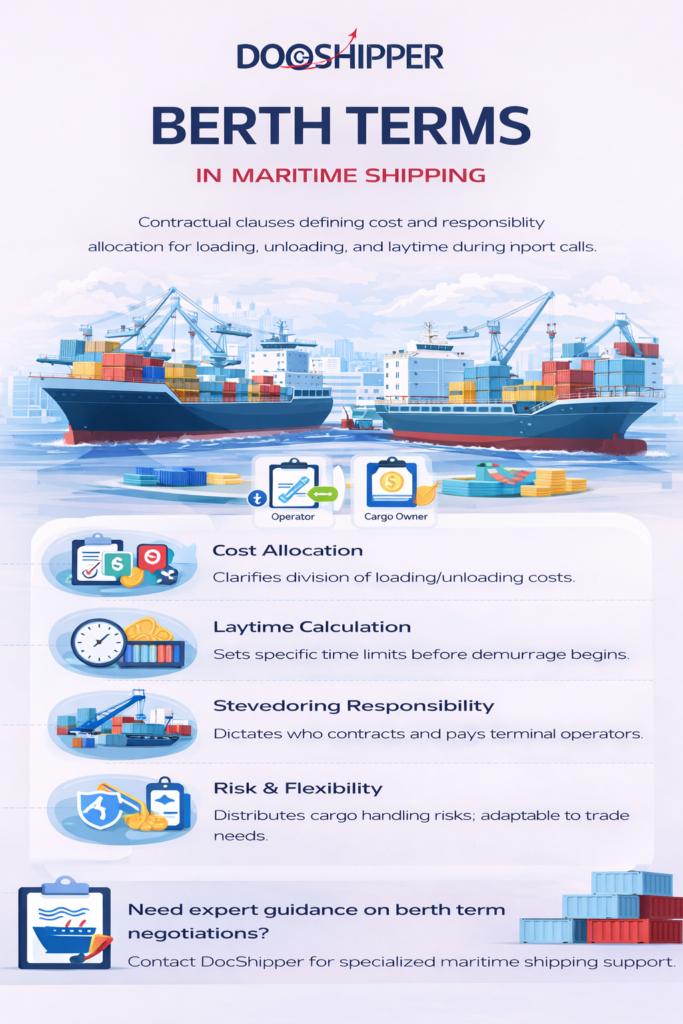
Key characteristics of berth terms include:
- Cost allocation clarity between vessel operator and cargo owner
- Laytime calculations that determine when demurrage begins
- Stevedoring responsibility for loading and discharge operations
- Risk distribution during cargo handling at the terminal
- Commercial flexibility allowing negotiation based on trade routes and cargo types
In-Depth Analysis & Expertise
The maritime industry recognizes several standardized berth term configurations. Understanding these variants prevents costly misinterpretations during contract negotiations.
Gross Terms (also called “Liner Terms” or “Berth Terms”) place all loading and discharging costs on the shipowner. The charterer pays a higher freight rate that includes stevedoring, but gains predictable budgeting. This arrangement dominates containerized shipping.
Free In and Out (FIO) transfers all cargo handling expenses to the charterer. The vessel owner provides only the ship and crew. Freight rates appear lower, but the charterer must arrange and finance all terminal operations. This structure prevails in bulk commodity trades.
Free In, Liner Out (FILO) creates a hybrid where the charterer pays for loading while the shipowner covers discharge costs. This asymmetric distribution often reflects port infrastructure differences or negotiating leverage between parties.
Free Out (FO) assigns discharge costs exclusively to the charterer while the shipowner handles loading expenses. Regional trade customs and cargo characteristics typically drive this selection. According to International Maritime Organization guidelines, clear documentation of these terms prevents jurisdictional disputes.
At DocShipper, we systematically review berth term clauses in charter parties to ensure our clients understand their financial obligations before vessel arrival, eliminating surprise charges at destination ports.
Practical Examples & Data
Real-world application demonstrates how berth terms directly impact shipping economics. Consider these comparative scenarios:
| Berth Term | Loading Cost | Discharge Cost | Freight Rate Impact | Typical Application |
|---|---|---|---|---|
| Gross Terms | Shipowner | Shipowner | +15-25% | Container shipping |
| FIO | Charterer | Charterer | Base rate | Bulk commodities |
| FILO | Charterer | Shipowner | +8-12% | Project cargo |
| LIFO | Shipowner | Charterer | +10-15% | Specialized trades |
Case Study: A European importer chartered a 50,000 DWT bulk carrier under FIO terms to transport grain from Argentina. Stevedoring costs at Buenos Aires totaled $18,500 for loading (370 hours at $50/hour). Discharge at Rotterdam cost €22,000 ($23,800). Total handling expenses reached $42,300.
Had the same shipment operated under Gross Terms, the freight rate would have increased from $28/ton to $33/ton (base $1,400,000 vs. $1,650,000), but the charterer would have paid zero separate handling fees. The $250,000 freight differential exceeded actual stevedoring costs by $207,700, demonstrating why experienced shippers negotiate FIO terms for bulk cargoes.
Laytime implications vary significantly. Under Gross Terms, laytime typically begins when the vessel is “ready to load” at the berth. Under FIO terms, laytime may commence earlier when the vessel arrives at the port limits, potentially adding 12-24 hours of demurrage exposure for the charterer.
Regional variations affect term selection. Asian ports often favor FIO structures due to competitive stevedoring markets, while European terminals frequently operate under Liner Terms with bundled services. North American grain exports predominantly use FIO, whereas breakbulk shipments from the same ports may employ FILO arrangements.
Industry data shows that berth term disputes account for approximately 18% of maritime arbitration cases globally, with average claim values exceeding $125,000 per incident. Clear contractual language reduces this litigation risk substantially.
Conclusion
Berth terms fundamentally shape the economics and risk profile of maritime shipping contracts. Proper selection and clear documentation prevent costly disputes and enable accurate budgeting throughout the supply chain.
Need expert guidance on berth term negotiations for your shipments? Contact DocShipper for specialized support in optimizing your maritime logistics contracts.
DocShipper Platform
One platform. Your entire supply chain
Sourcing, freight, customs & documents — all centralised, all visible, 24/7.
📚 Quiz
Test Your Knowledge: Berth Terms
Q1 — What do Berth Terms primarily define in a maritime shipping contract?
Q2 — Under FIO (Free In and Out) terms, who bears all stevedoring costs at both loading and discharge ports?
Q3 — A European importer is shipping containerized goods on a regular liner service. Which berth term arrangement is most likely to apply?
🎯 Your Result
📞 Free Quote in 24hFAQ | Berth Terms: Definition, Calculation & Practical Examples
Berth terms govern cargo handling costs at the port, while delivery terms (Incoterms) define the broader transfer of risk and responsibility from seller to buyer throughout the entire transport chain.
The charterer bears all stevedoring expenses under Free In and Out (FIO) arrangements, covering both loading at origin and discharge at destination ports.
Gross Terms include handling costs in the freight rate (15-25% premium), while FIO terms offer lower base rates with separate stevedoring charges paid directly by the charterer.
Modifications require mutual written agreement from both parties. Post-signature changes are uncommon and typically only occur when unforeseen circumstances fundamentally alter operational conditions.
Courts generally apply regional trade customs or precedent from similar contracts. This ambiguity often leads to disputes, making explicit term specification essential.
No. Containerized cargo predominantly uses Gross Terms, bulk commodities favor FIO, and specialized cargoes often employ hybrid arrangements like FILO or LIFO.
Under Gross Terms, laytime begins when the vessel reaches the berth. Under FIO terms, it may start earlier at port limits, potentially adding 12-24 hours of demurrage exposure.
Statement of Facts, time sheets, stevedore invoices, and port receipts provide evidence of when operations occurred and who incurred specific costs.
Yes, though application differs. Voyage charters explicitly state terms per shipment, while time charters may establish standing arrangements for the charter period.
Force majeure clauses typically suspend laytime during strikes, but cost responsibility depends on the specific berth terms. Under FIO, the charterer still arranges alternative stevedoring if possible.
Absolutely. FILO (Free In, Liner Out) and LIFO (Liner In, Free Out) create asymmetric cost distributions, common when port capabilities or commercial leverage differ between origin and destination.
The Baltic and International Maritime Council publishes standard charter party forms with clearly defined berth term clauses, reducing ambiguity and facilitating international trade consistency.
Need Help with
Logistics or Sourcing ?
First, we secure the right products from the right suppliers at the right price by managing the sourcing process from start to finish. Then, we simplify your shipping experience - from pickup to final delivery - ensuring any product, anywhere, is delivered at highly competitive prices.


Fill the Form
Prefer email? Send us your inquiry, and we’ll get back to you as soon as possible.
Contact us