


In short ⚡
A Bilateral Trade Agreement (BTA) is a commercial treaty between two countries designed to reduce or eliminate trade barriers such as tariffs, quotas, and customs restrictions. These agreements facilitate market access, promote economic cooperation, and establish preferential trading conditions that benefit exporters and importers in both signatory nations.
Introduction
Many businesses struggle to understand whether their products qualify for preferential tariffs under bilateral agreements. This confusion often leads to overpayment of customs duties or missed opportunities for competitive pricing in foreign markets.
Bilateral Trade Agreements represent critical instruments in international logistics strategy. They directly impact landed costs, customs clearance speed, and market competitiveness for companies engaged in cross-border trade.
Key characteristics of BTAs include:
- Tariff reduction or elimination on specified product categories
- Rules of origin requirements determining product eligibility
- Customs procedure simplification through harmonized documentation
- Dispute resolution mechanisms for trade conflicts
- Mutual recognition standards for product certifications and quality controls
Mechanisms and Legal Framework
Bilateral Trade Agreements operate through preferential tariff schedules that specify reduced duty rates for qualifying goods. Each agreement contains annexes listing products by HS code with corresponding tariff concessions.
The rules of origin constitute the most technical aspect of BTAs. These regulations determine whether a product qualifies as “originating” from a partner country. Criteria typically include substantial transformation thresholds, value-added percentages, or specific manufacturing processes performed within the treaty zone.
Certificate of Origin (CO) documentation serves as proof of eligibility. Exporters must obtain these certificates from authorized chambers of commerce or customs authorities. Form A certificates apply to GSP schemes, while bilateral agreements often use specific formats like EUR.1 or manufacturer declarations.
The cumulation principle allows materials from multiple partner countries to count toward origin requirements. Bilateral cumulation permits inputs from treaty partners, while diagonal cumulation extends this to regional agreement networks.
Legal enforcement falls under international trade law frameworks. The World Trade Organization (WTO) oversees compliance through its dispute settlement body, though bilateral agreements may establish independent arbitration panels. Businesses can consult official resources like the WTO Regional Trade Agreements database for comprehensive treaty texts and schedules.
At DocShipper, we systematically verify origin certificate requirements and eligibility criteria before shipment to prevent costly customs delays or penalty assessments at destination ports.
Concrete Examples and Data
Examining real-world applications demonstrates how Bilateral Trade Agreements impact logistics costs and competitive positioning.
Comparative Tariff Analysis
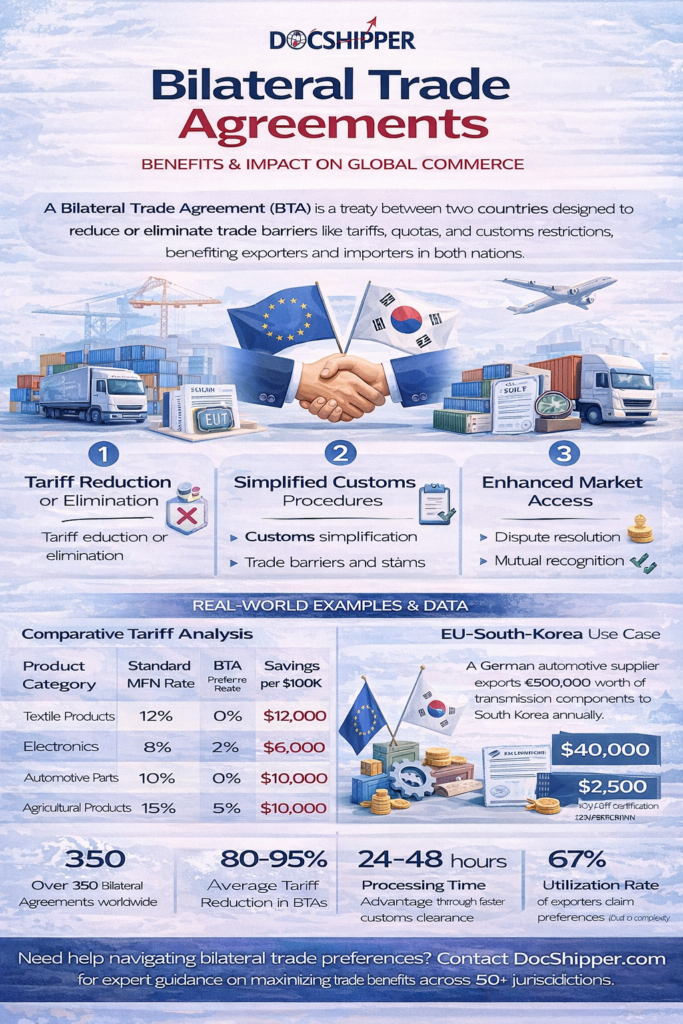
| Product Category | Standard MFN Rate | BTA Preferential Rate | Savings per $100K |
|---|---|---|---|
| Textile Products (HS 61) | 12% | 0% | $12,000 |
| Electronics (HS 85) | 8% | 2% | $6,000 |
| Automotive Parts (HS 87) | 10% | 0% | $10,000 |
| Agricultural Products (HS 07) | 15% | 5% | $10,000 |
Use Case: EU-South Korea FTA
A German automotive supplier exports €500,000 worth of transmission components to South Korea annually. Before the EU-Korea FTA (2011), the standard tariff was 8%, costing €40,000 yearly.
Under the bilateral agreement:
- Tariff elimination reduced duty to 0% over a five-year phase-in period
- Annual savings reached €40,000 at full implementation
- Compliance cost for origin certification averaged €2,500 annually
- Net benefit totaled €37,500 per year
- Market share increase of 18% due to improved price competitiveness
Key Data Points
- Global BTA coverage: Over 350 bilateral agreements currently in force worldwide
- Average tariff reduction: BTAs typically eliminate 80-95% of tariff lines
- Processing time advantage: Preferential treatment reduces customs clearance by 24-48 hours
- ROI threshold: Origin certification costs become profitable when duty savings exceed 0.5% of shipment value
- Utilization rate: Only 67% of eligible exporters actively claim BTA preferences due to documentation complexity
Conclusion
Bilateral Trade Agreements represent strategic tools that directly reduce logistics costs and enhance market access. Proper utilization requires thorough understanding of origin rules and documentation requirements.
Need assistance navigating bilateral trade preferences for your shipments? Contact DocShipper for expert guidance on tariff optimization and customs compliance.
📚 Quiz
Test Your Knowledge: Bilateral Trade Agreement
Q1 — What is the primary purpose of a Bilateral Trade Agreement (BTA)?
Q2 — A company wants to claim preferential tariff rates under a BTA for goods it simply repackages in the partner country. Will these goods qualify?
Q3 — A German exporter ships automotive parts to South Korea under the EU-Korea FTA. Which document must they obtain to benefit from the 0% preferential tariff rate?
🎯 Your Result
📞 Free Quote in 24hFAQ | Bilateral Trade Agreement: Definition, Benefits & Concrete Examples
Bilateral agreements involve two countries, while multilateral agreements include three or more nations. Bilateral treaties offer more tailored terms but provide narrower geographic coverage than regional multilateral frameworks like NAFTA or the EU.
Check the agreement's tariff schedule using your product's HS code. Then verify your goods meet the rules of origin criteria, which typically require substantial transformation or minimum local content percentages in the exporting country.
Most bilateral agreements require origin certification for preferential treatment. However, some modern treaties allow approved exporters to self-certify through invoice declarations once they obtain authorized exporter status from customs authorities.
Generally no. Re-exported goods rarely qualify unless they undergo substantial processing that changes their tariff classification. Simple repackaging or minor assembly typically does not meet origin requirements under bilateral trade agreements.
Incorrect claims may result in retroactive duty assessment, penalties ranging from 10-40% of duty value, and potential loss of trusted trader status. Customs authorities can audit shipments up to three years after clearance.
Implementation periods vary by product sensitivity. Non-sensitive goods often receive immediate duty elimination, while sensitive sectors like agriculture or textiles may phase out over 5-15 years through staged reductions.
Modern comprehensive BTAs increasingly include service trade provisions covering sectors like telecommunications, financial services, and professional services. However, traditional agreements focus primarily on merchandise trade and tariff reductions.
Absolutely. While documentation requirements exist, the duty savings often provide proportionally greater benefits to smaller exporters. Many countries offer simplified certification procedures for low-value shipments under bilateral agreements.
Diagonal cumulation allows materials from multiple countries within a network of interconnected bilateral agreements to count toward origin requirements. This facilitates complex supply chains spanning several treaty partners.
Post-Brexit, the UK negotiated continuity agreements replicating EU bilateral treaties. However, rules of origin now require UK-specific content calculations, and separate certificates of origin are necessary for UK exports versus EU member state exports.
Yes, electronic origin systems are expanding. Platforms like the EU's REX system allow registered exporters to self-certify digitally. Blockchain-based solutions are emerging to streamline certificate verification and reduce fraud risks.
Bilateral Investment Treaties (BITs) complement trade agreements by protecting foreign direct investment through provisions on expropriation, fair treatment, and dispute resolution. They create legal certainty for companies establishing operations in partner countries.
Need Help with
Logistics or Sourcing ?
First, we secure the right products from the right suppliers at the right price by managing the sourcing process from start to finish. Then, we simplify your shipping experience - from pickup to final delivery - ensuring any product, anywhere, is delivered at highly competitive prices.


Fill the Form
Prefer email? Send us your inquiry, and we’ll get back to you as soon as possible.
Contact us




