In short ⚡
A Bill of Materials (BOM) structure is a comprehensive hierarchical list detailing all components, raw materials, assemblies, and quantities required to manufacture a finished product. It serves as the master blueprint connecting engineering design, procurement, production planning, and inventory management throughout the supply chain.
Introduction
Confusion between different BOM formats causes delays, production errors, and costly procurement mistakes in international trade. A single miscommunication between engineering and manufacturing can halt an entire production line.
Understanding BOM structure becomes critical when coordinating suppliers across multiple countries, managing customs documentation, and ensuring quality control throughout complex supply chains.
- Hierarchical organization showing parent-child relationships between assemblies and components
- Multi-level structure enabling detailed cost tracking and inventory planning
- Standardized format ensuring communication accuracy between departments and partners
- Version control system managing engineering changes and product iterations
- Integration capability linking ERP, PLM, and MRP systems across the organization
BOM Structure Types & Technical Framework
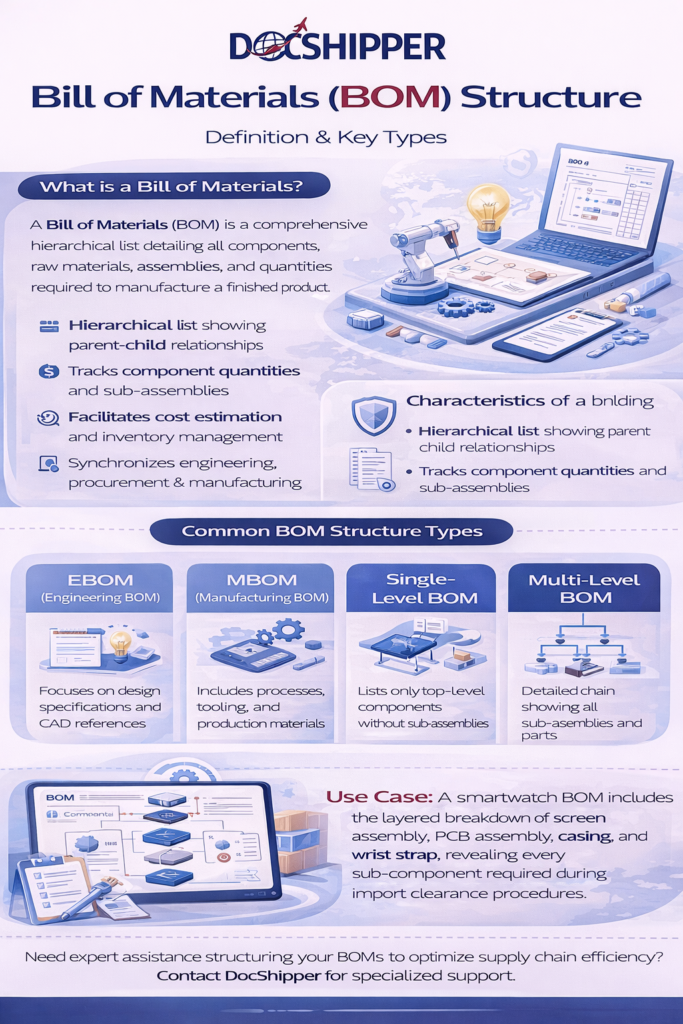
The Engineering BOM (EBOM) originates from product design teams and reflects the theoretical product structure. It contains every component as designed, including alternative parts, specifications, and CAD references. This version prioritizes design intent over manufacturing feasibility.
The Manufacturing BOM (MBOM) transforms the EBOM into a production-ready document. It includes packaging materials, process steps, tooling requirements, and work instructions. Manufacturing adds items like adhesives, labels, and consumables absent from engineering drawings.
A single-level BOM displays only immediate children of a parent assembly without showing sub-assembly details. This simplified view helps purchasing teams quickly identify direct material requirements for procurement planning.
The multi-level BOM reveals the complete product hierarchy through indented structures showing every component relationship. Each indentation level represents assembly depth, enabling precise cost roll-ups and material requirement calculations across the entire product tree.
According to the ISO 16792 standard, BOM data exchange formats must ensure interoperability between CAD systems and enterprise software. This standardization prevents data loss during international collaborations.
At DocShipper, we systematically verify BOM accuracy against commercial invoices and packing lists to prevent customs classification errors that could delay shipments or trigger penalty assessments during import clearance procedures.
Practical Applications & Industry Data
Consider an automotive manufacturer producing electric vehicle battery packs. The BOM structure contains over 2,500 line items across seven assembly levels, from individual lithium cells to complete battery modules.
| BOM Type | Primary User | Key Content | Update Frequency |
|---|---|---|---|
| EBOM | Design Engineering | CAD references, specifications, tolerances | Per design revision |
| MBOM | Production Planning | Process steps, tooling, consumables | Per process change |
| Service BOM | After-Sales Support | Spare parts, maintenance items | Per product lifecycle |
| Sales BOM | Commercial Teams | Optional features, configurations | Per pricing update |
Use Case: A medical device company importing components from five countries discovered 18% cost reduction opportunities by restructuring their BOM. They identified duplicate part numbers, consolidated suppliers, and eliminated obsolete components still listed in legacy systems.
Industry research shows companies with structured BOM governance reduce procurement lead times by 23% and decrease inventory carrying costs by 31% compared to organizations using uncontrolled spreadsheet-based systems.
In electronics manufacturing, a properly structured BOM enables automated component placement programming for pick-and-place machines. This integration reduces setup time from hours to minutes when switching between product variants on the same production line.
Customs authorities increasingly require detailed BOMs for valuation purposes, particularly for complex machinery imports. Incomplete component listings can trigger extended inspections, delaying clearance by weeks while authorities verify accurate duty assessments.
DocShipper’s procurement teams use validated BOM structures to conduct supplier audits, ensuring component specifications match purchase orders before production begins, preventing quality issues that could compromise entire shipments.
Conclusion
Mastering BOM structure fundamentals ensures seamless coordination between design, manufacturing, and logistics teams while preventing costly errors in international supply chains. Proper implementation transforms this technical document into a strategic asset driving operational efficiency.
Need expert guidance on BOM management for your import operations? Contact DocShipper for specialized support tailored to your supply chain requirements.
DocShipper Platform
One platform. Your entire supply chain
Sourcing, freight, customs & documents — all centralised, all visible, 24/7.
📚 Quiz
Test Your Knowledge: Bill of Materials (BOM) Structure
Q1 — What is the primary purpose of a Bill of Materials (BOM) structure?
Q2 — What is the key difference between an Engineering BOM (EBOM) and a Manufacturing BOM (MBOM)?
Q3 — A customs authority requests a detailed BOM for a complex machinery import. The importer submits only a single-level BOM listing the top-level assembly. What is the most likely outcome?
🎯 Your Result
📞 Free Quote in 24hFAQ | Bill of Materials (BOM) Structure: Definition, Types & Practical Examples
EBOM reflects design intent with CAD references and theoretical structure, while MBOM adds manufacturing processes, tooling, consumables, and assembly sequences required for actual production.
Complexity varies by product. Consumer electronics typically have 3-5 levels, automotive assemblies reach 7-10 levels, while aerospace components may exceed 15 hierarchical levels.
Yes, manufacturing BOMs often include labor operations, outsourced services, and process steps with time allocations, enabling complete production cost calculations beyond material expenses.
Detailed component listings help customs authorities determine correct HS codes and duty rates. Incomplete BOMs may trigger reclassification, additional duties, or shipment holds.
Enterprise solutions include SAP, Oracle, and Siemens Teamcenter. Mid-market options include Arena PLM, Propel, and Odoo. Selection depends on integration requirements and company size.
Update BOMs immediately when engineering changes occur, suppliers change, or components become obsolete. Quarterly reviews ensure accuracy even without design modifications.
A phantom BOM represents temporary sub-assemblies consumed immediately during production without inventory storage. These transient items simplify material planning while maintaining assembly logic.
Yes, products often have regional variants, customer-specific configurations, or revision histories requiring separate BOM versions with controlled change management and effectivity dates.
Multi-level BOMs enable MRP systems to calculate gross and net requirements across all assembly levels, optimizing reorder points and safety stock for each component.
Effectivity dates define when specific BOM versions become active or obsolete, managing engineering changes without disrupting ongoing production or existing inventory commitments.
BOMs enable cost roll-ups from raw materials through finished goods, allocating material, labor, and overhead expenses across assembly levels for accurate product costing.
Modular BOMs organize components into interchangeable modules or options, enabling mass customization where customers select features without creating unique BOM versions for every configuration.
Need Help with
Logistics or Sourcing ?
First, we secure the right products from the right suppliers at the right price by managing the sourcing process from start to finish. Then, we simplify your shipping experience - from pickup to final delivery - ensuring any product, anywhere, is delivered at highly competitive prices.


Fill the Form
Prefer email? Send us your inquiry, and we’ll get back to you as soon as possible.
Contact us