In short ⚡
Blocked trains refer to freight trains that are prevented from continuing their scheduled journey due to operational, infrastructural, or regulatory obstacles. This disruption causes significant delays in international supply chains, affecting cargo delivery timelines and generating additional costs for shippers and logistics providers.Introduction
Imagine your container sitting on a train for days, unable to move forward. This scenario happens more frequently than most importers realize. Blocked trains represent one of the most frustrating yet preventable challenges in rail freight logistics.
In international trade, especially on major corridors like China-Europe rail routes or North American cross-border shipments, train blockages can derail entire supply chain schedules. Understanding why trains get blocked helps businesses anticipate delays and implement contingency strategies.
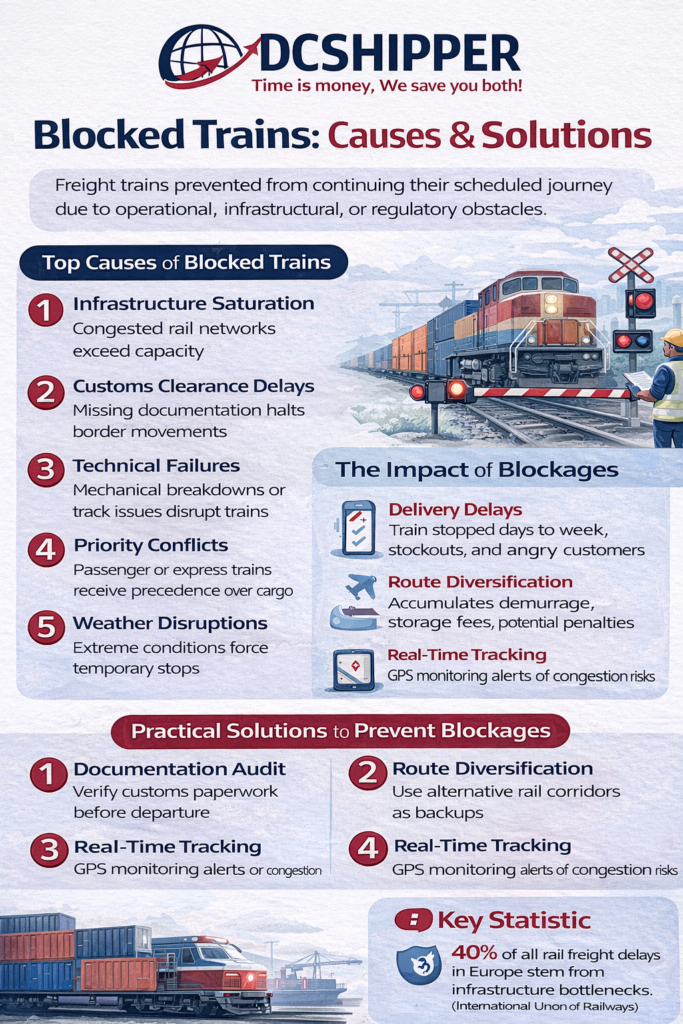
- Infrastructure saturation: Congested rail networks exceed operational capacity
- Customs clearance delays: Documentation issues halt cross-border movements
- Technical failures: Mechanical problems or track maintenance create bottlenecks
- Priority conflicts: Passenger trains or express freight receive precedence
- Weather disruptions: Extreme conditions force temporary suspensions
Causes and Operational Mechanisms
Train blockages stem from multiple interconnected factors within complex rail networks. The most common cause involves capacity constraints at border crossings and major hubs. When more trains attempt to pass through a junction than infrastructure can handle, queues form rapidly.
Customs and regulatory holds represent another critical factor. Cross-border freight must clear multiple jurisdictions, each with distinct documentation requirements. A single missing certificate or incorrect HS code can immobilize an entire train until authorities resolve the issue.
Operational priority systems also contribute significantly. Rail networks typically prioritize passenger services and high-value express freight over standard cargo trains. During peak periods, this hierarchy pushes regular freight trains into extended waiting positions.
Infrastructure maintenance creates predictable but unavoidable blockages. Track repairs, signal upgrades, and bridge inspections require temporary closures. While operators schedule these activities, unexpected emergency maintenance can block routes without warning.
Intermodal transfer delays compound the problem at multimodal terminals. When containers cannot be unloaded promptly due to warehouse congestion or equipment shortages, trains remain immobilized at platforms, blocking subsequent arrivals.
According to the International Union of Railways, infrastructure bottlenecks account for approximately 40% of all rail freight delays in Europe. At DocShipper, we monitor real-time rail network conditions to reroute shipments proactively when blockage risks emerge on primary corridors.
Impact Assessment & Practical Solutions
The financial and operational consequences of blocked trains extend throughout the supply chain. Understanding these impacts helps businesses develop effective mitigation strategies.
Comparative Impact Analysis
| Impact Category | Short Blockage (1-3 days) | Extended Blockage (4-7 days) |
|---|---|---|
| Delivery Delay | Minor schedule adjustment | Critical deadline miss, potential penalties |
| Additional Costs | €200-500 per container | €800-2,000 per container |
| Inventory Impact | Manageable with buffer stock | Production disruption, stockouts |
| Customer Relations | Advance notice maintains trust | Damaged reputation, lost accounts |
| Alternative Options | Wait for clearance | Emergency air freight or truck rerouting |
Practical Use Case: China-Europe Rail Corridor
A textile importer shipped 40 containers via the New Silk Road route from Chengdu to Duisburg. The train encountered a blockage at the Poland-Belarus border due to customs documentation discrepancies affecting three containers.
Scenario details:
- Original transit time: 16 days
- Blockage duration: 5 days at border
- Additional demurrage: €1,200 per container
- Total extra cost: €48,000
- Customer penalty for late delivery: €25,000
Resolution approach: DocShipper’s customs team remotely corrected documentation errors within 36 hours, coordinated with border authorities for priority clearance, and negotiated partial demurrage waivers, reducing total additional costs by 60%.
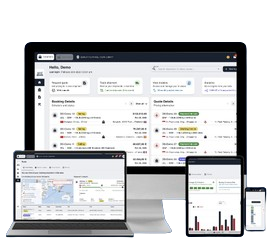
DocShipper Platform
One platform. Your entire supply chain
Sourcing, freight, customs & documents — all centralised, all visible, 24/7.
Prevention Strategies
Pre-shipment documentation audit: Verify all customs paperwork completeness before departure. This simple step eliminates 70% of border blockage causes.
Route diversification: Maintain alternative rail corridors in contingency plans. Southern routes through Turkey or Northern routes via Russia offer backup options when primary paths experience congestion.
Real-time tracking integration: Modern GPS and rail network monitoring systems provide 4-6 hour advance warning of potential blockages, enabling proactive communication with clients.
Flexible scheduling buffers: Build 3-5 day cushions into delivery timelines for rail shipments on routes with historical blockage patterns.
Insurance coverage: Specialized rail freight delay insurance mitigates financial exposure from extended blockages, typically costing 0.3-0.5% of cargo value.
Conclusion
Blocked trains represent a controllable risk when approached with proper planning and expert support. Proactive documentation management and route monitoring minimize disruption probability significantly.
Need assistance navigating rail freight challenges? Contact DocShipper for comprehensive logistics solutions that keep your cargo moving.
📚 Quiz
Test Your Knowledge: Blocked Trains
Q1 — What is the correct definition of a "blocked train" in freight logistics?
Q2 — A shipper assumes that standard cargo insurance will cover all financial losses caused by a blocked train. Is this correct?
Q3 — A textile importer's train is blocked at the Poland-Belarus border for 5 days due to documentation errors on 3 containers. Which action is most effective to resolve the situation quickly?
🎯 Your Result
📞 Free Quote in 24hFAQ | Blocked Trains: Definition, Causes & Practical Solutions
Most blockages resolve within 24-72 hours. However, complex customs issues or infrastructure failures can extend delays to 5-7 days in worst-case scenarios.
Yes, modern freight forwarders provide GPS tracking and rail network status updates. DocShipper offers real-time monitoring with proactive delay notifications to clients.
Cost responsibility depends on blockage cause. Infrastructure issues typically fall on carriers, while documentation errors may incur shipper charges. Insurance and contract terms determine final liability.
Yes. Border crossings between different gauge systems (China-Kazakhstan, Poland-Belarus) experience higher blockage rates. High-traffic corridors like Rotterdam-Duisburg also face regular congestion.
Blocked trains are completely immobilized and cannot proceed, while delayed trains continue moving at reduced speeds. Blockages require active intervention; delays often resolve naturally.
Technically possible but logistically complex and expensive. Containers must be unloaded, transferred to trucks, and rebooked. This option suits only critical time-sensitive cargo.
Frequently. Most rail networks prioritize passenger services, forcing freight trains into sidings during peak commuter hours or when express trains pass.
Essential documents include commercial invoices, packing lists, certificates of origin, HS code declarations, and transit permits. Accuracy and completeness are critical.
Scheduled maintenance blockages receive 2-4 weeks notice. Emergency infrastructure repairs may provide only 24-48 hours warning or occur without advance notification.
Basic cargo insurance covers physical damage, not delay-related losses. Specialized delay insurance or business interruption policies protect against blocked train financial impacts.
Temperature-controlled containers maintain conditions during blockages, but extended delays risk spoilage. Operators prioritize clearing refrigerated cargo, and emergency unloading procedures exist for critical situations.
Compensation depends on contract terms and blockage cause. Force majeure events typically exclude liability, while carrier negligence may warrant claims under international rail freight conventions.
Need Help with
Logistics or Sourcing ?
First, we secure the right products from the right suppliers at the right price by managing the sourcing process from start to finish. Then, we simplify your shipping experience - from pickup to final delivery - ensuring any product, anywhere, is delivered at highly competitive prices.


Fill the Form
Prefer email? Send us your inquiry, and we’ll get back to you as soon as possible.
Contact us