


In short ⚡
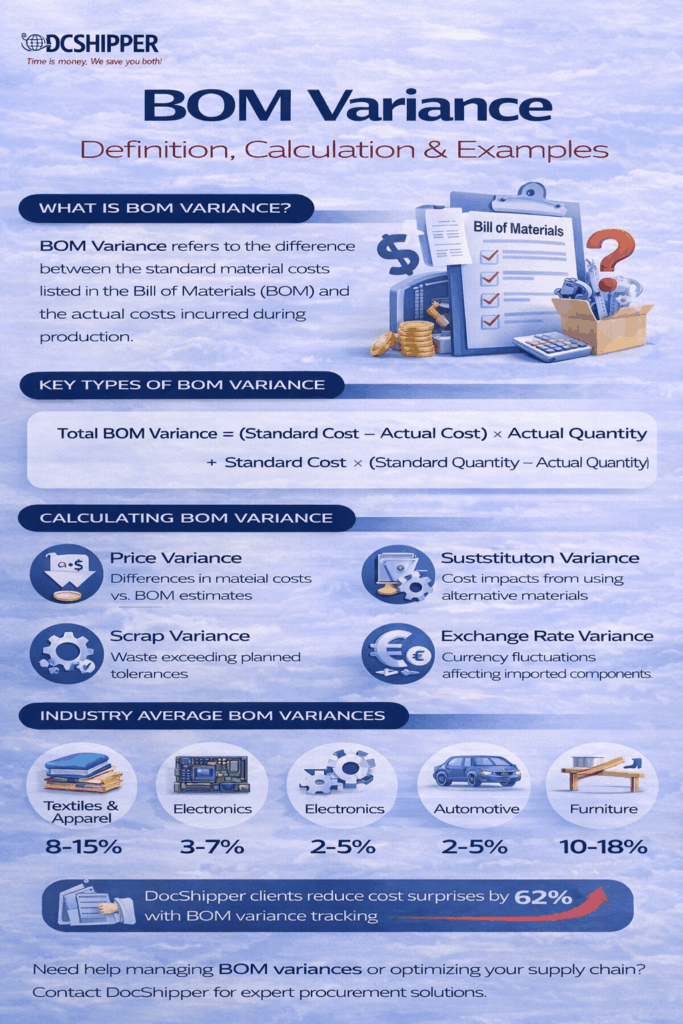
Bill of Materials (BOM) Variance refers to the difference between the standard material costs defined in the BOM and the actual costs incurred during production or procurement. This variance highlights discrepancies in quantities, prices, or specifications, enabling manufacturers and importers to identify inefficiencies, control costs, and optimize supply chain operations.Introduction
Many importers and manufacturers struggle with unexpected cost overruns during production or procurement. The culprit? BOM variance. This metric reveals hidden inefficiencies between planned and actual material consumption.
In international trade, understanding BOM variance is critical. It impacts pricing accuracy, supplier negotiations, and profitability. A single percentage point of variance can translate to thousands in lost margin on large orders.
Key characteristics of BOM variance include:
- Price variance – Differences between expected and actual material costs
- Quantity variance – Discrepancies in material usage versus specifications
- Substitution variance – Cost impacts from using alternative materials
- Scrap variance – Waste exceeding planned tolerances
- Exchange rate variance – Currency fluctuations affecting imported components
Technical Analysis & Expert Insights
BOM variance analysis operates on two fundamental dimensions: material price variance (MPV) and material quantity variance (MQV). Together, these metrics provide comprehensive visibility into procurement and production efficiency.
The calculation follows this formula:
Total BOM Variance = (Standard Cost – Actual Cost) × Actual Quantity + Standard Cost × (Standard Quantity – Actual Quantity)
Understanding the root causes requires examining several factors. Supplier pricing fluctuations often drive price variance, particularly in volatile commodity markets. Production inefficiencies or quality issues typically cause quantity variance. Design changes without BOM updates create systematic discrepancies.
From a regulatory perspective, accurate BOM management impacts customs declarations. The World Customs Organization requires precise material declarations for valuation purposes. Variance documentation helps demonstrate due diligence during audits.
At DocShipper, we integrate BOM variance tracking into our procurement oversight process. This allows us to flag cost deviations before shipment, protecting our clients from budget surprises and ensuring accurate customs documentation.
Exchange rate considerations add complexity for international sourcing. A 5% currency swing can transform a favorable variance into a loss. Forward contracts and hedging strategies mitigate this risk, but require accurate BOM forecasting.
Practical Examples & Data
Consider a furniture importer sourcing 1,000 chairs from Vietnam. The standard BOM specifies:
| Component | Standard Qty | Standard Price | Actual Qty | Actual Price | Variance |
|---|---|---|---|---|---|
| Wood (m³) | 0.15 | $450 | 0.17 | $480 | -$13.50 |
| Fabric (m²) | 0.80 | $12 | 0.78 | $11.50 | +$0.64 |
| Hardware (set) | 1 | $3.20 | 1 | $3.50 | -$0.30 |
| Total per Unit | -$13.16 |
For 1,000 chairs, this variance totals -$13,160 – a 19% cost overrun. The primary driver? Wood quantity variance (13% overconsumption) combined with price increases.
Use Case: Electronics Manufacturing
A smartphone component order reveals substitution variance. The supplier used alternative capacitors due to shortages. While functionally equivalent, the replacement cost $0.08 more per unit. Across 50,000 units, this created a $4,000 unfavorable variance.
Industry data shows typical variance ranges:
- Textiles & Apparel: 8-15% variance (high material volatility)
- Electronics: 3-7% variance (tight specifications, supplier consolidation)
- Automotive: 2-5% variance (mature supply chains, long-term contracts)
- Furniture: 10-18% variance (natural material variability, craft production)
DocShipper clients using our variance monitoring service reduce cost surprises by an average of 62%, enabling more accurate pricing and margin protection.
Conclusion
BOM variance management separates profitable importers from those constantly firefighting cost overruns. By systematically tracking and analyzing variances, businesses gain predictive control over their supply chain economics.
Need expert guidance on BOM variance tracking or procurement optimization? Contact DocShipper for tailored logistics solutions.
📚 Quiz
Test Your Knowledge: Bill of Materials (BOM) Variance
Q1 — What does Bill of Materials (BOM) Variance measure?
Q2 — A supplier uses a functionally equivalent but more expensive alternative component due to a shortage. Which type of BOM variance does this create?
Q3 — A furniture importer's BOM specifies 0.15 m³ of wood per chair at $450/m³, but production actually uses 0.17 m³ at $480/m³. Which statement best describes this situation?
🎯 Your Result
📞 Free Quote in 24hFAQ | Bill of Materials (BOM) Variance: Definition, Calculation & Concrete Examples
Primary causes include supplier price changes, currency fluctuations, material substitutions, production waste exceeding standards, and inaccurate initial BOM specifications. Quality issues and design changes without BOM updates also contribute significantly.
Calculate variance at each production batch or shipment. For high-volume operations, weekly or monthly analysis identifies trends early. Critical or high-value items warrant real-time monitoring to enable immediate corrective action.
Industry standards vary: electronics typically maintain 3-5%, while apparel may accept 10-12%. The key is consistency and trend direction. Increasing variance signals deteriorating control, regardless of absolute percentage.
Significant variance may require adjusted customs declarations if actual material costs differ substantially from declared values. Persistent variance documentation helps demonstrate good faith during customs audits and reduces dispute risk.
Yes. Favorable variance occurs when actual costs fall below standard costs through supplier negotiations, bulk discounts, material efficiency improvements, or favorable exchange rates. However, investigate to ensure quality hasn't been compromised.
ERP systems with integrated procurement modules, specialized PLM software, and supply chain analytics platforms provide automated variance tracking. Excel-based systems work for smaller operations but require disciplined manual updates.
Scrap exceeding planned tolerances creates unfavorable quantity variance. A 2% scrap increase on a $50,000 material order costs $1,000. Tracking scrap separately from other variance sources enables targeted process improvements.
Traditional BOM variance focuses on materials. However, comprehensive variance analysis often includes labor efficiency variance separately. This provides complete production cost visibility while maintaining distinct accountability for materials versus labor.
Engineering changes without BOM updates create systematic variance. Implement change control processes requiring simultaneous BOM revisions. Version control ensures production uses current specifications, eliminating this variance source.
BOM variance compares planned versus actual material costs and quantities. Yield variance specifically measures output efficiency – how many finished units result from given inputs. Yield variance is a subset contributing to overall BOM variance.
Forward contracts lock exchange rates for future purchases, eliminating currency-driven price variance. This converts uncertain foreign currency costs into predictable domestic currency amounts, improving budget accuracy for imported materials.
Yes. Fixed-price contracts, volume commitments with price protection, and cost-plus arrangements with caps all reduce price variance. Quality agreements with waste penalties minimize quantity variance. Strategic supplier partnerships enable collaborative variance reduction.
Need Help with
Logistics or Sourcing ?
First, we secure the right products from the right suppliers at the right price by managing the sourcing process from start to finish. Then, we simplify your shipping experience - from pickup to final delivery - ensuring any product, anywhere, is delivered at highly competitive prices.


Fill the Form
Prefer email? Send us your inquiry, and we’ll get back to you as soon as possible.
Contact us




