


In short ⚡
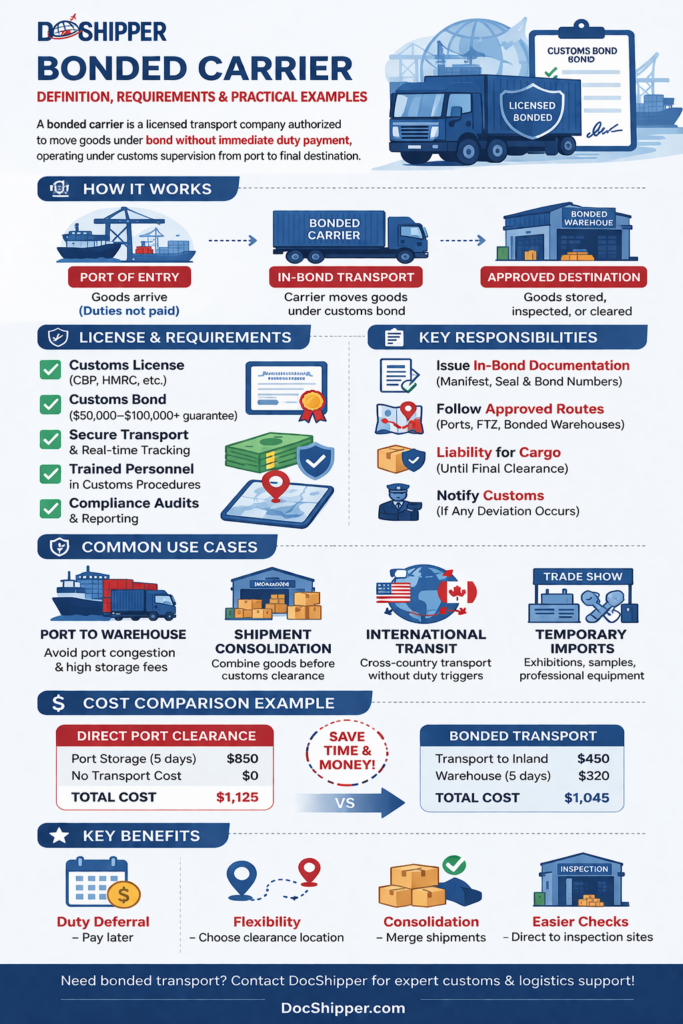
A bonded carrier is a licensed transportation company authorized by customs authorities to move goods under bond without immediate duty payment. This carrier operates under a customs bond guarantee, ensuring secure transit of imported merchandise from entry points to final destinations or bonded warehouses while duties remain unpaid.
Introduction
Many importers face confusion about who can legally transport goods before customs clearance is complete. The question becomes critical when merchandise arrives at a port but needs to reach an inland facility for inspection or storage. Without proper authorization, moving uncustomed goods violates international trade regulations.
The bonded carrier system solves this challenge by creating a secure chain of custody for duty-unpaid goods. This mechanism is fundamental to modern logistics, enabling flexible supply chain management while maintaining customs control. Understanding bonded carrier operations is essential for any business engaged in international trade.
Key characteristics of bonded carriers include:
- Licensed authorization from national customs authorities (CBP, HMRC, etc.)
- Financial guarantee through a customs bond covering potential duties and penalties
- Strict documentation requirements for each shipment movement
- Liability for goods from pickup to delivery at approved locations
- Regular compliance audits and reporting obligations
Regulatory Framework & Operational Requirements
The bonded carrier designation requires formal certification from customs authorities in each operating jurisdiction. In the United States, carriers must obtain approval from U.S. Customs and Border Protection (CBP) and maintain a continuous bond. European operators need authorization under Union Customs Code provisions from national customs administrations.
The licensing process involves several critical components. First, carriers must demonstrate financial stability sufficient to cover potential duty liabilities. Second, they must establish secure transportation protocols that prevent unauthorized access to bonded goods. Third, they need tracking systems that provide real-time location data to customs authorities. Fourth, personnel must complete specialized training in customs procedures and documentation. Finally, carriers must maintain insurance coverage protecting against loss or damage during transit.
Operational responsibilities extend beyond simple transportation. Bonded carriers must issue proper documentation for each movement, including the in-bond number, seal numbers, and detailed cargo manifests. They bear legal responsibility for ensuring goods reach only approved destinations—typically bonded warehouses, Foreign Trade Zones, or customs examination facilities. Any deviation from the authorized route requires immediate notification to customs authorities.
The bond amount varies based on cargo value and carrier history. Most jurisdictions require minimum bonds ranging from $50,000 to $100,000, though high-volume operators may need significantly larger guarantees. This financial instrument protects governments against revenue loss if goods disappear or duties go unpaid.
At DocShipper, we work exclusively with certified bonded carriers to ensure your goods move legally and securely through the customs process, eliminating the risk of penalties or shipment delays due to improper handling.
Practical Applications & Cost Analysis
Bonded carrier services prove essential in several common trade scenarios. The most frequent use case involves moving containerized imports from seaports to inland distribution centers. Rather than clearing customs at the congested port facility, importers can transport goods under bond to a facility near their final market, where clearance processing is faster and storage costs are lower.
Consider a practical example: A electronics retailer imports $500,000 worth of consumer goods arriving at the Port of Los Angeles. Direct port clearance would incur:
| Cost Component | Port Clearance | Bonded Transit to Inland Facility |
|---|---|---|
| Port Storage (5 days) | $850 | $0 |
| Bonded Transportation | $0 | $450 |
| Inland Warehouse (5 days) | N/A | $320 |
| Customs Processing Fee | $275 | $275 |
| Total Cost | $1,125 | $1,045 |
Beyond cost savings, bonded carrier services enable strategic customs planning. Importers can consolidate multiple shipments at a bonded warehouse before filing a single customs entry, reducing administrative burden. They can also delay duty payment until goods are actually sold, improving cash flow management.
Another critical application involves goods in transit through a country to a final destination elsewhere. For example, Asian exports destined for Canada frequently transit through U.S. ports. Bonded carriers move these goods across American territory without triggering U.S. import duties, as the merchandise never enters U.S. commerce.
The system also supports temporary importation scenarios. Trade show equipment, professional tools, or samples entering for limited periods can move under bond to exhibition sites, then return to the port for re-export without formal customs clearance. This eliminates unnecessary duty payments on goods that will leave the country.
Key operational advantages include:
- Duty deferral: Payment postponed until goods clear customs at the final location
- Flexibility: Goods can move to optimal clearance points rather than congested ports
- Consolidation: Multiple shipments combined before customs processing
- Examination facilitation: Transport to specialized inspection facilities when required
- Supply chain optimization: Direct delivery to distribution centers under customs control
Conclusion
Bonded carrier services form an essential component of efficient international logistics, providing legal authority to move duty-unpaid goods while maintaining customs control. Understanding when and how to utilize these services can significantly reduce costs and improve supply chain flexibility.
Need assistance coordinating bonded transportation for your imports? Contact DocShipper for expert guidance on customs procedures and carrier selection.
📚 Quizz
Test Your Knowledge: Bonded Carrier
Q1 — What is the defining characteristic of a bonded carrier?
Q2 — A bonded carrier delivers goods to a retail store directly from the port, bypassing a bonded warehouse. Is this permitted?
Q3 — An importer ships Asian electronics destined for Canada through a U.S. port. Which scenario correctly describes the role of a bonded carrier here?
🎯 Your Result
📞 Free Quote in 24hFAQ | Bonded Carrier: Definition, Requirements & Practical Examples
A bonded carrier holds specific customs authorization and a financial bond to transport duty-unpaid goods under customs control. Regular carriers cannot legally move merchandise before customs clearance is completed and duties are paid.
Bond costs typically range from $400 to $1,200 annually for a $50,000 continuous bond, depending on the carrier's claims history and financial strength. Higher bond amounts for larger operations increase premiums proportionally.
No. Companies must apply to customs authorities, demonstrate financial responsibility, maintain proper insurance, implement security protocols, and obtain approval before operating as bonded carriers. The process typically takes 30-60 days.
The bonded carrier becomes liable for all duties, taxes, and penalties on the missing merchandise. Their customs bond covers these amounts, though the carrier's insurance may reimburse the bond company after payment.
U.S. regulations allow 30 days for in-bond movements from the port of arrival to the destination. Extensions may be granted for valid reasons, but goods cannot remain in bonded transit indefinitely without customs clearance.
Bonded transportation typically costs 10-20% more than standard freight due to additional documentation, compliance requirements, and insurance. However, savings from duty deferral and optimized clearance locations often offset these costs.
Required documents include the in-bond entry number (IT/IE), bill of lading, cargo manifest, seal numbers, and proof of delivery. Carriers must maintain these records for five years for customs audit purposes.
Yes, bonded carriers can move goods between countries under international transit procedures like TIR (Transports Internationaux Routiers) or ATA Carnet systems, provided they hold appropriate authorizations in each jurisdiction.
Certain restricted items like firearms, hazardous materials requiring immediate inspection, and perishable goods with short shelf lives may face limitations. Specific restrictions vary by country and commodity classification.
Modern systems use electronic manifests, GPS tracking, and sealed containers with tamper-evident devices. Carriers must report departures, arrivals, and any incidents immediately through customs electronic data interchange systems.
Using unlicensed carriers for duty-unpaid goods can result in immediate duty assessment, penalties up to the value of the merchandise, seizure of goods, and potential criminal charges for customs violations.
No. Bonded carriers can only deliver to approved locations such as bonded warehouses, Foreign Trade Zones, or customs examination facilities. Goods must clear customs before delivery to retail or commercial premises.
Need Help with Logistics or Sourcing ?
First, we secure the right products from the right suppliers at the right price by managing the sourcing process from start to finish. Then, we simplify your shipping experience - from pickup to final delivery - ensuring any product, anywhere, is delivered at highly competitive prices.


Fill the Form
Prefer email? Send us your inquiry, and we’ll get back to you as soon as possible.
Contact us


