


In short ⚡
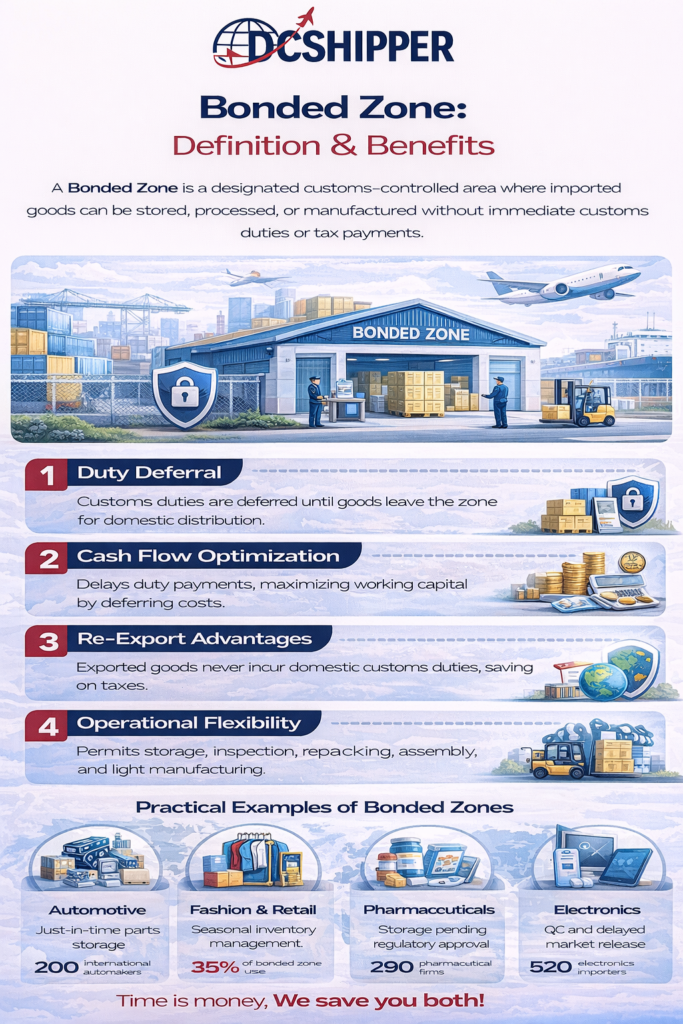
A Bonded Zone is a designated customs-controlled area where imported goods can be stored, processed, or manufactured without immediate payment of duties and taxes. These zones enable businesses to defer customs charges until goods enter domestic commerce, optimizing cash flow and facilitating international trade operations.
Introduction
Importers frequently face a critical challenge: paying customs duties on goods before they’re sold or distributed. This upfront cost strains working capital and creates financial inefficiencies, especially for businesses handling high-value shipments or re-export operations.
Bonded zones solve this problem by creating secure customs territories where normal duty obligations are suspended. These facilities play a strategic role in global supply chains, enabling companies to manage inventory, perform value-added services, and optimize tax liabilities within legal frameworks.
- Duty Deferral: Taxes and duties remain unpaid until goods leave the zone for domestic consumption
- Customs Supervision: Facilities operate under strict regulatory oversight and monitoring systems
- Operational Flexibility: Goods can be stored, inspected, repacked, labeled, or light-manufactured
- Re-export Advantages: Products leaving the zone for foreign markets incur no domestic duties
- Time Limits: Most jurisdictions impose maximum storage periods (typically 3-5 years)
Regulatory Framework & Operational Mechanisms
Bonded zones function under internationally recognized customs conventions, particularly the Revised Kyoto Convention administered by the World Customs Organization. National customs authorities license these facilities after verifying security standards, accounting systems, and compliance protocols.
The legal foundation distinguishes bonded zones from free trade zones. While both offer duty advantages, bonded warehouses specifically focus on temporary storage with customs suspension, whereas free zones may permit broader manufacturing and commercial activities with different regulatory parameters.
Operators must maintain detailed inventory records linking each item to its customs declaration. Physical security requirements include perimeter fencing, surveillance systems, and controlled access points. Customs officers retain authority to inspect goods and audit records without notice.
Permitted activities vary by jurisdiction but commonly include: quality testing, sorting, grading, repacking into smaller units, labeling for different markets, and simple assembly operations. Complex manufacturing typically requires upgraded facility status or different licensing.
At DocShipper, we guide clients through bonded zone authorization processes, ensuring facility compliance and optimizing operational workflows to maximize duty deferral benefits while maintaining regulatory adherence.
The duty calculation trigger occurs when goods are “entered for consumption”—the moment they leave customs control for domestic distribution. At this point, import duties apply based on the goods’ classification, origin, and applicable trade agreements. For reference on international customs procedures, consult the World Customs Organization.
Practical Applications & Financial Impact
Understanding bonded zone advantages requires examining real-world scenarios. Consider an electronics importer bringing 10,000 smartphones valued at $500 each into the United States, where the duty rate is 6%.
| Scenario | Immediate Import | Bonded Warehouse |
|---|---|---|
| Total Goods Value | $5,000,000 | $5,000,000 |
| Duty Payment Timing | At entry (Day 1) | At withdrawal (Day 90+) |
| Duties Owed | $300,000 | $300,000 (deferred) |
| Cash Flow Impact (90 days) | -$300,000 upfront | $0 (gradual as sold) |
| Re-exported Units (2,000) | $60,000 duty (drawback claim needed) | $0 duty (never entered commerce) |
This comparison reveals the working capital advantage. By storing goods in a bonded facility, the importer avoids tying up $300,000 in duty payments. If only 8,000 units enter domestic commerce over three months, duties are paid incrementally as inventory moves, aligning tax obligations with revenue generation.
Re-export scenarios demonstrate additional value. The 2,000 units shipped to Canada or Mexico never trigger U.S. duties. Under immediate import, the company would pay $60,000 upfront and later file complex duty drawback claims—a process taking 6-12 months with no guarantee of full recovery.
Industries benefiting most from bonded zones include:
- Automotive: Parts storage for just-in-time manufacturing across borders
- Fashion/Retail: Seasonal inventory management with market-responsive distribution
- Pharmaceuticals: Regulatory testing and market authorization delays
- Electronics: High-value goods requiring quality control before market release
- Commodities: Bulk materials awaiting favorable market pricing
At DocShipper, we calculate precise duty deferral savings for your specific product mix and help establish bonded warehouse partnerships that align with your distribution network and cash flow objectives.
Conclusion
Bonded zones represent a strategic financial tool for international traders, transforming duty obligations from upfront costs into manageable expenses aligned with sales cycles. Proper utilization requires understanding regulatory requirements and operational best practices.
Need expert guidance on bonded warehouse strategies for your supply chain? Contact DocShipper for tailored logistics solutions that optimize your customs operations.
📚 Quiz
Test Your Knowledge: Bonded Zone
Q1 — What is the primary purpose of a Bonded Zone?
Q2 — A company imports 10,000 units and re-exports 2,000 of them directly from a bonded warehouse to a foreign market. What duties apply to those 2,000 re-exported units?
Q3 — Which of the following activities is typically NOT permitted inside a standard bonded warehouse?
🎯 Your Result
📞 Free Quote in 24hFAQ | Bonded Zone: Definition, Benefits & Practical Examples
Bonded warehouses, container freight stations, duty-free shops, and certain manufacturing facilities can obtain bonded status. Customs authorities license each based on security standards and operational controls.
Most countries permit 3-5 years of storage. The U.S. allows five years, the EU typically three years, with extensions possible under special circumstances through customs approval.
Prohibited goods (weapons, narcotics) cannot enter bonded zones. Perishable items face practical time limits. Restricted goods (alcohol, tobacco) require additional licensing beyond standard bonded warehouse authorization.
Ownership can transfer between parties, but goods remain under customs control. The new owner assumes duty obligations when withdrawing items for domestic consumption.
Customs must be notified immediately. Damaged goods may be destroyed under supervision without duty payment, or duties adjusted based on diminished value if entered for consumption.
No. Initial entry declarations are required, and full customs clearance occurs upon withdrawal. Bonded status defers duty payment but doesn't bypass compliance requirements or safety inspections.
Bonded warehouses focus on storage with duty suspension. Foreign trade zones (FTZ) in the U.S. permit manufacturing, assembly, and broader commercial activities with additional regulatory frameworks and benefits.
Entry bonds, warehouse receipts, detailed inventory records, and withdrawal declarations. Each movement requires documentation linking goods to original customs declarations and tracking duty liability.
Yes. Third-party logistics providers operate public bonded warehouses where multiple importers share space. This eliminates the need for individual facility licensing and large-scale operations.
Warehouse operators charge storage fees (typically monthly), handling charges, and administrative costs. These expenses should be weighed against duty deferral savings and cash flow benefits.
The warehouse operator or bond holder becomes liable for duties on missing goods. This risk necessitates comprehensive insurance and robust security systems for bonded facility operators.
Simple operations like repackaging, labeling, and quality testing are permitted. Substantial transformation or manufacturing typically requires upgraded facility status or transfer to a foreign trade zone.
Need Help with Logistics or Sourcing ?
First, we secure the right products from the right suppliers at the right price by managing the sourcing process from start to finish. Then, we simplify your shipping experience - from pickup to final delivery - ensuring any product, anywhere, is delivered at highly competitive prices.


Fill the Form
Prefer email? Send us your inquiry, and we’ll get back to you as soon as possible.
Contact us


