In short ⚡
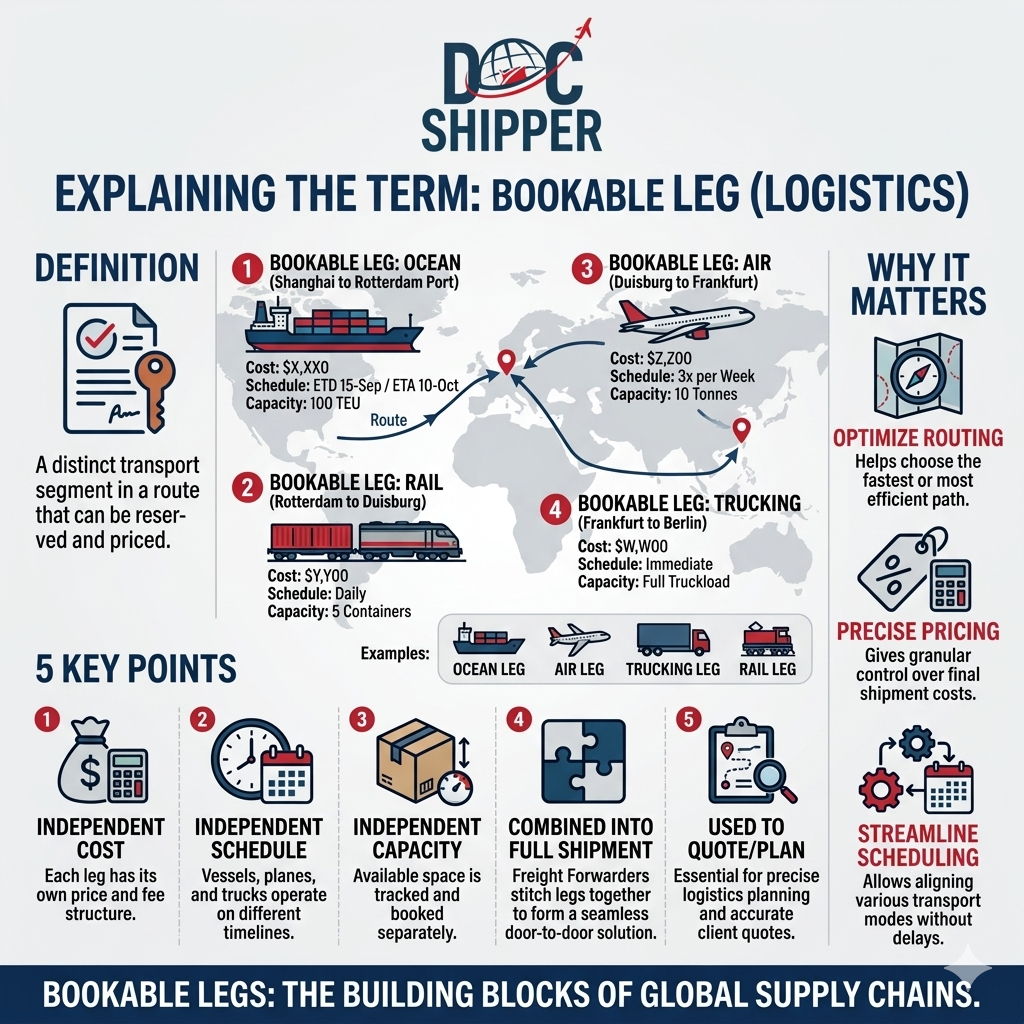
A bookable leg is an individual transport segment within a multimodal shipment that can be independently reserved with a carrier. It represents a distinct portion of the journey—such as ocean freight from Shanghai to Rotterdam or trucking from warehouse to port—allowing freight forwarders and shippers to optimize routing, costs, and carrier selection across complex international supply chains.
Introduction
Many shippers mistakenly view international shipments as single, indivisible journeys. In reality, a door-to-door movement from Shenzhen to Hamburg involves multiple independent transport segments—each requiring separate booking, documentation, and carrier coordination. Understanding bookable legs is essential for cost control, transit time optimization, and regulatory compliance in global trade.
In multimodal logistics, each leg represents a contractual relationship with a specific carrier or service provider. Mismanaging these segments leads to delays, cost overruns, and customs complications. Mastering bookable leg management enables:
- Carrier diversification: Select optimal providers per segment rather than relying on single-source routing
- Cost transparency: Isolate expenses by transport mode (ocean, air, road, rail) for accurate landed cost calculation
- Risk mitigation: Identify bottlenecks and develop contingency plans for critical segments
- Customs efficiency: Align documentation with each leg’s jurisdictional requirements
- Carbon footprint tracking: Measure emissions per segment to meet ESG reporting standards
Technical Mechanisms & Logistics Implications
A bookable leg functions as a modular component within the broader shipment architecture. Each leg has distinct characteristics: carrier, mode, origin/destination points, transit time, and tariff structure. The leg’s boundaries are defined by transfer points—locations where cargo custody changes between service providers.
From a contractual perspective, each leg generates separate transport documents. An ocean leg produces a Bill of Lading (B/L), while trucking segments require a CMR (Convention relative au contrat de transport international de Marchandises par Route) or waybill. These documents establish liability frameworks and serve as proof of delivery for each segment. At DocShipper, we systematically verify document alignment across all legs to prevent customs clearance delays.
The booking process varies by transport mode. Ocean legs require container allocation weeks in advance during peak seasons, while air freight legs can often be booked 48-72 hours pre-departure. Road and rail segments typically allow shorter booking windows but demand precise scheduling to meet vessel or flight cut-off times. This temporal complexity requires sophisticated coordination.
Incoterms directly impact bookable leg responsibility. Under FOB terms, the buyer arranges the main ocean leg, while the seller handles pre-carriage to the port. DDP terms place all leg bookings on the seller. Misalignment between Incoterms and actual leg management creates financial disputes and insurance gaps. The International Chamber of Commerce provides authoritative guidance on these allocations.
Modern Transportation Management Systems (TMS) enable leg-level visibility through API integrations with carriers. Real-time tracking data flows from each leg, aggregating into comprehensive shipment status. This granularity allows proactive intervention—rerouting subsequent legs if an earlier segment experiences delays. At DocShipper, our digital platform consolidates leg-specific milestones into unified dashboards for client transparency.
Concrete Examples & Data
Consider a typical China-to-Germany shipment structured as four bookable legs:
| Leg | Mode | Route | Transit Time | Cost (20′ Container) |
|---|---|---|---|---|
| Leg 1 | Trucking | Factory (Shenzhen) → Yantian Port | 1 day | $180 |
| Leg 2 | Ocean Freight | Yantian → Hamburg Port | 28 days | $2,400 |
| Leg 3 | Rail | Hamburg → Munich Terminal | 2 days | $320 |
| Leg 4 | Trucking | Munich Terminal → Final Warehouse | 1 day | $210 |
Total transit time: 32 days | Total transport cost: $3,110
This breakdown reveals that the ocean leg accounts for 77% of costs but 87.5% of transit time. By analyzing legs independently, shippers can identify optimization opportunities—such as switching Leg 3 from rail to direct trucking, reducing costs by $90 while maintaining similar transit times.
Use Case: Air Freight Urgency
A medical equipment manufacturer needs urgent delivery to Paris. The optimized routing involves:
- Leg 1: Express trucking (Factory → Hong Kong Airport) – 6 hours, $450
- Leg 2: Air freight (HKG → CDG) – 14 hours flight time, $6,800
- Leg 3: Customs clearance handling (CDG) – 8 hours, $280
- Leg 4: Final mile delivery (CDG → Hospital) – 4 hours, $190
Total door-to-door time: 32 hours. By pre-booking all legs simultaneously and coordinating cut-off times, the shipper achieves next-day delivery despite crossing three jurisdictions. At DocShipper, we specialize in synchronizing time-sensitive legs to meet critical deadlines.
Key Data Points:
- Average ocean leg bookings require 10-15 days advance notice during peak season (Q3-Q4)
- Multimodal shipments with 3+ legs experience 18% fewer delays when managed through integrated TMS platforms
- Leg-level carbon tracking reduces emissions by 12-15% through optimized mode selection
- Documentation errors at leg transfer points cause 40% of customs delays in EU imports
- Dynamic leg rerouting during disruptions saves 3-7 days compared to static routing
DocShipper Platform
Optimize Your Global Logistics with Cutting-Edge Solutions
Enhance efficiency, cut costs, and gain 24/7 visibility 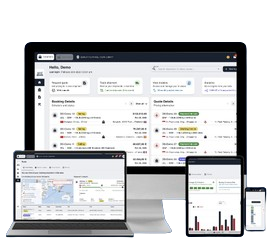 over your entire supply chain.
- Cut your shipping costs and maximize your margins
- Manage sourcing, freight, & customs on one platform
- Get real-time tracking and analytics
Conclusion
Mastering bookable leg management transforms complex international shipments into controllable, optimized processes. By treating each segment as an independent unit with specific requirements, shippers gain cost transparency, operational flexibility, and risk mitigation capabilities essential for competitive global trade.
Need expert guidance on structuring your multimodal shipments? Contact DocShipper for tailored logistics solutions that optimize every leg of your supply chain.
📚 Quiz
Test Your Knowledge: Bookable Leg
Q1. What is a bookable leg in multimodal logistics?
Q2. Under FOB (Free On Board) Incoterms, who is responsible for booking the main ocean leg?
Q3. A shipper is analyzing a China-to-Germany shipment with 4 bookable legs. The ocean leg costs $2,400 out of a $3,110 total. What does this leg-level breakdown primarily enable the shipper to do?
🎯 Your Result
📞 Free Quote in 24hFAQ | Bookable Leg: Definition, Calculation & Concrete Examples
A bookable leg is a segment that can be independently reserved with a carrier, involving separate contracts and documentation. Not all segments qualify as bookable legs—internal warehouse movements, for example, lack carrier booking requirements.
Yes. Freight forwarders like DocShipper consolidate leg bookings under master agreements, handling carrier coordination while providing unified billing and documentation. This simplifies management without sacrificing optimization opportunities.
Incoterms determine which party books each leg. Under EXW, the buyer arranges all legs. FOB splits responsibility at the port of loading. DDP places all leg bookings on the seller. Misalignment creates liability gaps.
Delays cascade through subsequent legs unless proactively managed. Advanced TMS platforms trigger automatic notifications, allowing rescheduling of dependent legs. Buffer time between legs mitigates minor disruptions.
Absolutely. Long-distance domestic movements often involve multiple legs—trucking to rail terminal, rail transport, final delivery. Leg-based management optimizes costs and transit times even within single countries.
Sum carrier charges for each leg, then add ancillary costs (fuel surcharges, documentation fees, handling charges). Include customs duties and taxes if legs cross borders. Landed cost calculators automate this process.
Yes, provided transfer points accommodate carrier changes. This requires coordinating cargo handover, updating documentation, and ensuring insurance continuity. Freight forwarders manage these transitions seamlessly.
Each leg generates mode-specific documents: Bills of Lading (ocean), Air Waybills (air), CMRs (road), CIMs (rail). Multimodal shipments require a master transport document linking all legs, plus customs declarations at border crossings.
GPS and API integrations provide real-time location data per leg. This granularity enables precise ETA predictions, proactive exception management, and accurate inventory planning. Aggregated leg data powers predictive analytics.
Transfer points define leg boundaries—ports, airports, rail terminals, cross-dock facilities. They're critical for liability determination, documentation requirements, and scheduling coordination. Efficient transfer points minimize dwell time between legs.
Sometimes. Consolidation services merge multiple shippers' cargo on shared legs, reducing per-unit costs. However, this extends transit times and reduces flexibility. Full container loads offer leg-level control without consolidation compromises.
Modern TMS platforms automate carrier selection, rate comparison, and booking confirmation across all legs. They integrate real-time tracking, document management, and compliance checks, reducing manual coordination by 60-70% while improving accuracy.
Need Help with
Logistics or Sourcing ?
First, we secure the right products from the right suppliers at the right price by managing the sourcing process from start to finish. Then, we simplify your shipping experience - from pickup to final delivery - ensuring any product, anywhere, is delivered at highly competitive prices.


Fill the Form
Prefer email? Send us your inquiry, and we’ll get back to you as soon as possible.
Contact us