In short ⚡
Booking is the formal reservation of cargo space on a vessel, aircraft, or truck with a carrier. It confirms the transport agreement between shipper and carrier, specifying departure dates, container type, and routing. This critical step secures capacity and initiates documentation for international shipments.
Introduction
Many importers lose shipments or face unexpected delays because they misunderstand the booking process. A booking isn’t just a phone call—it’s a binding commercial agreement that triggers the entire logistics chain.
In international trade, securing cargo space at the right time directly impacts delivery schedules, inventory management, and customer satisfaction. Without a proper booking, your goods simply won’t move.
- Capacity guarantee: Reserves physical space on the selected transport mode
- Rate confirmation: Locks in freight costs and surcharges
- Documentation trigger: Initiates Bill of Lading and customs paperwork
- Routing specification: Defines ports of loading/discharge and transit points
- Equipment allocation: Assigns specific container types (20’/40’/HC/RF)
Booking Process & Technical Requirements
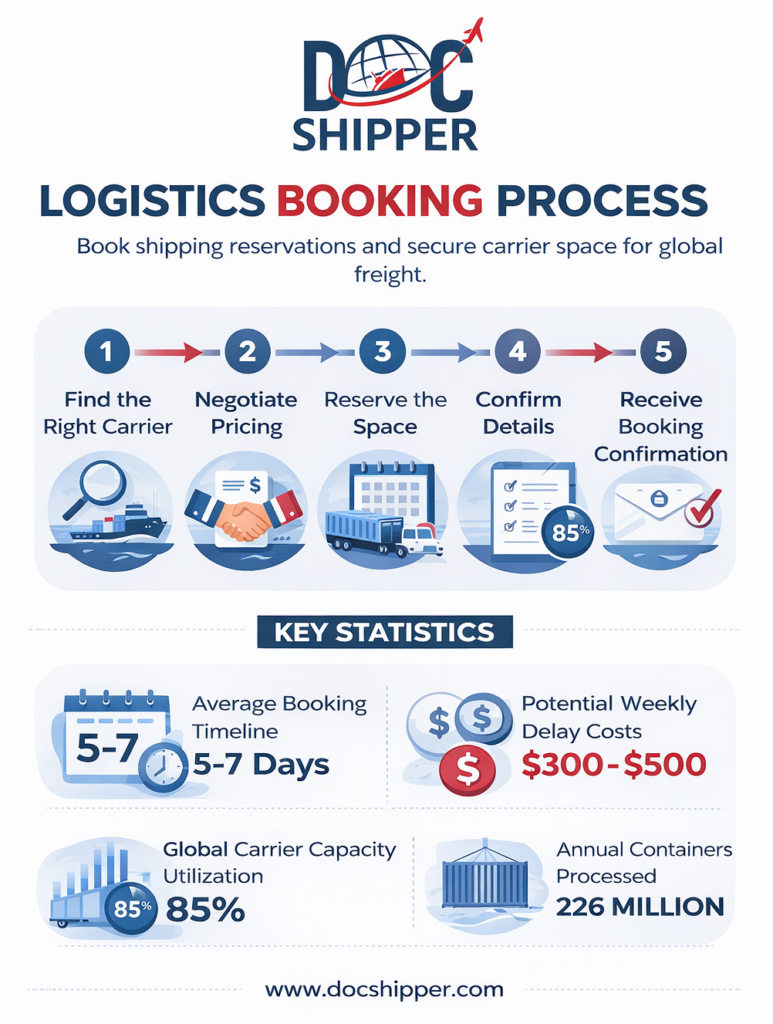
The booking process follows a structured workflow between shipper, freight forwarder, and carrier. Understanding each step prevents costly errors and shipment rejections.
Booking request submission requires essential information: commodity description, weight, volume, origin/destination, preferred sailing date, and Incoterms. Incomplete data leads to booking rejections or incorrect equipment assignment.
Carrier confirmation validates space availability and issues a booking number. This alphanumeric reference becomes the shipment’s primary identifier throughout the transport cycle. Carriers typically respond within 24-48 hours for standard bookings.
Cut-off deadlines govern three critical milestones: documentation cut-off (when shipping instructions must be submitted), VGM cut-off (verified gross mass declaration), and cargo cut-off (physical container delivery to terminal). Missing any deadline results in rolled cargo—your shipment moves to the next available vessel.
Amendment procedures allow changes to bookings before cut-off times. Modifications to quantity, equipment type, or routing may incur fees. At DocShipper, we manage these amendments proactively to avoid disruptions and ensure your cargo sails as planned.
Booking confirmation documents include the booking number, vessel name/voyage, container allocation, and special handling instructions. According to ICC regulations, these documents form part of the contractual transport agreement and must be retained for compliance purposes.
Practical Examples & Industry Data
Real-world scenarios illustrate how booking decisions impact logistics outcomes. Industry data reveals patterns that help optimize shipping strategies.
| Booking Timing | Space Availability | Rate Impact | Risk Level |
|---|---|---|---|
| 3+ weeks advance | Guaranteed | Standard rates | Low |
| 1-2 weeks advance | Subject to availability | +15-25% premium | Medium |
| Less than 1 week | Limited/waitlist | +40-60% surcharge | High |
| Peak season (Q4) | Heavily constrained | +100-200% increase | Critical |
Use Case: A European electronics importer books 40′ HC containers from Shenzhen to Rotterdam. Booking 21 days before sailing secures $2,800 per container. The same booking made 5 days before departure costs $4,200—a 50% premium. During November-December peak season, rates can exceed $7,000 for identical routing.
Container type selection directly affects booking success. Standard 20′ and 40′ containers have higher availability than specialized equipment (refrigerated, open-top, flat-rack). Reefer bookings require additional lead time for pre-trip inspections and temperature calibration.
Port congestion data shows that major gateways (Shanghai, Los Angeles, Rotterdam) experience 15-30% booking rollovers during peak periods. Secondary ports often provide better equipment availability and faster vessel loading.
Digital booking platforms now handle 45% of global container bookings, reducing confirmation times from 48 hours to under 2 hours. However, complex shipments (hazardous goods, oversized cargo, multi-modal routing) still require manual processing.
Booking accuracy metrics reveal that 22% of initial bookings contain errors requiring amendments. The most common mistakes include incorrect commodity codes, missing VGM declarations, and mismatched Incoterms—all preventable with proper documentation review.
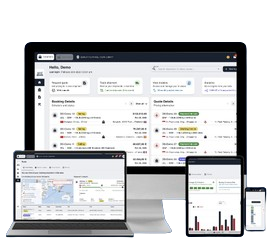
DocShipper Platform
One platform. Your entire supply chain
Sourcing, freight, customs & documents — all centralised, all visible, 24/7.
Conclusion
Mastering the booking process ensures cargo moves efficiently through the supply chain. Proper timing, accurate information, and understanding carrier requirements prevent delays and control costs.
Need expert assistance with your shipping bookings? Contact DocShipper for professional logistics support tailored to your trade requirements.
📚 Quizz
Test Your Knowledge: Booking in Logistics
Q1 — What is a "booking" in international logistics?
Q2 — What happens to your cargo if you miss the booking cut-off deadline?
Q3 — A European importer needs to ship 40' HC containers from Shenzhen to Rotterdam in early December. Based on industry data, what is the best booking strategy?
🎯 Your Result
📞 Free Quote in 24hFAQ | Booking in Logistics: Definition, Process & Practical Examples
You need commodity description, HS code, gross weight, volume/dimensions, shipper/consignee details, origin/destination ports, preferred sailing date, Incoterms, and any special handling requirements (hazmat, temperature control).
Standard practice is 2-3 weeks before desired departure. Peak seasons require 4-6 weeks advance booking. Last-minute bookings (under 1 week) face limited availability and premium rates.
Yes, amendments are possible before documentation cut-off. Changes may incur fees depending on timing and nature of modification. Contact your carrier or freight forwarder immediately when changes are needed.
Your cargo gets rolled to the next available sailing. This causes delivery delays and may require rebooking fees. Some carriers offer premium services to accommodate late bookings with surcharges.
The booking number is a unique identifier linking your shipment to carrier systems. It's required for container pickup, documentation submission, and cargo tracking throughout the transport journey.
Yes. FCL (full container load) bookings reserve entire containers. LCL (less than container load) bookings reserve space within consolidated containers. Each follows different pricing and documentation procedures.
Verified Gross Mass (VGM) is the certified weight of a packed container required by SOLAS regulations. It must be submitted before the VGM cut-off specified in your booking confirmation.
Both options exist. Direct carrier bookings suit high-volume shippers with established relationships. Freight forwarders provide better rates through volume consolidation and handle complex multi-modal arrangements.
Common reasons include incomplete information, hazardous goods without proper declarations, embargoed commodities, unpaid freight invoices, or requesting unavailable equipment types during capacity constraints.
Contract rates are negotiated annually with guaranteed space and fixed pricing. Spot market bookings reflect real-time supply/demand with variable rates—lower during slack seasons, significantly higher during peak periods.
Booking confirmation reserves space and outlines transport terms. The Bill of Lading is the legal document issued after cargo loading, serving as receipt, contract, and title document for the goods.
Generally no. Bookings are tied to specific shipper accounts and cannot be transferred. Canceling and rebooking under a different entity is required, subject to availability and potential fees.
Need Help with
Logistics or Sourcing ?
First, we secure the right products from the right suppliers at the right price by managing the sourcing process from start to finish. Then, we simplify your shipping experience - from pickup to final delivery - ensuring any product, anywhere, is delivered at highly competitive prices.


Fill the Form
Prefer email? Send us your inquiry, and we’ll get back to you as soon as possible.
Contact us