


In short ⚡
Business Process Management (BPM) is a systematic approach to analyzing, optimizing, and automating business workflows to improve operational efficiency, reduce costs, and enhance service quality. In international logistics, BPM enables companies to streamline complex supply chain operations, from order processing to customs clearance and final delivery.Introduction
Many logistics companies struggle with inefficient processes that lead to delays, errors, and increased operational costs. Manual documentation, disconnected systems, and lack of visibility create bottlenecks in international shipping operations.
Business Process Management addresses these challenges by providing a structured methodology to design, execute, monitor, and continuously improve business workflows. In the import/export sector, BPM is essential for managing the complexity of multi-party transactions, regulatory compliance, and time-sensitive deliveries.
- Process Visibility: Real-time tracking of shipments, documents, and milestones across the supply chain
- Automation Capabilities: Reduction of manual tasks through workflow automation and system integration
- Compliance Management: Systematic approach to meeting customs, trade, and regulatory requirements
- Performance Metrics: KPI tracking for continuous improvement and data-driven decision making
- Risk Mitigation: Early identification of potential delays, documentation errors, or compliance issues
In-Depth Analysis & Expertise
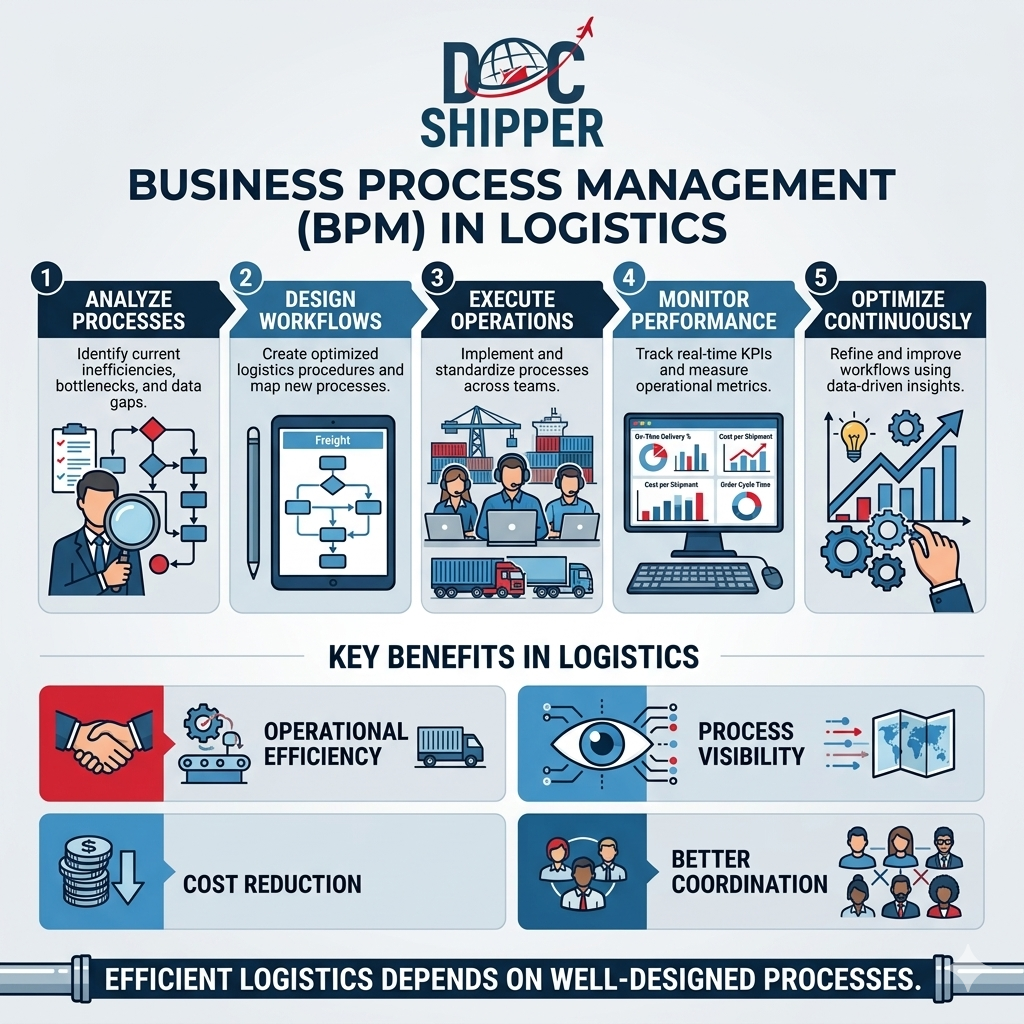
BPM in logistics operates through a continuous cycle of process discovery, modeling, execution, monitoring, and optimization. The methodology identifies inefficiencies in current workflows and implements structured improvements that can be measured and refined over time.
The core components of BPM include process mapping (visualizing workflows), business rules engines (automating decision logic), workflow orchestration (coordinating activities across systems), and analytics dashboards (monitoring performance). These elements work together to create an integrated management system.
In international shipping, process standardization is critical. BPM enables companies to create repeatable workflows for document preparation, customs declarations, carrier booking, and exception handling. This consistency reduces errors and training time while improving service quality.
Regulatory compliance represents a major BPM application in logistics. The system can automatically verify that all required documents are present, validate data against customs requirements, and flag potential issues before submission. According to WTO Trade Facilitation guidelines, process optimization can reduce border compliance time by 30-50%.
At DocShipper, we implement BPM frameworks to manage complex multi-modal shipments, ensuring that every step—from supplier pickup to final delivery—follows optimized workflows with built-in quality controls and real-time visibility for our clients.
The integration layer connects BPM systems with existing logistics software (TMS, WMS, ERP), customs platforms, and carrier APIs. This connectivity eliminates data silos and enables end-to-end process automation without requiring complete system replacement.
Concrete Examples & Data
Understanding BPM impact requires examining real-world applications and measurable outcomes. The following comparisons illustrate how process management transforms logistics operations.
| Process Area | Without BPM | With BPM | Improvement |
|---|---|---|---|
| Document Processing | 4-6 hours manual preparation | 30 minutes automated generation | 87% time reduction |
| Customs Clearance | 3-5 days average | 24-48 hours | 60% faster processing |
| Error Rate | 12-15% documentation errors | 2-3% errors | 80% error reduction |
| Operational Cost | $85 per shipment | $45 per shipment | 47% cost savings |
| Customer Visibility | Email updates on request | Real-time portal access | 100% transparency |
Use Case: Electronics Importer — A mid-sized electronics distributor importing from Asia processed 200 shipments monthly with manual workflows. After implementing BPM, they achieved: document preparation time reduced from 5 hours to 45 minutes per shipment, customs clearance delays decreased by 65%, and operational costs dropped by $8,000 monthly.
Key Performance Indicators for BPM in logistics include: cycle time reduction (30-50% typical), first-time-right rate improvement (from 75% to 95%+), exception handling time (reduced by 40-60%), and customer satisfaction scores (increasing 20-30 points on NPS scale).
Industry data shows that companies implementing comprehensive BPM solutions achieve ROI within 8-14 months through reduced labor costs, fewer penalties, faster inventory turnover, and improved carrier relationships due to consistent, accurate documentation.
Process automation extends beyond documentation. Automated booking confirmations, proactive exception alerts, predictive delay notifications, and intelligent routing recommendations represent advanced BPM capabilities that transform reactive logistics into proactive supply chain management.
DocShipper Platform
Cut logistics costs. Not corners.
See exactly where your logistics costs are bleeding — and how to fix it. Book your expert demo.

Conclusion
Business Process Management represents a fundamental shift from ad-hoc operations to systematic, measurable, and continuously improving logistics workflows. Companies that embrace BPM gain competitive advantages through reduced costs, faster processing, and superior customer service.
Need guidance implementing BPM in your logistics operations? Contact DocShipper for expert consultation on process optimization and workflow automation tailored to your international shipping needs.
📚 Quiz
Test Your Knowledge: Business Process Management (BPM)
Q1 — What is the primary purpose of Business Process Management (BPM) in logistics?
Q2 — A logistics manager says: "We already use workflow automation, so we have full BPM in place." Is this correct?
Q3 — A mid-sized freight forwarder wants to implement BPM but is concerned about having to replace their existing TMS and ERP systems. What is the correct approach?
🎯 Your Result
📞 Free Quote in 24hFAQ | BPM (Business Process Management): Definition, Calculation & Concrete Examples
BPM is a comprehensive management discipline encompassing process design, execution, monitoring, and optimization. Workflow automation is a component of BPM that executes specific tasks automatically. BPM provides the strategic framework; automation is the tactical tool.
Initial implementation typically requires 3-6 months for core processes, depending on complexity and system integration needs. Full organizational adoption may take 12-18 months as processes are refined and expanded across departments.
Absolutely. Cloud-based BPM solutions offer scalable options for small operations. Even basic process standardization and automation deliver significant efficiency gains, reducing manual workload and improving service consistency without large capital investment.
Start with high-volume, repetitive processes: customs documentation, carrier booking, shipment tracking updates, and invoice processing. These deliver quick wins and measurable ROI while building organizational confidence in BPM methodology.
No. Modern BPM platforms integrate with existing systems through APIs and connectors. The goal is to orchestrate processes across multiple systems, not replace them. This approach protects existing technology investments while adding coordination capabilities.
BPM systems enforce standardized document preparation, validate data against regulatory requirements, maintain audit trails, and flag potential compliance issues before submission. This systematic approach reduces errors, penalties, and clearance delays significantly.
Key metrics include: average processing time per shipment, documentation error rates, customs clearance duration, cost per transaction, on-time delivery percentage, and customer satisfaction scores. Establish baselines before implementation to measure improvement accurately.
Yes. Advanced BPM systems use business rules engines to identify exceptions (missing documents, customs holds, carrier delays) and trigger appropriate workflows—escalating issues, notifying stakeholders, and initiating corrective actions automatically based on predefined logic.
BPM creates unified workflows across ocean, air, road, and rail transport modes. It manages mode-specific requirements while maintaining consistent processes for documentation, tracking, and communication, ensuring seamless transitions between transport segments.
Staff need training on new workflows, system interfaces, and exception handling procedures. Effective programs combine initial classroom instruction (2-3 days), hands-on practice with test scenarios, and ongoing support during the first 30-60 days of live operation.
BPM systems trigger automated customer notifications at key milestones (booking confirmation, departure, customs clearance, delivery). Clients access self-service portals for real-time status, documents, and tracking information, reducing inquiry volume while improving satisfaction.
AI enhances BPM through predictive analytics (forecasting delays), intelligent document processing (extracting data from varied formats), dynamic routing optimization, and continuous learning from historical data to refine processes automatically over time.
Need Help with Logistics or Sourcing ?
First, we secure the right products from the right suppliers at the right price by managing the sourcing process from start to finish. Then, we simplify your shipping experience - from pickup to final delivery - ensuring any product, anywhere, is delivered at highly competitive prices.


Fill the Form
Prefer email? Send us your inquiry, and we’ll get back to you as soon as possible.
Contact us


