


In short ⚡
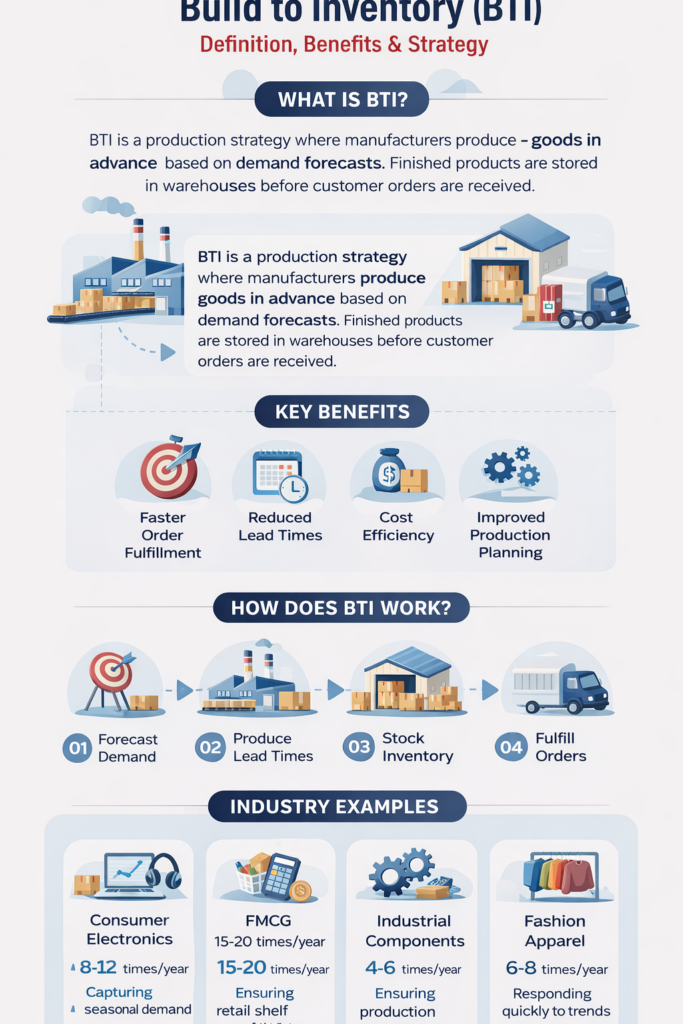
Build to Inventory (BTI) is a production strategy where manufacturers produce goods in advance based on demand forecasts, storing finished products in warehouses before customer orders are received. This anticipatory approach enables immediate order fulfillment, reduces lead times, and optimizes production schedules for standardized products with predictable demand patterns.Introduction
In international trade, the timing between production and delivery can make or break a business relationship. Many importers struggle with extended lead times that frustrate customers and create cash flow challenges.
Build to Inventory addresses this fundamental tension in supply chain management. By producing goods before orders arrive, companies position themselves to respond instantly to market demand while maintaining efficient manufacturing operations.
This production philosophy proves essential for businesses operating in competitive markets where delivery speed determines market share. Key characteristics include:
- Forecast-driven production — Manufacturing volumes determined by demand predictions rather than confirmed orders
- Inventory buffer strategy — Finished goods stored strategically to enable immediate shipment
- Economies of scale — Longer production runs reduce per-unit manufacturing costs
- Market responsiveness — Rapid order fulfillment without production delays
- Risk distribution — Balancing inventory holding costs against lost sales opportunities
In-Depth Analysis & Strategic Implications
The Build to Inventory model fundamentally differs from alternative production strategies like Build to Order (BTO) or Make to Order (MTO). Understanding these distinctions determines operational success in global logistics.
Production planning methodology relies on sophisticated forecasting techniques. Manufacturers analyze historical sales data, seasonal patterns, market trends, and economic indicators to determine optimal production volumes. Statistical methods like moving averages, exponential smoothing, and regression analysis inform these critical decisions.
Inventory management complexity represents the strategic challenge of BTI operations. Companies must calculate optimal stock levels that balance carrying costs (warehousing, insurance, obsolescence) against stockout costs (lost sales, customer dissatisfaction). The Economic Order Quantity (EOQ) formula and safety stock calculations guide these determinations.
According to the Supply Chain Brain Institute, successful BTI implementation requires integrated demand planning systems that synchronize sales forecasts with production capacity and inventory targets.
Cash flow implications cannot be overlooked. BTI requires substantial working capital investment since companies finance production before receiving customer payments. This financial exposure necessitates careful liquidity management and often requires access to credit facilities or factoring arrangements.
Quality control advantages emerge from BTI’s production continuity. Longer manufacturing runs enable consistent process control, worker skill development, and equipment optimization. At DocShipper, we observe that our clients using BTI strategies typically demonstrate more predictable quality standards compared to those operating under rush production scenarios.
Risk mitigation strategies prove essential for BTI success. Companies employ demand sensing technologies, flexible manufacturing systems, and postponement strategies to minimize obsolescence risks. Product lifecycle management becomes critical when inventory turnover rates decline.
Concrete Examples & Operational Data
Real-world implementation of Build to Inventory varies significantly across industries and product categories. Examining specific scenarios illuminates the practical considerations importers face.
Industry Comparison Analysis
| Industry Sector | Typical Inventory Turnover | Lead Time Reduction | Primary BTI Benefit |
|---|---|---|---|
| Consumer Electronics | 8-12 times/year | 45-60 days to 2-5 days | Seasonal demand capture |
| Fast-Moving Consumer Goods | 15-20 times/year | 30-45 days to 1-3 days | Retail shelf availability |
| Industrial Components | 4-6 times/year | 60-90 days to 7-14 days | Production continuity assurance |
| Fashion Apparel | 6-8 times/year | 90-120 days to 3-7 days | Trend responsiveness |
Practical Use Case: Electronics Importer
A European electronics distributor importing wireless headphones from China illustrates BTI effectiveness:
- Initial situation: 60-day lead time from order to delivery, causing frequent stockouts during promotional periods
- BTI implementation: Established quarterly production schedule based on 12-month rolling forecast
- Inventory investment: Maintained 45-day supply (€280,000 inventory value) in European warehouse
- Financial outcome: 23% sales increase from eliminated stockouts offset 8% carrying cost increase
- Customer satisfaction: Order fulfillment time reduced from 8-10 weeks to 2-3 days
DocShipper Platform
Optimize Your Global Logistics with Cutting-Edge Solutions
Enhance efficiency, cut costs, and gain 24/7 visibility  over your entire supply chain.
- Cut your shipping costs and maximize your margins
- Manage sourcing, freight, & customs on one platform
- Get real-time tracking and analytics
Cost-Benefit Calculation Framework
Determining BTI viability requires quantitative analysis. Consider these critical metrics:
- Carrying cost percentage: Typically 20-30% annually of inventory value (warehousing, insurance, capital cost, obsolescence)
- Stockout cost estimation: Lost margin plus customer lifetime value impact from unavailability
- Production cost variance: Per-unit savings from extended runs versus small-batch production (often 12-18% reduction)
- Working capital requirement: Average inventory value multiplied by cash conversion cycle days
- Demand forecast accuracy: Percentage deviation between projected and actual sales (target: ±15% for BTI success)
DocShipper supports clients transitioning to BTI strategies by coordinating production schedules with shipping windows, optimizing container utilization, and establishing strategic warehousing partnerships that minimize total landed costs while maintaining inventory availability.
Conclusion
Build to Inventory represents a strategic choice that trades inventory investment for market responsiveness and operational efficiency. Success depends on accurate demand forecasting, disciplined inventory management, and sufficient working capital to support anticipatory production.
Need guidance implementing a Build to Inventory strategy for your international supply chain? Contact DocShipper for expert consultation on production planning, inventory optimization, and logistics coordination.
📚 Quiz
Test Your Knowledge: Build to Inventory (BTI)
Q1 — What best defines the Build to Inventory (BTI) production strategy?
Q2 — A common misconception about BTI is that it eliminates financial risk entirely. What is the reality?
Q3 — A European distributor imports standardized wireless headphones from China with a 60-day ocean freight lead time. Which approach best suits a BTI strategy?
🎯 Your Result
📞 Free Quote in 24hFAQ | Build to Inventory (BTI): Definition, Strategy & Concrete Examples
Build to Inventory produces goods based on forecasts before orders arrive, while Build to Order begins manufacturing only after receiving confirmed customer orders. BTI prioritizes speed and availability; BTO emphasizes customization and minimal inventory risk.
Industries with standardized products, predictable demand patterns, and high stockout costs benefit most—including consumer electronics, FMCG, pharmaceuticals, and seasonal products. Markets requiring immediate availability favor BTI over custom production approaches.
Successful forecasting combines historical sales analysis, seasonal adjustment factors, market trend monitoring, and statistical methods like exponential smoothing. Advanced systems integrate point-of-sale data, promotional calendars, and economic indicators for improved accuracy.
Carrying costs typically range from 20-30% annually of inventory value, including warehousing expenses (8-12%), insurance (2-4%), capital cost (6-10%), and obsolescence risk (4-8%). Percentages vary by product category and storage requirements.
Working capital needs equal average inventory value multiplied by days of supply maintained. A company holding 60 days of inventory worth $500,000 requires approximately $500,000 in working capital, plus additional funds for production materials and operational expenses.
BTI works poorly for fully customized products but succeeds with mass customization strategies using postponement. Companies produce standardized base products to inventory, then add customization features upon order receipt, balancing efficiency with personalization.
Primary risks include obsolescence from demand shifts, cash flow strain from inventory investment, warehousing cost escalation, and potential losses from overproduction. Effective risk management requires accurate forecasting, flexible manufacturing, and inventory optimization systems.
Seasonal products require careful production timing to build inventory before peak periods while minimizing post-season excess. Companies use seasonal indexes, promotional calendars, and historical patterns to determine optimal production schedules and inventory levels.
Enterprise Resource Planning (ERP) systems integrate demand forecasting, production scheduling, and inventory management. Advanced Planning Systems (APS), demand sensing tools, and warehouse management systems optimize BTI operations through real-time data integration and predictive analytics.
Ocean freight lead times (20-45 days) necessitate longer forecast horizons for BTI planning. Companies must coordinate production schedules with shipping windows, optimize container utilization, and establish strategic warehousing locations to balance inventory investment with delivery speed requirements.
Key performance indicators include inventory turnover ratio (target: 8-12x annually), forecast accuracy (±15%), fill rate percentage (target: 95%+), days of inventory on hand, and gross margin return on inventory investment (GMROI). Regular monitoring enables continuous optimization.
Small importers should start with high-velocity products, maintain conservative inventory levels (30-45 days supply), use rolling forecasts with monthly adjustments, and establish flexible supplier agreements allowing production modifications. Gradual expansion minimizes financial exposure while building forecasting capabilities.
Need Help with
Logistics or Sourcing ?
First, we secure the right products from the right suppliers at the right price by managing the sourcing process from start to finish. Then, we simplify your shipping experience - from pickup to final delivery - ensuring any product, anywhere, is delivered at highly competitive prices.


Fill the Form
Prefer email? Send us your inquiry, and we’ll get back to you as soon as possible.
Contact us




:%20Definition%20&%20Guide%20for%202026)