
In short ⚡
The Cash Conversion Cycle (CCC) is a financial metric measuring the time between cash outflow for inventory and cash inflow from sales. It reveals how efficiently a company manages working capital, directly impacting liquidity and operational performance in international trade.
Introduction
Many importers struggle with cash flow despite profitable operations. The culprit? Poor management of the time gap between paying suppliers and receiving customer payments.
In international logistics, the Cash Conversion Cycle becomes critical due to extended shipping times, customs delays, and varied payment terms across borders. Understanding this metric helps businesses optimize working capital and maintain healthy cash reserves.
- Days Inventory Outstanding (DIO): Time inventory sits before sale
- Days Sales Outstanding (DSO): Time to collect payment after sale
- Days Payables Outstanding (DPO): Time before paying suppliers
- Working Capital Impact: Directly affects liquidity needs
- Operational Efficiency Indicator: Reveals supply chain effectiveness
In-Depth Analysis & Strategic Implications
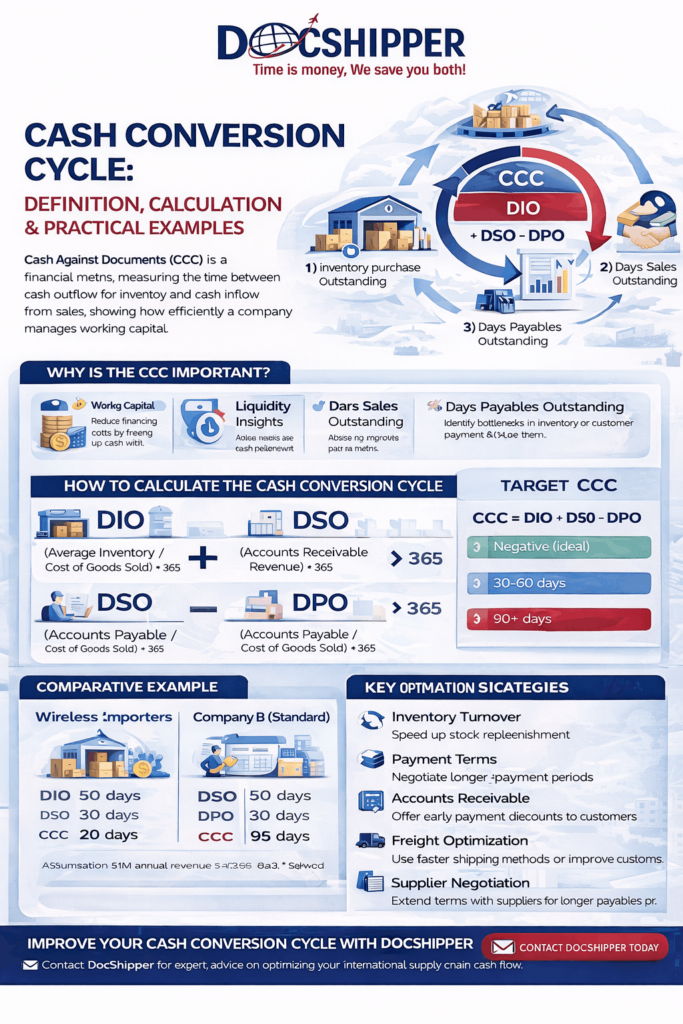
The Cash Conversion Cycle formula combines three components: CCC = DIO + DSO – DPO. Each element represents a distinct phase in the cash flow timeline.
Days Inventory Outstanding measures inventory efficiency. In international trade, this includes transit time from factory to warehouse. High DIO indicates overstocking or slow-moving products. Calculate it as: (Average Inventory / Cost of Goods Sold) × 365.
Days Sales Outstanding tracks collection efficiency. Cross-border transactions often involve letters of credit or extended payment terms. DSO calculation: (Accounts Receivable / Revenue) × 365. According to International Monetary Fund data, global trade payment terms average 45-60 days.
Days Payables Outstanding represents supplier payment timing. Longer DPO improves cash position but may strain supplier relationships. Formula: (Accounts Payable / Cost of Goods Sold) × 365. Negotiating favorable terms becomes crucial in import operations.
A negative CCC indicates the company receives customer payments before paying suppliers—an ideal scenario. Positive CCC requires financing to bridge the gap. At DocShipper, we help clients optimize payment terms and shipping schedules to reduce their Cash Conversion Cycle and improve liquidity management.
Industry benchmarks vary significantly. Retail typically shows 30-60 day cycles, while manufacturing may extend to 90-120 days. International logistics adds 15-45 days depending on shipping routes and customs procedures.
Practical Examples & Comparative Data
Consider two importers with identical revenue but different cycle management:
| Metric | Company A (Optimized) | Company B (Standard) |
|---|---|---|
| DIO | 45 days | 75 days |
| DSO | 30 days | 60 days |
| DPO | 60 days | 30 days |
| CCC | 15 days | 105 days |
| Working Capital Need | $41,096 | $287,671 |
Assuming $1M annual revenue, Company A requires significantly less working capital. This translates to reduced financing costs and improved return on invested capital.
Real-world case: An electronics importer reduced CCC from 85 to 42 days by implementing just-in-time inventory, negotiating 45-day supplier terms, and offering 2% early payment discounts to customers. Annual working capital needs dropped by $180,000.
Key optimization strategies include:
- Inventory management: Air freight for fast-moving items, sea freight for bulk
- Payment term negotiation: Leverage volume for extended DPO
- Invoice factoring: Convert receivables to immediate cash
- Demand forecasting: Reduce excess inventory holding
- Customs efficiency: Pre-clearance reduces DIO by 5-10 days
International trade adds complexity through currency fluctuations and documentation delays. A 30-day shipping transit effectively increases DIO before goods even reach your warehouse.
Conclusion
The Cash Conversion Cycle directly determines working capital efficiency and business sustainability. Optimizing each component—inventory turnover, collection speed, and payment timing—creates competitive advantage through improved liquidity.
Need expert guidance on optimizing your international supply chain cash flow? Contact DocShipper for customized logistics solutions that reduce your Cash Conversion Cycle.
📚 Quiz
Test Your Knowledge: Cash Conversion Cycle
Q1. What does the Cash Conversion Cycle (CCC) measure?
Q2. A company has a negative Cash Conversion Cycle. What does this mean?
Q3. An electronics importer ships goods by ocean freight (30-day transit). How does this directly affect their Cash Conversion Cycle?
🎯 Your Result
📞 Free Quote in 24hFAQ | Cash Conversion Cycle: Definition, Calculation & Practical Examples
A CCC below 30 days is excellent, 30-60 days is good, and above 90 days requires optimization. Negative cycles indicate superior cash management where customers pay before supplier obligations.
Ocean freight adds 20-45 days to DIO, while air freight adds 3-7 days. Customs clearance delays can extend the cycle by another 5-15 days depending on documentation accuracy and port efficiency.
Yes, companies like Amazon maintain negative cycles by collecting customer payments immediately while negotiating extended supplier terms. This requires strong market position and efficient inventory turnover.
CCC measures time duration in days, while working capital measures dollar amount (current assets minus current liabilities). CCC efficiency directly impacts working capital requirements.
Monthly monitoring provides actionable insights. Quarterly deep analysis helps identify trends. Annual comparison reveals long-term efficiency improvements or deterioration requiring strategic adjustments.
Not automatically. Aggressive inventory reduction may cause stockouts. Pressuring customers for faster payment might lose sales. Balance cycle optimization with customer satisfaction and supplier relationships.
Letters of Credit typically add 7-14 days to DSO due to bank processing. However, they reduce risk. The security benefit often outweighs the slight CCC extension in international transactions.
Professional customs clearance reduces DIO by preventing delays. Pre-clearance and accurate documentation can shave 5-10 days off the cycle, directly improving cash flow in import operations.
Seasonal fluctuations are normal. Calculate separate cycles for peak and off-peak periods. Focus on year-over-year improvements rather than month-to-month comparisons for meaningful trend analysis.
Inventory financing doesn't change the CCC calculation but reduces the cash burden. It converts inventory into immediate working capital while goods await sale, bridging the gap without altering underlying efficiency.
Real-time tracking reduces uncertainty in DIO calculations. Knowing exact inventory location and status enables better demand forecasting and inventory positioning, ultimately shortening the conversion cycle.
Absolutely critical. Startups have limited capital reserves. A 90-day cycle versus 30-day cycle can mean the difference between sustainable growth and cash-strapped failure. Early optimization establishes healthy financial habits.
Need Help with Logistics or Sourcing ?
First, we secure the right products from the right suppliers at the right price by managing the sourcing process from start to finish. Then, we simplify your shipping experience - from pickup to final delivery - ensuring any product, anywhere, is delivered at highly competitive prices.


Fill the Form
Prefer email? Send us your inquiry, and we’ll get back to you as soon as possible.
Contact us