


In short ⚡
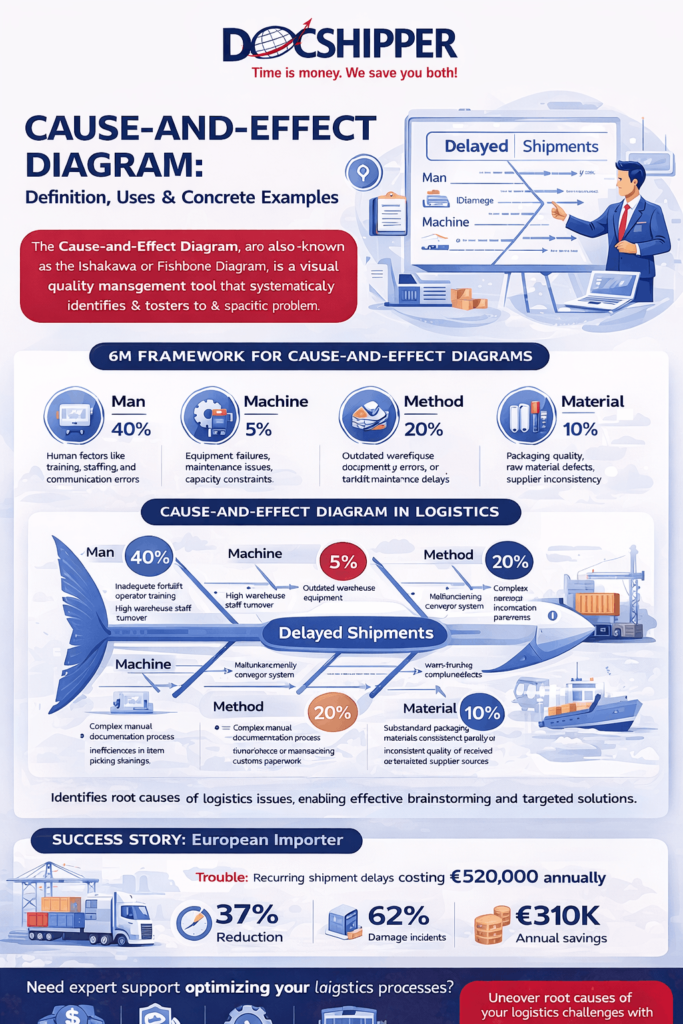
The Cause-and-Effect Diagram, also known as the Ishikawa or Fishbone Diagram, is a visual quality management tool that systematically identifies and organizes potential causes contributing to a specific problem or effect in logistics operations. It categorizes root causes into major groups to facilitate structured problem-solving and process improvement.
Introduction
Supply chain disruptions cost businesses millions annually, yet many companies struggle to pinpoint the exact root causes behind recurring issues. Delayed shipments, damaged goods, and customs clearance problems often stem from multiple interconnected factors that remain invisible without proper analysis.
The Cause-and-Effect Diagram addresses this challenge by providing a structured framework for identifying and categorizing problem sources in international logistics. Originally developed by Dr. Kaoru Ishikawa in the 1960s, this tool has become essential for quality control and continuous improvement in global trade operations.
Key characteristics of Cause-and-Effect Diagrams in logistics:
- Visual representation that maps relationships between problems and their contributing factors
- Categorical organization typically using the 6M framework (Man, Machine, Method, Material, Measurement, Environment)
- Collaborative tool that facilitates team brainstorming and cross-functional problem-solving
- Root cause identification that goes beyond symptoms to address fundamental issues
- Documentation capability that creates a permanent record of analysis for future reference
In-Depth Analysis & Expert Methodology
The Cause-and-Effect Diagram operates on a fundamental principle: every effect has multiple causes that can be systematically categorized and analyzed. The diagram’s fishbone structure places the problem statement (effect) at the head, with major cause categories branching off as “bones.”
In international logistics, the 6M framework provides the most comprehensive categorization system. Man (Manpower) encompasses human factors such as training gaps, communication errors, or staffing shortages. Machine (Equipment) addresses technical failures, outdated systems, or capacity constraints affecting cargo handling.
Method (Process) examines procedural weaknesses, including inadequate documentation protocols, inefficient workflows, or non-compliant customs procedures. Material covers issues related to packaging quality, product specifications, or raw material defects that impact shipment integrity.
Measurement identifies problems with data accuracy, tracking systems, or performance metrics that lead to incorrect decisions. Environment (Mother Nature) considers external factors such as weather conditions, regulatory changes, or market fluctuations beyond direct control.
The construction process follows a structured methodology. Teams begin by clearly defining the problem statement with measurable specificity. Brainstorming sessions then populate each major category with potential causes, which are further subdivided into sub-causes through iterative questioning techniques like the “5 Whys.”
According to the American Society for Quality, effective Cause-and-Effect Diagrams require cross-functional participation to capture diverse perspectives. At DocShipper, we systematically apply this tool during client onboarding to identify potential bottlenecks before they impact shipment timelines, ensuring proactive risk mitigation throughout the supply chain.
The diagram’s analytical power lies in its ability to reveal hidden interdependencies between seemingly unrelated factors. For instance, a customs clearance delay might trace back to inadequate staff training (Man), outdated classification software (Machine), and ambiguous documentation procedures (Method) simultaneously.
Concrete Examples & Data-Driven Applications
Real-world application demonstrates the diagram’s practical value in resolving complex logistics challenges. Consider a European importer experiencing a 23% increase in damaged cargo arrivals over six months.
Case Study: Cargo Damage Analysis
Problem Statement: 23% increase in damaged goods upon arrival at destination port.
| Category | Identified Causes | Impact Level |
|---|---|---|
| Man | Warehouse staff untrained in fragile goods handling protocols | High (40%) |
| Material | Substandard packaging materials from new supplier | High (35%) |
| Method | Inadequate quality inspection before container loading | Medium (15%) |
| Machine | Forklift equipment exceeding recommended load capacity | Low (10%) |
Analysis revealed that 75% of damage stemmed from just two categories: inadequate staff training and inferior packaging materials. This data-driven insight enabled targeted corrective actions, reducing damage rates to 8% within three months through comprehensive training programs and supplier quality audits.
Comparative Application Across Industries:
- Manufacturing: 68% of companies using Cause-and-Effect Diagrams report faster defect resolution times (average 12 days vs. 28 days without structured analysis)
- Pharmaceutical logistics: Temperature excursion incidents decreased by 41% after implementing fishbone analysis for cold chain failures
- E-commerce fulfillment: Order accuracy improved from 94.2% to 98.7% following systematic cause identification for picking errors
- Automotive supply chains: Just-in-time delivery compliance increased 22% through root cause analysis of delay patterns
- Perishable goods transport: Spoilage rates reduced by 34% after mapping environmental and timing factors affecting freshness
A practical simulation for customs clearance delays illustrates the methodology. Assume an importer faces average clearance times of 9 days versus the industry standard of 4 days. The Cause-and-Effect Diagram might reveal:
Primary causes: Incomplete commercial invoices (Method – 30%), HS code misclassification (Man – 25%), outdated compliance software (Machine – 20%), inconsistent supplier documentation (Material – 15%), and seasonal customs staffing shortages (Environment – 10%).
By quantifying each factor’s contribution, the importer can prioritize solutions. Implementing automated HS code validation and supplier documentation standards could address 45% of delays with relatively low investment, while seasonal staffing issues require alternative strategies like advance filing or bonded warehouse utilization.
Conclusion
The Cause-and-Effect Diagram transforms complex logistics challenges into manageable, categorized problems with identifiable solutions. Its structured approach prevents costly guesswork and enables data-driven decision-making across international supply chains.
Need expert guidance in applying root cause analysis to your logistics operations? Contact DocShipper for comprehensive supply chain optimization support.
📚 Quiz
Test Your Knowledge: Cause-and-Effect Diagram
Q1 — What is the primary purpose of a Cause-and-Effect Diagram in logistics?
Q2 — In the 6M framework used with Cause-and-Effect Diagrams, which category would cover an outdated HS code classification software causing customs delays?
Q3 — A logistics manager discovers that 75% of cargo damage stems from only two cause categories. What is the recommended next step according to the Cause-and-Effect methodology?
🎯 Your Result
📞 Free Quote in 24hFAQ | Cause-and-Effect Diagram: Definition, Application & Concrete Examples
Cause-and-Effect Diagrams identify multiple potential causes qualitatively, while fault tree analysis uses Boolean logic to calculate failure probabilities quantitatively. The fishbone approach is exploratory; fault trees require predefined failure scenarios.
There is no fixed limit, but practical diagrams typically include 3-7 primary causes per category, with 2-4 sub-causes for each. Overcrowding reduces clarity; prioritize factors with measurable impact on the problem.
Yes. Organizations use "reverse fishbone diagrams" to identify factors contributing to successful outcomes, enabling replication of best practices. The structure remains identical, but the "effect" represents a desired result rather than a problem.
Cross-functional teams of 5-8 participants produce the most comprehensive results. Smaller groups may lack diverse perspectives; larger groups become difficult to facilitate effectively. Include representatives from operations, quality, and management.
Use data collection to quantify each cause's contribution, then apply Pareto analysis (80/20 rule). Voting systems, impact-effort matrices, or statistical correlation studies help rank causes objectively before resource allocation.
Yes. Software like Lucidchart, Microsoft Visio, Minitab, and specialized quality management platforms offer templates. Digital tools enable collaborative editing, version control, and integration with other process improvement methodologies.
Cause-and-Effect Diagrams are a core tool in Six Sigma's "Analyze" phase (DMAIC cycle). They complement statistical analysis by providing visual hypothesis generation before data-driven validation of root causes.
Review quarterly or whenever significant process changes occur. Seasonal variations, new suppliers, regulatory updates, or technology implementations may introduce new causal factors requiring diagram revision and updated corrective actions.
While possible, separate diagrams for each distinct problem provide clearer analysis. If problems share root causes, create individual diagrams first, then synthesize findings. Combining problems prematurely obscures specific causal relationships.
Frequent errors include vague problem statements, confusing symptoms with causes, insufficient team diversity, premature solution focus before full cause identification, and failure to validate hypotheses with actual data post-construction.
The 8M framework adds "Management" (leadership decisions, policies) and "Maintenance" (preventive care, equipment upkeep) to the original 6Ms. This expanded model better captures organizational and asset management factors in complex operations.
Include the problem statement with baseline metrics, participant list, date created, data sources validating each cause, prioritization methodology used, assigned corrective actions, responsible parties, and follow-up review schedule for comprehensive traceability.
Need Help with
Logistics or Sourcing ?
First, we secure the right products from the right suppliers at the right price by managing the sourcing process from start to finish. Then, we simplify your shipping experience - from pickup to final delivery - ensuring any product, anywhere, is delivered at highly competitive prices.


Fill the Form
Prefer email? Send us your inquiry, and we’ll get back to you as soon as possible.
Contact us


