


In short ⚡
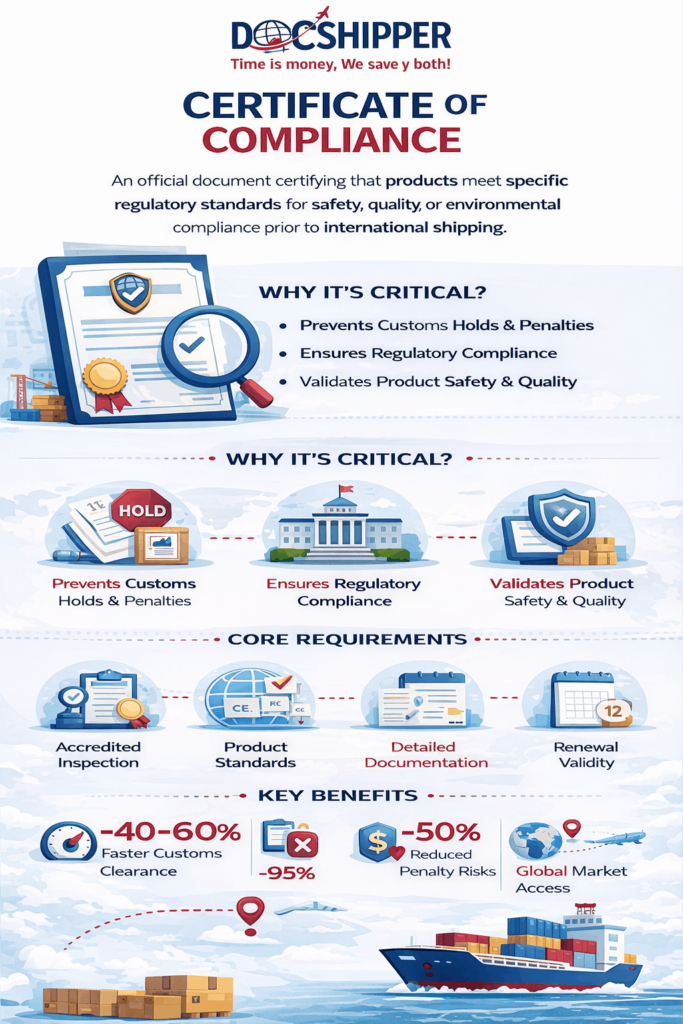
A Certificate of Compliance (CoC) is an official document certifying that goods, products, or processes meet specific regulatory standards, safety requirements, or technical specifications mandated by importing countries. This certificate validates conformity with legal, quality, or environmental norms before customs clearance.
Introduction
Import-export operations frequently encounter delays when shipments lack proper compliance documentation. The Certificate of Compliance represents a critical validation tool that prevents costly customs holds and regulatory penalties.
This certification bridges the gap between manufacturing standards and destination country regulations. Without it, shipments face rejection, quarantine, or destruction at borders.
Key characteristics of Certificates of Compliance include:
- Third-party verification by accredited inspection bodies or government agencies
- Product-specific standards covering safety, environmental impact, and technical performance
- Country-dependent requirements varying by destination market regulations
- Time-sensitive validity with expiration dates requiring periodic renewal
- Legal enforceability backed by international trade agreements and national laws
Regulatory Framework & Compliance Mechanisms
The Certificate of Compliance operates within complex regulatory ecosystems that vary significantly across jurisdictions. Understanding these mechanisms prevents shipment disruptions.
Issuing authorities include government agencies (FDA, CE marking bodies), independent testing laboratories (SGS, Bureau Veritas), and industry-specific certification organizations. Each authority follows standardized protocols aligned with international norms like ISO standards or regional directives.
Mandatory compliance sectors typically encompass electronics (electromagnetic compatibility), food products (sanitary regulations), pharmaceuticals (GMP certification), and chemicals (REACH compliance in the EU). These sectors face strict pre-shipment inspection requirements.
Verification processes involve laboratory testing, factory audits, documentation review, and sample analysis. Inspection bodies assess manufacturing processes, quality control systems, and product specifications against declared standards. This multi-layered approach ensures genuine compliance rather than superficial documentation.
Legal implications extend beyond customs clearance. Non-compliant shipments trigger penalties ranging from import bans to criminal liability for safety violations. The EU Product Safety Directive and US Consumer Product Safety Act impose strict manufacturer accountability. According to EU conformity assessment regulations, non-compliance can result in market withdrawal and financial penalties up to 4% of annual turnover.
Documentation integration requires coordination with commercial invoices, packing lists, and bills of lading. The CoC must reference specific shipment details including HS codes, product descriptions, and quantity declarations. At DocShipper, we systematically cross-reference compliance certificates with shipping documentation to prevent discrepancies that trigger customs audits.
Renewal cycles vary by product category and destination. Electronics certifications often require annual revalidation, while construction materials may hold five-year validity periods. Tracking these timelines prevents expired certificates from delaying shipments.
Practical Applications & Case Studies
Real-world compliance scenarios demonstrate the tangible impact of proper certification on supply chain efficiency and cost management.
Comparative Compliance Requirements by Region
| Region | Primary Standard | Issuing Body | Typical Cost Range | Processing Time |
|---|---|---|---|---|
| European Union | CE Marking | Notified Bodies | $2,000–$15,000 | 4–12 weeks |
| United States | FCC/FDA Certification | Accredited Labs | $1,500–$10,000 | 3–8 weeks |
| Middle East (GCC) | G-Mark/SASO | Government Agencies | $800–$5,000 | 2–6 weeks |
| China | CCC Certification | CNCA | $3,000–$20,000 | 8–16 weeks |
| Australia | RCM Mark | ACMA-Accredited | $1,200–$8,000 | 3–10 weeks |
Case Study: Electronics Shipment to Germany
A US manufacturer shipping 5,000 Bluetooth speakers to Hamburg required CE marking compliance. Initial testing revealed electromagnetic interference exceeding EN 55032 limits. Redesign costs totaled $12,000, delaying shipment by six weeks. However, obtaining proper certification prevented potential €50,000 in penalties and product recalls.
Cost breakdown: Product testing ($4,500), technical file preparation ($2,800), notified body review ($3,200), factory audit ($1,500). Total investment: $12,000 versus potential loss of $87,000 (shipment value + penalties).
Key Compliance Factors
Five critical elements determine certification success:
- Pre-shipment planning: Initiate compliance verification 90–120 days before export deadlines
- Standard identification: Match product categories to destination-specific regulatory codes
- Accredited partner selection: Verify testing lab accreditation through official registries
- Documentation accuracy: Ensure technical specifications align with physical product samples
- Continuous monitoring: Track regulatory updates through government portals and industry associations
Failure rates for first-time applicants average 23% across industries, primarily due to incomplete technical documentation or mismatched product specifications. Working with experienced compliance consultants reduces rejection rates to below 5%.
Conclusion
The Certificate of Compliance serves as the gateway between production and global market access, transforming regulatory requirements into competitive advantages for prepared exporters. Proper certification management reduces clearance times by 40–60% while eliminating costly rejections.
Need expert guidance on compliance certification for your shipments? Contact DocShipper for comprehensive support navigating international regulatory requirements.
📚 Quiz
Certificate of Compliance
Q1 — What is the primary purpose of a Certificate of Compliance (CoC) in international trade?
Q2 — A manufacturer believes one Certificate of Compliance obtained in the EU will automatically cover their shipments to the United States and China. Is this correct?
Q3 — A US exporter is planning to ship 5,000 Bluetooth speakers to Germany in 10 weeks. When should they initiate the compliance certification process?
🎯 Your Result
📞 Free Quote in 24hFAQ | Certificate of Compliance: Definition, Requirements & Practical Examples
Electronics, medical devices, food products, cosmetics, toys, construction materials, and chemicals typically require CoC documentation. Requirements depend on destination country regulations and product risk classification.
Processing times range from 2–16 weeks depending on product complexity, testing requirements, and certification body workload. Rush services may reduce timelines by 30–50% at premium costs.
Generally no. Each jurisdiction maintains unique standards. However, some mutual recognition agreements exist (e.g., EU-US MRA for certain products), allowing single certifications to cover multiple markets.
Customs authorities may detain goods, demand immediate certification, impose fines, or order shipment return/destruction. Delays average 15–45 days with storage fees accumulating daily.
Responsibility typically falls on the manufacturer or importer of record, depending on trade terms (Incoterms). Exporters should clarify obligations in sales contracts to avoid disputes.
Costs vary widely: $800–$20,000 depending on product type, testing complexity, and certification body. Annual renewals typically cost 30–50% less than initial certifications.
No. CoC verifies product compliance with safety/quality standards, while Certificate of Origin documents manufacturing location for tariff determination and trade agreement eligibility.
Some jurisdictions allow manufacturer self-declaration for low-risk products. However, high-risk categories (medical devices, explosives) require third-party certification from accredited bodies.
Check official government registries (e.g., NIST for US, ACCREDIA for Italy) or international accreditation databases like IAF/ILAC. Fraudulent certifications result in shipment seizure and legal penalties.
Essential elements include issuing body details, product description, applicable standards, test results, manufacturer information, certification date, validity period, and unique certificate number.
Yes, when issued by accredited bodies through secure platforms. Many customs authorities now accept electronic certificates with digital signatures, reducing processing times and paperwork.
Renewal frequency depends on product category and certification type. Annual renewals are common for electronics, while construction materials may have 3–5 year validity periods. Track expiration dates carefully.
Need Help with
Logistics or Sourcing ?
First, we secure the right products from the right suppliers at the right price by managing the sourcing process from start to finish. Then, we simplify your shipping experience - from pickup to final delivery - ensuring any product, anywhere, is delivered at highly competitive prices.


Fill the Form
Prefer email? Send us your inquiry, and we’ll get back to you as soon as possible.
Contact us


