


In short ⚡
The Certificate of Free Sale (CFS) is an official document issued by a government authority or regulatory body certifying that a product is legally sold and distributed in the country of origin. This certificate confirms the product complies with local regulations and is freely marketable, serving as essential proof for international trade and customs clearance.
Introduction
Many exporters encounter costly delays when importing regulated products without proper documentation. Customs authorities in destination countries frequently reject shipments lacking proof that goods meet manufacturing country standards.
The Certificate of Free Sale bridges this documentation gap. It serves as governmental validation that products—particularly pharmaceuticals, medical devices, cosmetics, and food supplements—are approved for commercial distribution in their origin market.
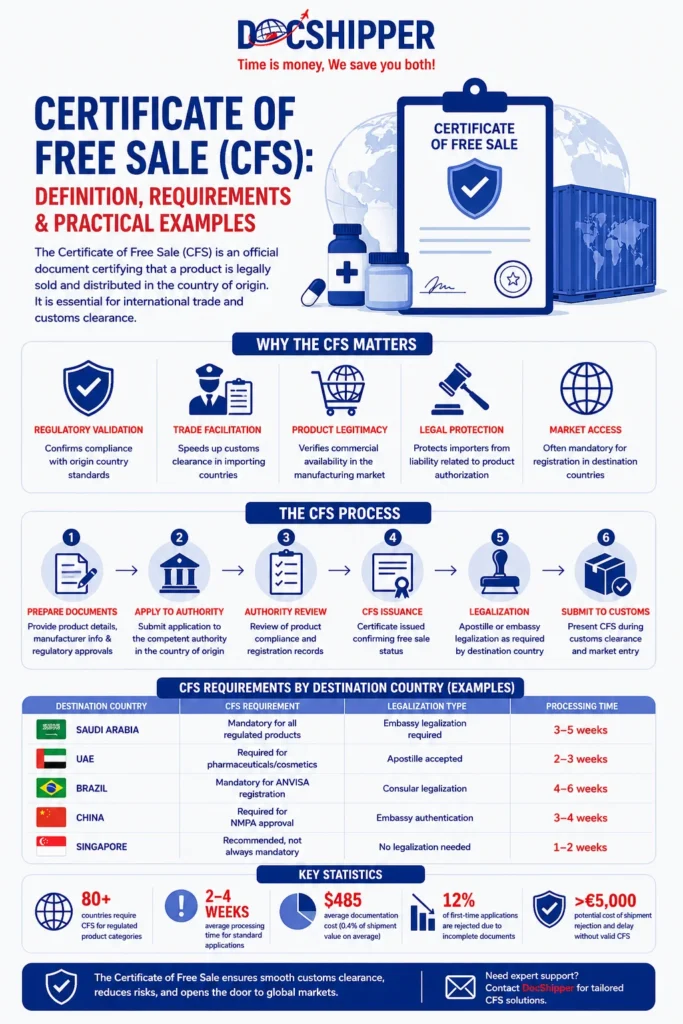
Key characteristics of the CFS include:
- Regulatory validation: Confirms compliance with origin country standards
- Trade facilitation: Accelerates customs clearance in importing nations
- Product legitimacy: Verifies commercial availability in the manufacturing market
- Legal protection: Shields importers from liability regarding product authorization
- Market access: Often mandatory for registration in destination countries
Regulatory Framework & Compliance Requirements
The Certificate of Free Sale operates within complex regulatory ecosystems. Issuing authorities vary by product category and jurisdiction, creating a multilayered approval process for international traders.
Issuing authorities typically include health ministries, food safety agencies, or chambers of commerce. In the United States, the FDA issues CFS for pharmaceuticals and medical devices. European exporters obtain certificates from national competent authorities like ANSM in France or BfArM in Germany.
The document must contain mandatory elements: product name and description, manufacturer details, regulatory approval references, product registration numbers, and an explicit statement confirming free sale status. Missing any component renders the certificate invalid for customs purposes.
Legalization requirements add another compliance layer. Many destination countries require apostille certification under the Hague Convention or embassy legalization. This authentication chain verifies the issuing authority’s legitimacy and the document’s authenticity.
Product categories requiring CFS include pharmaceuticals (prescription and OTC medications), medical devices (from surgical instruments to diagnostic equipment), cosmetics and personal care products, dietary supplements, and increasingly, food products for specific markets.
Processing timelines vary significantly. Standard applications typically require 2-4 weeks, though expedited services exist. At DocShipper, we streamline this process by coordinating directly with regulatory authorities to minimize delays and ensure complete documentation compliance.
For comprehensive regulatory guidance, consult the FDA’s Certificate of Exportability guidelines or your national regulatory authority.
Practical Applications & Country-Specific Examples
Understanding CFS requirements through concrete scenarios clarifies this document’s critical role in international trade. Different markets impose varying documentation standards that directly impact shipment clearance.
Comparative Requirements by Destination Market
| Destination Country | CFS Requirement | Legalization Type | Processing Time |
|---|---|---|---|
| Saudi Arabia | Mandatory for all regulated products | Embassy legalization required | 3-5 weeks |
| UAE | Required for pharmaceuticals/cosmetics | Apostille accepted | 2-3 weeks |
| Brazil | Mandatory for ANVISA registration | Consular legalization | 4-6 weeks |
| China | Required for NMPA approval | Embassy authentication | 3-4 weeks |
| Singapore | Recommended, not always mandatory | No legalization needed | 1-2 weeks |
Case Study: Pharmaceutical Export to Middle East
A European pharmaceutical manufacturer sought to export vitamin supplements to Saudi Arabia. The shipment value totaled €120,000 with 5,000 units.
Documentation requirements: The Saudi Food and Drug Authority (SFDA) mandated a Certificate of Free Sale from the origin country, legalized through the Saudi embassy. The manufacturer obtained the CFS from their national health authority, then submitted it for apostille and embassy authentication.
Timeline breakdown: CFS issuance took 10 business days. Apostille processing required 5 days. Embassy legalization added 12 days. Total documentation timeline: 27 days before shipment departure.
Cost implications: CFS application fee: €150. Apostille: €35. Embassy legalization: €180. Translation services: €120. Total documentation cost: €485, representing 0.4% of shipment value—a minimal investment preventing potential rejection costs exceeding €5,000.
Outcome: Customs clearance in Riyadh proceeded without delays. The complete documentation package enabled immediate SFDA review and market authorization, allowing product distribution within 48 hours of arrival.
Critical Success Factors
- Advance planning: Initiate CFS applications 6-8 weeks before planned shipment
- Accuracy verification: Ensure product names match exactly across all documentation
- Regulatory monitoring: Track destination country requirement changes
- Translation quality: Use certified translators for non-English documents
- Digital copies: Maintain electronic backups for expedited reissuance if needed
DocShipper systematically manages these requirements for clients, coordinating with regulatory bodies across 50+ countries to ensure compliant documentation for every shipment.
Conclusion
The Certificate of Free Sale represents more than bureaucratic formality—it’s a strategic compliance tool enabling market access across regulated industries. Proper documentation prevents costly shipment rejections and accelerates international market entry.
Need expert guidance on CFS requirements for your specific products and destinations? Contact DocShipper for comprehensive documentation support tailored to your international trade needs.
📚 Quiz
Certificate of Free Sale
1. What does a Certificate of Free Sale (CFS) officially certify?
2. A manufacturer produces a pharmaceutical product exclusively for export — it is not sold on the domestic market. Can they obtain a Certificate of Free Sale for this product?
3. A European exporter is shipping cosmetics to Brazil. Which authentication process does the CFS require before Brazilian customs will accept it?
🎯 Your Result
📞 Free Quote in 24hFAQ | Certificate of Free Sale: Definition, Requirements & Practical Examples
Pharmaceuticals, medical devices, cosmetics, dietary supplements, and certain food products typically require CFS for international trade. Requirements vary by destination country regulations and product classification.
Validity periods range from 6 months to 2 years depending on the issuing authority and destination country requirements. Most certificates remain valid for one year from issuance date.
Yes, provided the certificate remains within its validity period and covers the exact products being shipped. Some countries require original certificates for each shipment, while others accept certified copies.
A Certificate of Origin identifies manufacturing location for tariff purposes. A CFS confirms regulatory approval and free sale status in the origin market—addressing product compliance rather than geographic origin.
Government regulatory agencies issue CFS documents. In the US, the FDA issues them; in EU countries, national health authorities; in other regions, health ministries or designated regulatory bodies handle issuance.
Not universally. Countries party to the Hague Convention accept apostille. Non-member countries require full consular legalization through their embassies. Destination country requirements determine the authentication level needed.
Generally no. The certificate confirms products are freely sold in the origin market. Export-only products typically cannot obtain CFS, though some authorities issue alternative export certificates.
Essential elements include product name, manufacturer details, regulatory approval numbers, explicit free sale confirmation, issuing authority stamp/signature, and issuance date. Missing elements invalidate the certificate for customs purposes.
Fees vary by country and product type, typically ranging from $50 to $300 per certificate. Additional costs include legalization ($30-$200), translation services ($50-$150), and expedited processing fees if applicable.
Customs authorities may refuse entry, detain the shipment, or impose storage fees pending documentation. In severe cases, goods face destruction or forced re-export at the shipper's expense, creating significant financial losses.
Acceptance varies by country. Some customs authorities accept certified digital copies, while others mandate original physical documents with wet signatures and official seals. Always verify destination country requirements beforehand.
GMP certification validates manufacturing process quality standards. CFS confirms regulatory approval and market availability. Both documents serve distinct compliance purposes, and many markets require both for regulated product imports.
Need Help with
Logistics or Sourcing ?
First, we secure the right products from the right suppliers at the right price by managing the sourcing process from start to finish. Then, we simplify your shipping experience - from pickup to final delivery - ensuring any product, anywhere, is delivered at highly competitive prices.


Fill the Form
Prefer email? Send us your inquiry, and we’ll get back to you as soon as possible.
Contact us




