


In short ⚡
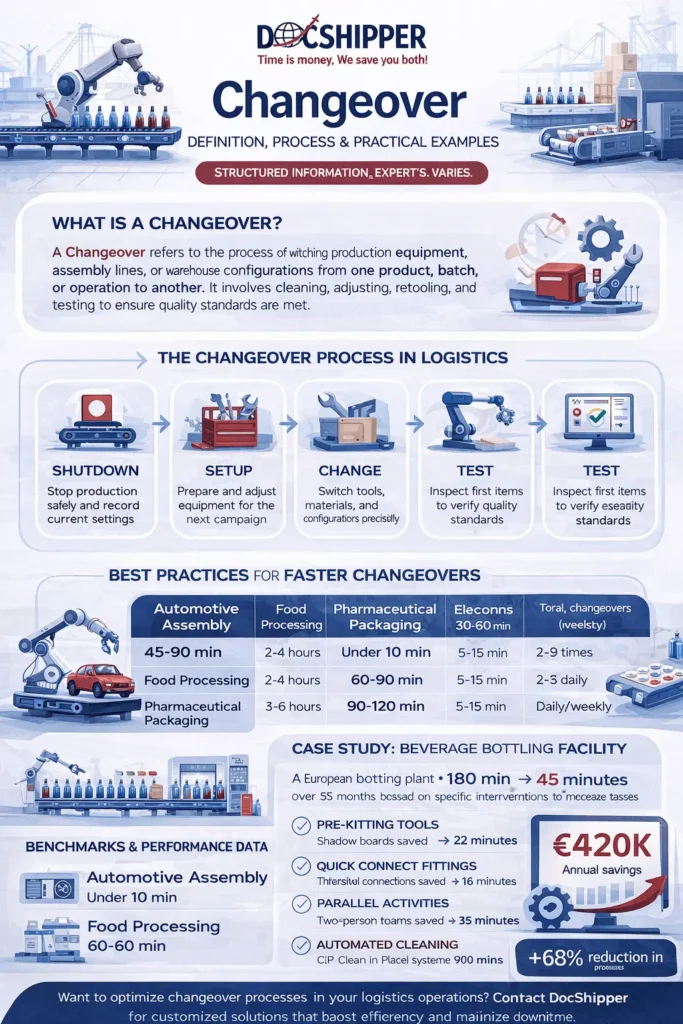
Changeover refers to the process of switching production equipment, assembly lines, or warehouse configurations from one product, batch, or operation to another. It encompasses all activities required to stop producing one item and start producing a different one, including cleaning, adjusting, retooling, and testing equipment to ensure quality standards are met.
Introduction
Many manufacturers struggle with production delays caused by inefficient equipment transitions. Each minute spent switching between product runs translates directly into lost revenue and reduced throughput capacity.
Changeover optimization has become critical in modern supply chain management. In industries demanding high product variety with short lead times, minimizing transition periods determines competitive advantage.
Key characteristics of effective changeover management include:
- Standardized procedures – Documented step-by-step protocols reduce variation and errors
- Time measurement – Tracking SMED (Single-Minute Exchange of Die) metrics identifies improvement opportunities
- Cross-functional training – Operators skilled in multiple setups accelerate transitions
- Pre-staging materials – Preparing tools and components before shutdown eliminates waiting time
- Quality verification – First-piece inspection ensures new production meets specifications immediately
Technical Mechanisms & Operational Impact
The changeover process involves both internal activities (performed while equipment is stopped) and external activities (completed while machines run). Lean manufacturing principles focus on converting internal tasks to external ones whenever possible.
Manufacturing facilities typically categorize changeovers into three types. Minor changeovers require simple adjustments like changing labels or packaging materials. Major changeovers involve significant equipment reconfiguration, such as replacing molds or dies. Product family changeovers transition between similar items requiring minimal modification.
Regulatory compliance adds complexity in regulated industries. Pharmaceutical and food production facilities must follow FDA guidelines for cleaning validation between product runs. Documentation proving complete removal of allergens or active pharmaceutical ingredients becomes mandatory.
The SMED methodology pioneered by Shigeo Shingo systematically reduces changeover time. By separating internal and external activities, standardizing procedures, and eliminating adjustment steps, companies achieve dramatic time reductions. Toyota famously reduced press changeovers from four hours to three minutes using these principles.
At DocShipper, we help clients optimize warehouse changeovers when transitioning between different import campaigns. Our logistics experts implement staging protocols that minimize disruption to ongoing operations while preparing for new product arrivals.
Digital tracking systems revolutionize changeover management. IoT sensors monitor equipment status in real-time, triggering automated material delivery when transitions begin. Predictive analytics identify patterns causing delays, enabling proactive intervention before problems escalate.
Practical Examples & Performance Data
Industry benchmarks reveal significant performance variation across sectors. Understanding these metrics helps companies set realistic improvement targets and measure progress effectively.
| Industry | Average Changeover Time | Best-in-Class Target | Typical Frequency |
|---|---|---|---|
| Automotive Assembly | 45-90 minutes | Under 10 minutes | 2-3 times per shift |
| Food Processing | 2-4 hours | 60-90 minutes | 1-2 times daily |
| Pharmaceutical Packaging | 3-6 hours | 90-120 minutes | Weekly |
| Electronics Manufacturing | 30-60 minutes | 5-15 minutes | Multiple times daily |
Case Study: Beverage Bottling Facility
A European bottling plant reduced changeover time from 180 minutes to 45 minutes over six months. The improvement came from five specific interventions:
- Pre-kitting tools – Shadow boards with color-coded equipment reduced search time by 22 minutes
- Quick-connect fittings – Replacing threaded connections saved 18 minutes per changeover
- Parallel activities – Two-person teams working simultaneously cut time by 35 minutes
- Automated cleaning cycles – CIP (Clean-in-Place) systems eliminated 40 minutes of manual cleaning
- Visual work instructions – Digital displays reduced errors requiring rework by 68%
The facility calculated annual savings of €420,000 from increased production capacity. Additional benefits included 15% reduction in product waste during startup and improved employee morale from eliminating frustrating delays.
Financial impact varies significantly by production volume. High-volume operations with frequent changeovers see dramatic ROI from time reduction. A manufacturer performing 500 changeovers annually saves approximately €850 per hour reduced, assuming €170/hour fully-loaded production cost.
Conclusion
Changeover efficiency directly impacts production capacity, cost structure, and customer responsiveness. Companies implementing systematic improvement programs consistently outperform competitors in delivery speed and operational flexibility.
Need expert guidance optimizing your logistics transitions? Contact DocShipper for customized solutions that streamline your supply chain operations.
📚 Quiz
Test Your Knowledge: Changeover
Q1 — What does "changeover" refer to in a manufacturing or logistics context?
Q2 — A production manager says: "We only need to worry about changeover time while the machine is stopped." Is this correct?
Q3 — A beverage bottling plant wants to cut its 180-minute changeover time in half. Which approach is most aligned with SMED methodology?
🎯 Your Result
📞 Free Quote in 24hFAQ | Changeover: Definition, Process & Practical Examples in Logistics
Setup time refers specifically to preparing equipment before production starts, while changeover encompasses the entire transition including shutdown, cleaning, adjustment, and restart activities. Changeover is the broader term containing setup as one component.
SMED (Single-Minute Exchange of Die) converts internal activities to external ones performed while equipment runs, standardizes procedures to eliminate variation, and removes unnecessary adjustment steps. This methodology typically achieves 50-70% time reduction within initial implementation.
Best-practice manufacturers target changeover time below 5% of total production time. High-mix, low-volume operations may accept 10-15%, while mass production facilities often achieve under 2% through aggressive optimization programs.
Pharmaceutical manufacturing, chemical processing, and food production with allergen concerns typically require 2-6 hour changeovers due to extensive cleaning validation requirements. Regulatory compliance documentation adds significant time compared to non-regulated industries.
Complete elimination is impossible, but companies approach near-zero through dedicated equipment for each product variant. This strategy makes economic sense only for very high-volume items where equipment cost justifies eliminating transition time.
Skilled operators reduce changeover time by 30-50% compared to untrained personnel. Cross-training programs enabling any operator to perform any changeover eliminate delays waiting for specific individuals and improve scheduling flexibility.
Quick-change systems use standardized mounting interfaces, eliminating time-consuming bolt removal and alignment procedures. Magnetic clamping, pneumatic locks, and cartridge-style tool holders reduce mechanical changeover steps from 20-30 minutes to 2-5 minutes.
Essential metrics include total changeover time, first-pass quality rate, material waste during startup, frequency of changeovers, and labor hours consumed. Advanced manufacturers also track internal versus external activity ratios and improvement velocity.
Automation can both increase and decrease changeover time depending on flexibility. Dedicated automated lines eliminate changeovers but lack versatility. Flexible automation with quick-change end effectors and adaptive programming reduces transition time while maintaining product variety capability.
Faster changeovers enable smaller batch sizes, reducing work-in-process and finished goods inventory. Companies achieving single-digit minute changeovers often cut inventory carrying costs by 40-60% while improving product freshness and responsiveness to demand changes.
Most SMED implementations achieve positive ROI within 3-6 months through increased capacity utilization. Projects requiring capital equipment investment may extend to 12-18 months, but ongoing operational savings continue accumulating for years afterward.
Digital work instructions guide operators through procedures step-by-step, reducing errors and training time. Real-time dashboards display changeover status across facilities, enabling management intervention when delays occur. Historical data analytics identify recurring bottlenecks requiring systematic correction.
Need Help with
Logistics or Sourcing ?
First, we secure the right products from the right suppliers at the right price by managing the sourcing process from start to finish. Then, we simplify your shipping experience - from pickup to final delivery - ensuring any product, anywhere, is delivered at highly competitive prices.


Fill the Form
Prefer email? Send us your inquiry, and we’ll get back to you as soon as possible.
Contact us




