


In short ⚡
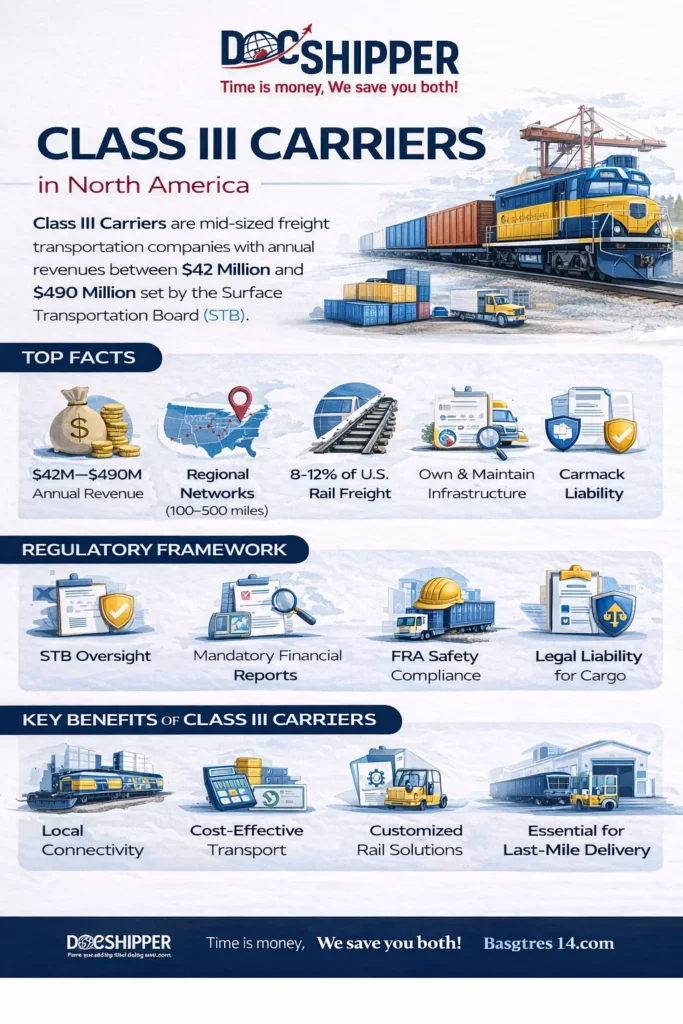
A Class III Carrier is a freight transportation company classified by the Surface Transportation Board (STB) with annual operating revenues between $42 million and $490 million. These mid-sized rail carriers bridge the gap between major Class I railroads and smaller Class II regional carriers, providing essential connections within North America's freight network while maintaining significant infrastructure and operational capacity.
Introduction
Many shippers mistakenly assume all rail carriers operate under identical regulations and capabilities. This misconception can lead to service mismatches and compliance issues in freight planning.
Understanding Class III Carrier classifications is critical for import/export operations. These carriers form the backbone of regional freight distribution, connecting ports to inland destinations and facilitating last-mile rail delivery where Class I carriers may not operate economically.
Key characteristics of Class III Carriers include:
- Revenue threshold: Annual operating revenues between $42 million and $490 million (adjusted periodically for inflation)
- Network scope: Typically operate regional or short-line networks spanning 100-500 miles
- Infrastructure ownership: Maintain dedicated track infrastructure, rolling stock, and terminal facilities
- Regulatory status: Subject to STB oversight but with less stringent reporting requirements than Class I carriers
- Market role: Provide essential connections between Class I mainlines and industrial facilities, ports, and distribution centers
Regulatory Framework & Classification Criteria
The Surface Transportation Board establishes carrier classifications based on annual operating revenue thresholds, which are inflation-adjusted every five years. Class III designation applies to carriers exceeding the Class II threshold but falling below Class I requirements.
The classification system serves multiple regulatory purposes. It determines reporting obligations, with Class III carriers required to submit quarterly financial reports but exempt from the extensive public disclosures mandated for Class I operators. It also affects rate regulation, as Class III carriers enjoy greater pricing flexibility for non-competitive routes.
From an operational standpoint, Class III carriers must maintain common carrier obligations, meaning they cannot refuse service without valid cause. They must also comply with Federal Railroad Administration (FRA) safety standards, including track maintenance protocols, crew certification requirements, and hazardous materials handling procedures.
The liability framework for Class III carriers differs from trucking or ocean freight. Under the Carmack Amendment, rail carriers assume full liability for cargo damage or loss during transit, unless caused by acts of God, shipper negligence, or inherent product defects. This creates distinct insurance and claims processes compared to other transport modes.
International shippers should note that Class III carriers often serve as connecting carriers in through-bill-of-lading arrangements. When DocShipper coordinates rail movements from U.S. ports, we verify interline agreements between Class I and Class III carriers to ensure seamless liability coverage and avoid gaps in cargo protection during transfers between rail networks.
For detailed classification criteria, consult the Surface Transportation Board official guidelines.
Operational Examples & Market Data
Approximately 35-40 Class III Carriers currently operate in North America, collectively managing over 15,000 route-miles of track. These carriers handle roughly 8-12% of total U.S. rail freight tonnage, demonstrating their significant role despite smaller individual market shares compared to Class I operators.
Consider this comparative scenario:
| Carrier Class | Revenue Range | Typical Network | Service Focus |
|---|---|---|---|
| Class I | $490M+ | Transcontinental (10,000+ miles) | Long-haul intermodal, bulk commodities |
| Class III | $42M – $490M | Regional (100-500 miles) | Port-to-warehouse, industrial switching |
| Class II | Below $42M | Short-line (50-150 miles) | Last-mile delivery, single-customer spurs |
Use Case: Container Movement from Port of Houston
A European manufacturer imports machinery components through Houston. The shipment requires delivery to a manufacturing facility 280 miles inland, served exclusively by a Class III carrier.
The logistics flow involves:
- Port discharge: Container unloaded and transferred to on-dock rail facility
- Class I linehaul: BNSF transports container 180 miles to interchange point
- Class III final delivery: Regional carrier completes 100-mile movement to plant siding
- Transit time: 4-6 days total (vs. 2-3 days for direct Class I service where available)
- Cost differential: Typically 15-25% lower than truck equivalent for this distance
At DocShipper, we pre-qualify Class III carriers for financial stability and service reliability before incorporating them into client supply chains, ensuring consistent performance despite their smaller operational scale.
Key operational metrics for Class III carriers:
- Average train speed: 15-25 mph (vs. 25-35 mph for Class I mainlines)
- Equipment utilization: 70-85% loaded car ratio
- Primary commodities: Chemicals, forest products, aggregates, agricultural products
- Interchange delays: Typically add 12-24 hours to total transit time
- Damage claim rates: 0.5-1.2% of shipments (comparable to Class I carriers)
Conclusion
Class III Carriers provide critical connectivity in North America’s freight ecosystem, enabling cost-effective rail access to locations beyond Class I networks. Understanding their regulatory status, operational capabilities, and service limitations is essential for optimizing import/export logistics strategies.
Need assistance navigating rail carrier options for your freight? Contact DocShipper for expert guidance on multimodal transportation solutions.
📚 Quiz
Test Your Knowledge: Class III Carrier
Q1 — According to the Surface Transportation Board (STB), what annual revenue range defines a Class III Carrier?
Q2 — A shipper believes that as a "common carrier," a Class III railroad can freely refuse any shipment it finds inconvenient. Is this correct?
Q3 — A European importer ships machinery components to Houston and needs delivery to a plant 280 miles inland, accessible only by a regional railroad. Which carrier class is most likely handling the final 100-mile leg to the plant siding?
🎯 Your Result
📞 Free Quote in 24hFAQ | Class III Carrier: Definition, Regulations & Practical Examples
The primary difference is annual operating revenue. Class III carriers generate $42-490 million annually, while Class II carriers earn below $42 million. Class III operators typically manage larger networks, more extensive infrastructure, and higher freight volumes than short-line railroads.
Yes, but most international shipments require interline agreements with Class I carriers for port-to-destination movements. Class III carriers rarely operate terminal facilities at major seaports, necessitating coordinated service with larger rail operators for import/export cargo.
The Surface Transportation Board reviews and adjusts classification thresholds every five years using the Railroad Cost Recovery Index (RCRI) to account for inflation. The current $42 million and $490 million thresholds reflect 2023 adjustments and will be reevaluated in 2028.
Class III carriers must maintain liability insurance covering cargo damage, third-party injuries, and environmental incidents. Minimum coverage typically ranges from $5-20 million depending on commodities handled, with hazardous materials requiring higher limits and specialized policies.
Most Class III carriers handle conventional railcars rather than intermodal containers. However, some larger Class III operators maintain container-handling capabilities at strategic terminals, particularly those serving port connections or distribution centers with high containerized freight volumes.
Class III movements typically add 1-3 days to total transit time compared to direct Class I service, due to lower train frequencies, slower track speeds, and interchange processing delays. However, for destinations without Class I access, Class III service provides the only rail option.
Standard rail documentation includes the bill of lading, shipping instructions, and commodity descriptions. For hazardous materials, shippers must provide emergency response information and comply with 49 CFR regulations. International shipments require customs documentation coordinated with connecting Class I carriers.
As common carriers, Class III operators cannot arbitrarily refuse service. However, they may decline shipments exceeding their infrastructure capabilities (weight limits, clearance restrictions) or commodities requiring specialized equipment they don't possess. Hazardous materials require proper certification and handling agreements.
Claims follow the same federal procedures as Class I carriers under the Carmack Amendment. Shippers must file claims within nine months of delivery (or expected delivery date). Class III carriers typically respond within 120 days, though smaller operations may require longer processing times than major railroads.
If annual revenues surpass $490 million for three consecutive years, the carrier must reclassify as Class I and assume additional reporting obligations. Conversely, sustained revenue below $42 million triggers reclassification to Class II status with reduced regulatory requirements.
Most Class III carriers utilize Railinc's Interline Settlement System (ISS) and participate in industry-standard EDI protocols for shipment tracking. However, real-time visibility may be less granular than Class I systems, with updates typically provided at major interchange points rather than continuous GPS tracking.
Class III carriers typically apply fuel surcharges based on regional diesel price indices, similar to Class I practices. However, surcharge formulas vary by carrier and may be negotiated in service contracts. Unlike standardized Class I programs, Class III surcharges often reflect local fuel cost variations and shorter haul distances.
Need Help with
Logistics or Sourcing ?
First, we secure the right products from the right suppliers at the right price by managing the sourcing process from start to finish. Then, we simplify your shipping experience - from pickup to final delivery - ensuring any product, anywhere, is delivered at highly competitive prices.


Fill the Form
Prefer email? Send us your inquiry, and we’ll get back to you as soon as possible.
Contact us




