


In short ⚡
The Clayton Act is a U.S. federal antitrust law enacted in 1914 that prohibits specific anti-competitive practices including price discrimination, exclusive dealing arrangements, and mergers that substantially lessen competition. It complements the Sherman Antitrust Act by addressing business practices not covered by earlier legislation, particularly impacting international trade through merger review requirements and supply chain exclusivity restrictions.
Introduction
Importers and exporters often encounter unexpected regulatory barriers when establishing distribution networks or negotiating exclusive supply agreements in the United States. The Clayton Act creates critical compliance requirements that directly affect international logistics operations, supplier relationships, and market entry strategies.
This legislation remains essential for global trade professionals because it governs how companies structure their commercial relationships across borders. Understanding its provisions prevents costly legal challenges and operational disruptions.
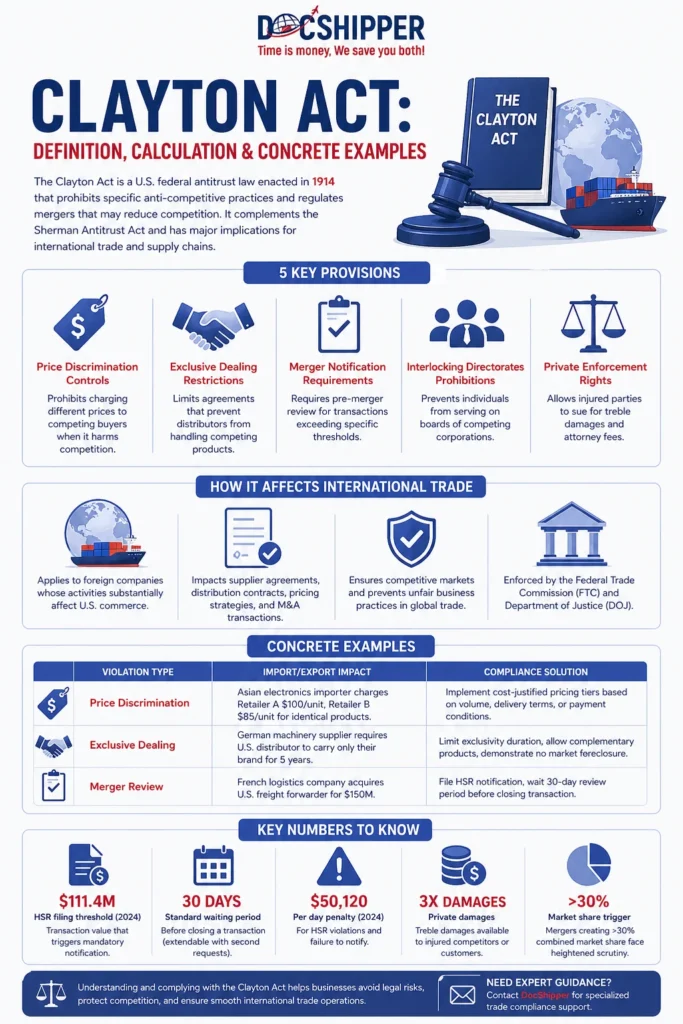
- Price discrimination controls: Prohibits charging different prices to competing buyers when it harms competition
- Exclusive dealing restrictions: Limits agreements that prevent distributors from handling competing products
- Merger notification requirements: Mandates pre-merger review for transactions exceeding specific thresholds
- Interlocking directorate prohibitions: Prevents individuals from serving on boards of competing corporations
- Private enforcement rights: Allows injured parties to sue for treble damages and attorney fees
Legal Mechanisms & Trade Implications
The Clayton Act operates through four primary sections that international businesses must navigate. Section 2 (Robinson-Patman Act amendments) addresses price discrimination, requiring suppliers to offer proportionally equal pricing to buyers at the same distribution level. This directly impacts import pricing strategies when selling to U.S. retailers or distributors.
Section 3 prohibits tying arrangements and exclusive dealing contracts that substantially lessen competition. For logistics providers and freight forwarders, this means exclusive distribution agreements with imported goods must not unreasonably restrict market access for competing products.
Section 7 governs mergers and acquisitions, requiring companies to file with the Federal Trade Commission when transaction values exceed Hart-Scott-Rodino thresholds (currently $111.4 million for 2024). International acquisitions involving U.S. assets or market impact trigger these requirements, creating waiting periods that affect transaction timelines.
The extraterritorial application extends Clayton Act jurisdiction to foreign companies whose activities substantially affect U.S. commerce. A European manufacturer establishing exclusive distribution in the U.S. market falls under this scrutiny, regardless of corporate domicile.
At DocShipper, we routinely advise clients on structuring supplier agreements to comply with Clayton Act restrictions, ensuring distribution contracts maintain competitive market access while protecting commercial interests. According to the Federal Trade Commission, violations can result in injunctions, divestitures, and substantial monetary penalties.
Concrete Examples & Data
Practical application demonstrates how the Clayton Act shapes international trade operations. Consider these documented scenarios:
| Violation Type | Import/Export Impact | Compliance Solution |
|---|---|---|
| Price Discrimination | Asian electronics importer charges Retailer A $100/unit, Retailer B $85/unit for identical products | Implement cost-justified pricing tiers based on volume, delivery terms, or payment conditions |
| Exclusive Dealing | German machinery supplier requires U.S. distributor to carry only their brand for 5 years | Limit exclusivity duration, allow complementary products, demonstrate no market foreclosure |
| Merger Review | French logistics company acquires U.S. freight forwarder for $150M | File HSR notification, wait 30-day review period before closing transaction |
Case Study: Automotive Parts Distribution
A Japanese automotive parts manufacturer established a U.S. subsidiary and required all regional distributors to exclusively carry their product line. After competitor complaints, FTC investigation revealed the arrangement foreclosed 35% of the regional market. The resolution required terminating exclusive clauses and allowing distributors to carry competing brands, demonstrating how supply chain control strategies must balance commercial objectives with antitrust compliance.
Quantifiable Impact: According to Department of Justice data, Clayton Act merger reviews averaged 11.2 months for complex international transactions in 2023, directly affecting deal timing and logistics planning for cross-border acquisitions.
- HSR filing threshold (2024): $111.4 million transaction value triggers mandatory notification
- Waiting period: 30 days standard, extendable with second requests
- Penalty exposure: Up to $50,120 per day for HSR violations (2024 adjustment)
- Private damages: Treble damages available to injured competitors or customers
- Market share trigger: Mergers creating >30% combined market share face heightened scrutiny
Conclusion
The Clayton Act fundamentally shapes how international businesses structure commercial relationships, pricing strategies, and corporate transactions within U.S. markets. Compliance requires proactive legal analysis integrated into supply chain planning and contract negotiation processes.
Need guidance on structuring compliant distribution agreements or navigating merger review requirements? Contact DocShipper for specialized trade compliance support.
📚 Quiz
Test Your Knowledge: Clayton Act
Q1 — What is the primary purpose of the Clayton Act?
Q2 — A foreign company headquartered outside the U.S. sets up an exclusive distribution network in the American market. Does the Clayton Act apply to them?
Q3 — A French logistics company acquires a U.S. freight forwarder for $150 million. What is the correct compliance step under the Clayton Act?
🎯 Your Result
📞 Free Quote in 24hFAQ | Clayton Act: Definition, Calculation & Concrete Examples
Yes, the Clayton Act applies extraterritorially when foreign business activities substantially affect U.S. commerce, including import distribution arrangements and acquisitions involving U.S. market assets.
For 2024, transactions valued at $111.4 million or above require HSR filing, with annual adjustments based on gross national product changes published by the Federal Trade Commission.
Volume discounts are permissible when cost-justified, meaning the price difference reflects actual cost savings from larger orders, different delivery methods, or payment terms rather than competitive harm.
Initial waiting periods are 30 days, but complex international transactions often receive second requests extending review to 11-18 months depending on competitive concerns and information production requirements.
No, exclusive agreements are legal when they do not substantially lessen competition. Factors include market share, agreement duration, availability of alternative distribution channels, and barriers to market entry.
Remedies include injunctions, forced divestitures, contract modifications, and civil penalties up to $50,120 daily for HSR violations. Private plaintiffs can recover treble damages plus attorney fees.
The Act prohibits tying arrangements where a seller conditions the sale of one product on purchasing another product when it substantially lessens competition or creates monopoly in any line of commerce.
The Sherman Act broadly prohibits monopolization and restraints of trade, while the Clayton Act specifically targets price discrimination, exclusive dealing, anti-competitive mergers, and interlocking directorates with more detailed provisions.
Yes, logistics mergers exceeding HSR thresholds require notification, and exclusive service agreements with shippers may face review if they substantially foreclose market access for competing freight forwarders.
Acceptable documentation includes detailed cost accounting showing differences in manufacturing, delivery, sales methods, or quantities sold that directly correspond to price variations between customers at the same distribution level.
Exemptions exist for acquisitions of goods in ordinary course of business, certain asset purchases below 10% of seller assets, and transactions involving financial institutions regulated by federal banking agencies.
Agencies analyze market concentration using Herfindahl-Hirschman Index calculations, entry barriers, vertical integration effects, and likelihood of coordinated behavior among remaining competitors post-transaction.
Need Help with
Logistics or Sourcing ?
First, we secure the right products from the right suppliers at the right price by managing the sourcing process from start to finish. Then, we simplify your shipping experience - from pickup to final delivery - ensuring any product, anywhere, is delivered at highly competitive prices.


Fill the Form
Prefer email? Send us your inquiry, and we’ll get back to you as soon as possible.
Contact us




