


In short ⚡
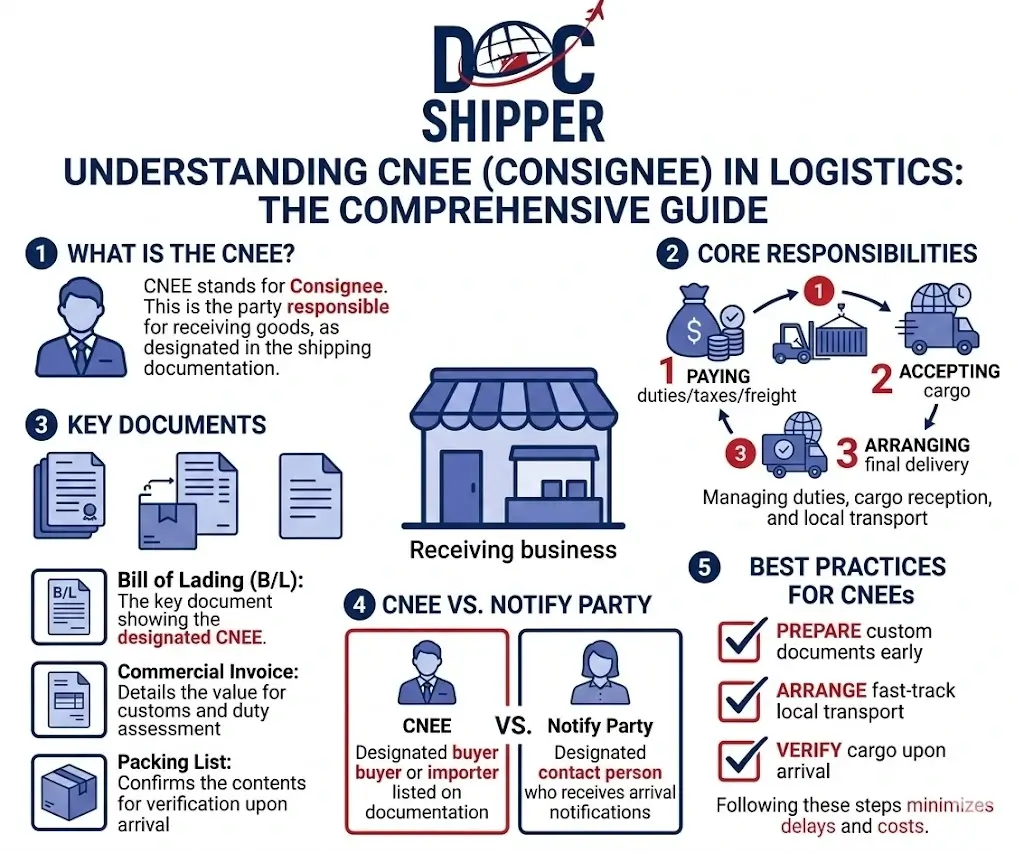
The CNEE (Consignee) is the party designated on shipping documents as the legal recipient of goods in international trade. This entity holds the right to take delivery of the cargo upon arrival at the destination port or warehouse, making it a critical stakeholder in customs clearance and logistics operations.
Introduction
A common source of confusion in international logistics is distinguishing between the buyer, the importer of record, and the consignee. While these roles may overlap, they serve distinct legal and operational functions.
The consignee designation directly impacts customs documentation, delivery authorization, and liability transfer. Misidentifying the consignee can lead to shipment delays, additional storage fees, or customs penalties.
Understanding the consignee’s role is essential for:
- Bill of Lading accuracy – The consignee name must match customs records exactly
- Delivery authorization – Only the named consignee can legally claim the goods
- Customs clearance responsibility – The consignee typically initiates import formalities
- Payment and documentation – Banks and freight forwarders verify consignee details for release
- Risk management – Incorrect consignee information can void insurance claims
In-Depth Analysis & Legal Framework
The consignee’s legal status is established through the Bill of Lading (B/L), which serves as both a contract of carriage and a document of title. Under international maritime law governed by the International Maritime Organization (IMO), the consignee holds specific rights and obligations.
Types of consignee designations include:
1. Named Consignee – A specific company or individual identified on the B/L. This designation is non-negotiable and restricts cargo release to the named party only.
2. Order Consignee – The B/L is marked “To Order” or “To Order of [Bank Name]”, making it a negotiable instrument. The cargo can be transferred by endorsement, commonly used in letter of credit transactions.
3. Bearer Consignee – Rare in modern trade, this designation allows whoever physically holds the original B/L to claim the goods. It carries significant security risks.
4. Notify Party – While not the consignee, this party receives shipment arrival notifications. Often, the notify party and consignee are the same entity, but they serve different legal functions.
Customs and regulatory implications are substantial. In most jurisdictions, the consignee must be registered with customs authorities as an importer. At DocShipper, we systematically verify consignee registration status before shipment to prevent clearance delays at destination ports.
The Incoterms® rules also affect consignee designation. Under DDP (Delivered Duty Paid), the seller may appear as the importer of record while the buyer remains the ultimate consignee. This distinction requires careful documentation to comply with both origin and destination country regulations.
Practical Examples & Data-Driven Scenarios
Understanding consignee roles becomes clearer through real-world applications. The following scenarios illustrate common configurations and their operational impacts.
Scenario Comparison Table
| Trade Scenario | Consignee | Importer of Record | Key Risk |
|---|---|---|---|
| Direct B2B Purchase (FOB) | Buyer Company | Buyer Company | Buyer assumes all import duties |
| Letter of Credit Transaction | To Order of Bank | Buyer (after payment) | Cargo held until payment cleared |
| DDP Shipment (Seller Delivers) | Buyer Company | Seller or Freight Forwarder | Seller liable for customs errors |
| Third-Party Logistics (3PL) | 3PL Warehouse | Original Buyer | Requires power of attorney |
| Amazon FBA Shipment | Amazon Fulfillment Center | Seller (Amazon Account Holder) | Amazon address must match exactly |
Use Case: Electronics Import to Germany
A U.S. manufacturer ships €50,000 worth of consumer electronics to a German distributor. The transaction uses a confirmed letter of credit with the following parties:
- Shipper (Exporter): TechCorp USA, Los Angeles
- Consignee: To Order of Deutsche Bank AG
- Notify Party: ElektroMarkt GmbH, Hamburg
- Importer of Record: ElektroMarkt GmbH (after payment)
The goods arrive at Hamburg port. Deutsche Bank holds the original Bill of Lading until ElektroMarkt fulfills payment terms. Once payment clears, the bank endorses the B/L to ElektroMarkt, who then becomes the legal consignee and can initiate customs clearance.
This structure protects the exporter’s payment while allowing the buyer to inspect goods before final acceptance. At DocShipper, we coordinate with banks and customs brokers to ensure seamless document transfer in such transactions.
Key Data Points
- Average delay for consignee mismatches: 3-7 days at destination port
- Demurrage costs: €80-150 per container per day in European ports
- Documentation amendment fees: $50-200 per Bill of Lading correction
- Customs penalty risk: Up to 20% of cargo value for incorrect importer declaration
- Letter of Credit transactions: Account for approximately 15% of global trade volume
Conclusion
The consignee designation is a foundational element of international shipping documentation that directly affects delivery rights, customs processing, and financial security. Accurate identification prevents costly delays and legal complications.
Need assistance with consignee documentation or customs clearance? Contact DocShipper for expert guidance on your international shipments.
📚 Quiz
Test Your Knowledge: CNEE (Consignee)
Q1 — What is the primary legal role of the CNEE (Consignee) in international shipping?
Q2 — A Bill of Lading is marked "To Order of Deutsche Bank AG." What does this mean for the consignee designation?
Q3 — A U.S. seller ships goods under DDP (Delivered Duty Paid) Incoterms to a French buyer. Who is most likely the importer of record in this scenario?
🎯 Your Result
📞 Free Quote in 24hFAQ | CNEE (Consignee): Definition, Role & Practical Examples in International Shipping
The consignee is the legal recipient with rights to claim the cargo, while the notify party simply receives arrival notifications. The notify party has no legal claim to the goods unless also designated as consignee.
Yes. In DDP shipments, third-party logistics arrangements, or letter of credit transactions, the consignee may be a freight forwarder, warehouse, or bank rather than the actual buyer.
The carrier will not release cargo until the B/L is amended. This requires contacting the shipper to issue a correction, which incurs fees and delays of 3-7 days on average.
The importer of record is legally responsible for duties and taxes. In many cases, this is the same entity as the consignee, but not always. Incoterms determine financial responsibility.
"To Order" makes the Bill of Lading negotiable, allowing ownership transfer through endorsement. It's commonly used in letter of credit transactions where banks hold title until payment is confirmed.
Yes, when the forwarder handles customs clearance or consolidates shipments. However, they must have proper authorization (power of attorney) from the actual importer to act on their behalf.
Yes. Air Waybills (AWB) require accurate consignee details just like ocean Bills of Lading. The consignee must be identified for customs clearance and delivery authorization at destination airports.
Typically: original Bill of Lading (or Telex/Express Release confirmation), commercial invoice, packing list, and proof of identity. Customs may require additional import licenses or certificates depending on the product.
For ocean freight with original B/L, changes are difficult and require shipper consent. For Express/Telex Release or air freight, amendments are easier but still require coordination with the carrier and may incur fees.
Insurance policies are typically issued to the consignee or "To Order" holder. If the consignee information doesn't match the insured party, claims may be denied or delayed pending documentation correction.
A straight consignee is non-negotiable – only the named party can receive goods. An order consignee allows the B/L to be endorsed and transferred, making it a negotiable instrument used in banking transactions.
Not physically, but the consignee (or their authorized customs broker) must provide documentation and authorization. Most countries allow licensed brokers to represent the consignee during clearance procedures.
Need Help with
Logistics or Sourcing ?
First, we secure the right products from the right suppliers at the right price by managing the sourcing process from start to finish. Then, we simplify your shipping experience - from pickup to final delivery - ensuring any product, anywhere, is delivered at highly competitive prices.


Fill the Form
Prefer email? Send us your inquiry, and we’ll get back to you as soon as possible.
Contact us




:%20Definition,%20Role%20&%20Practical%20Examples%20in%20International%20Shipping)