


In short ⚡
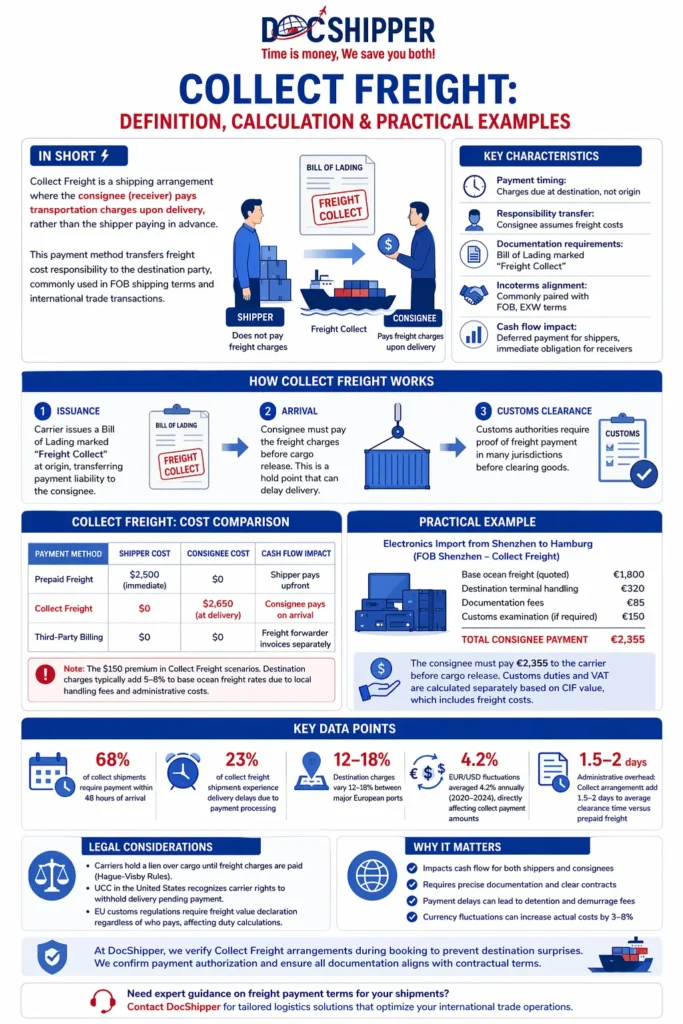
Collect Freight is a shipping arrangement where the consignee (receiver) pays transportation charges upon delivery, rather than the shipper paying in advance. This payment method transfers freight cost responsibility to the destination party, commonly used in FOB shipping terms and international trade transactions.Introduction
Many importers face unexpected delays when freight charges aren’t clearly defined. Confusion between prepaid and collect freight can halt shipments at customs or destination ports. Understanding who pays what—and when—is fundamental to smooth international logistics.
Collect Freight shifts payment responsibility downstream in the supply chain. This arrangement impacts cash flow, customs clearance procedures, and contractual obligations between buyers and sellers.
Key characteristics of Collect Freight include:
- Payment timing: Charges due at destination, not origin
- Responsibility transfer: Consignee assumes freight costs
- Documentation requirements: Bill of Lading marked “Freight Collect”
- Incoterms alignment: Commonly paired with FOB, EXW terms
- Cash flow impact: Deferred payment for shippers, immediate obligation for receivers
Mechanisms & Legal Implications
Collect Freight operates through specific documentation and contractual frameworks. The Bill of Lading (B/L) must explicitly state “Freight Collect” to establish legal payment obligation. Without this notation, carriers may refuse delivery or demand payment from the shipper.
The mechanism involves three critical components. First, the carrier issues a collect B/L at origin, transferring payment liability to the destination party. Second, the consignee must pay before cargo release, creating a hold point that can delay delivery. Third, customs authorities require proof of freight payment in many jurisdictions before clearing goods.
Legal implications vary by jurisdiction. Under the Hague-Visby Rules, carriers hold a lien over cargo until freight charges are paid. The Uniform Commercial Code (UCC) in the United States recognizes carrier rights to withhold delivery pending payment. EU customs regulations require freight value declaration regardless of who pays, affecting duty calculations.
Financial exposure differs from prepaid arrangements. The consignee bears currency fluctuation risk between contract date and payment date. Exchange rate variations can increase actual costs by 3-8% in volatile markets. Additionally, destination charges often exceed quoted rates due to local fees, demurrage, or detention charges not included in initial quotations.
At DocShipper, we verify Collect Freight arrangements during booking to prevent destination surprises. Our team confirms consignee payment authorization and ensures all documentation aligns with contractual terms before shipment departure.
For authoritative guidance on international freight payment terms, consult the ICC Incoterms® 2020 rules, which provide standardized interpretations of buyer-seller responsibilities.
Practical Examples & Data
Real-world applications demonstrate how Collect Freight impacts different trade scenarios. Understanding cost structures and payment timing helps businesses optimize cash flow and avoid delivery delays.
Comparative Cost Analysis
| Payment Method | Shipper Cost | Consignee Cost | Cash Flow Impact |
|---|---|---|---|
| Prepaid Freight | $2,500 (immediate) | $0 | Shipper pays upfront |
| Collect Freight | $0 | $2,650 (at delivery) | Consignee pays on arrival |
| Third-Party Billing | $0 | $0 | Freight forwarder invoices separately |
Note the $150 premium in Collect Freight scenarios. Destination charges typically add 5-8% to base ocean freight rates due to local handling fees and administrative costs.
Use Case: Electronics Import from Shenzhen to Hamburg
A German retailer imports 15 CBM of consumer electronics under FOB Shenzhen terms. The contract specifies Collect Freight, with the following breakdown:
- Base ocean freight: €1,800 (quoted by carrier)
- Destination terminal handling: €320
- Documentation fees: €85
- Customs examination (if required): €150
- Total consignee payment: €2,355 before customs duties
The consignee must pay €2,355 to the carrier before cargo release. Customs duties and VAT are calculated separately based on CIF value, which includes freight costs. This creates a compounding effect where freight charges increase the dutiable value.
Key Data Points
- Payment timing: 68% of collect shipments require payment within 48 hours of arrival
- Delay frequency: 23% of collect freight shipments experience delivery delays due to payment processing
- Cost variance: Destination charges vary 12-18% between major European ports
- Currency impact: EUR/USD fluctuations averaged 4.2% annually (2020-2024), directly affecting collect payment amounts
- Administrative overhead: Collect arrangements add 1.5-2 days to average clearance time versus prepaid freight
Conclusion
Collect Freight transfers payment responsibility to the consignee, impacting cash flow, documentation requirements, and delivery timelines. Understanding these mechanisms prevents costly delays and ensures smooth customs clearance.
Need expert guidance on freight payment terms for your shipments? Contact DocShipper for tailored logistics solutions that optimize your international trade operations.
📚 Quiz
Test Your Knowledge: Collect Freight
Q1 — What does "Collect Freight" mean in a shipping arrangement?
Q2 — A common misconception about Collect Freight is that it reduces the customs dutiable value since the shipper doesn't pay the freight. Is this correct?
Q3 — A German retailer imports electronics from Shenzhen under FOB terms with Collect Freight. The carrier quotes a base ocean freight of €1,800. What is the most accurate expectation for the consignee's total payment before cargo release?
🎯 Your Result
📞 Free Quote in 24hFAQ | Collect Freight: Definition, Calculation & Practical Examples
Collect Freight means the consignee pays transportation charges at destination, while Freight Prepaid indicates the shipper paid charges at origin. This affects cash flow, documentation, and who holds financial responsibility for delivery.
Changes require carrier approval and amended documentation. Most carriers allow modifications before cargo loading, but fees may apply. The Bill of Lading must be reissued to reflect the payment term change accurately.
The shipper becomes liable if the consignee refuses payment. Carriers hold cargo until charges are settled and may file claims against the shipper under the original contract of carriage.
Customs authorities include freight costs in CIF value calculations regardless of who pays. Collect Freight doesn't reduce dutiable value—it only changes payment timing and responsibility between trading parties.
Most carriers accept bank transfers, credit cards, or certified checks. Payment must clear before cargo release. Some destinations require cash or guaranteed payment instruments for immediate clearance.
Yes—payment delays can trigger demurrage and detention charges. Currency fluctuations may increase costs between quotation and payment. Consignees also face unexpected destination fees not included in initial freight quotes.
FOB, EXW, and FCA terms commonly pair with Collect Freight. These Incoterms transfer transportation responsibility to the buyer, making collect payment arrangements logical extensions of contractual obligations.
Yes, through third-party billing arrangements. The forwarder pays the carrier and invoices you separately. This adds flexibility but may include service fees ranging from 3-7% of freight value.
Payment terms vary by carrier and destination. Typical windows range from immediate payment (cash on delivery) to 48-72 hours after arrival. Delays beyond agreed terms trigger storage and penalty charges.
No direct impact on claims, but unpaid freight can complicate cargo release during claim investigations. Ensure freight payment and insurance coverage are coordinated to avoid compounding delivery delays during damage assessments.
Carriers issue a freight receipt or delivery order stamped "Paid" after receiving payment. This document is required for customs clearance and cargo release at most international destinations.
Absolutely. Air Waybills can specify "Freight Collect" just like ocean Bills of Lading. The same payment principles apply—consignee pays before cargo release at the destination airport.
Need Help with
Logistics or Sourcing ?
First, we secure the right products from the right suppliers at the right price by managing the sourcing process from start to finish. Then, we simplify your shipping experience - from pickup to final delivery - ensuring any product, anywhere, is delivered at highly competitive prices.


Fill the Form
Prefer email? Send us your inquiry, and we’ll get back to you as soon as possible.
Contact us




