


In short ⚡
Collecting is a logistics service where a carrier retrieves goods from multiple suppliers or locations and consolidates them into a single shipment for delivery to one destination. This process optimizes transport costs, reduces handling time, and streamlines supply chain operations by centralizing pickup operations before final distribution.Introduction
Many importers struggle with coordinating pickups from multiple suppliers across different regions. Managing separate shipments increases costs, extends lead times, and complicates customs clearance. Collecting solves this challenge by consolidating multiple pickups into one streamlined operation.
In international trade, collecting is essential for businesses sourcing from various manufacturers. It transforms fragmented logistics into a unified process, reducing both expenses and administrative burden.
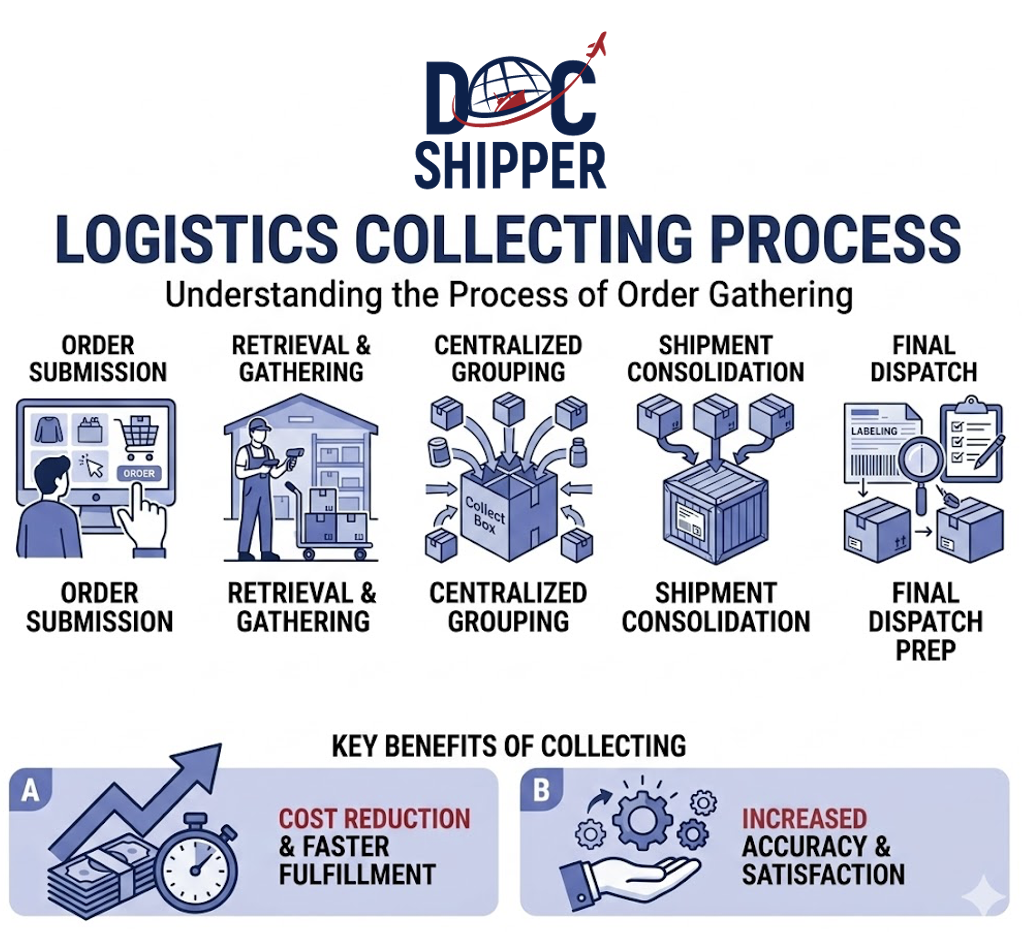
- Cost efficiency: Single consolidated shipment reduces per-unit transport costs
- Time optimization: Coordinated pickups eliminate delays between individual collections
- Simplified documentation: One master shipment instead of multiple customs entries
- Quality control: Centralized inspection point before final shipping
- Risk reduction: Fewer handling points minimize damage or loss probability
Collecting Process & Logistics Expertise
The collecting process begins with route planning. Logistics providers map supplier locations, calculate optimal pickup sequences, and schedule collections to minimize empty kilometers. This planning phase determines overall efficiency and cost-effectiveness.
Consolidation warehouses serve as temporary hubs where collected goods converge. Here, items undergo inspection, quality verification, and repacking if necessary. The warehouse acts as the control point before international departure.
Documentation management requires meticulous attention. Each supplier provides packing lists and commercial invoices. The freight forwarder consolidates these into a master bill of lading and unified customs declaration. According to World Customs Organization guidelines, proper documentation prevents clearance delays and penalties.
Transportation modes vary based on geography and urgency. Road transport dominates regional collecting (within 500 km), while intermodal solutions combine road and rail for longer distances. The choice impacts both cost and carbon footprint.
Technology integration enhances visibility. Real-time tracking systems monitor each pickup, while warehouse management software coordinates arrival schedules. At DocShipper, we implement GPS tracking and automated status updates to keep clients informed throughout the collecting phase.
Risk mitigation strategies include cargo insurance tailored to multi-origin shipments, supplier verification protocols, and contingency planning for pickup failures. Professional collecting services maintain backup supplier lists and alternative routing options.
Practical Examples & Cost Analysis
Consider a U.S. importer sourcing furniture components from five Chinese manufacturers in Guangdong province. Without collecting, shipping five separate containers costs approximately $12,000 ($2,400 per container). With collecting, goods consolidate into three full containers, reducing costs to $8,100—a 32.5% savings.
| Scenario | Number of Shipments | Total Cost | Lead Time |
|---|---|---|---|
| Individual Shipping | 5 containers | $12,000 | 18-22 days |
| Collecting Service | 3 containers | $8,100 | 14-16 days |
| Savings | – | $3,900 (32.5%) | 4-6 days faster |
European textile case: A fashion retailer sources from seven Italian workshops. Individual LTL shipments would require seven separate customs entries and €4,200 in transport. Collecting reduces this to one full truckload at €2,800, saving €1,400 while simplifying VAT procedures.
Key performance metrics for successful collecting operations include:
- Consolidation ratio: Aim for 75-85% container utilization to maximize savings
- Pickup punctuality: 95%+ on-time collection rate prevents bottlenecks
- Damage rate: Should remain below 0.5% during consolidation handling
- Documentation accuracy: 99%+ error-free customs paperwork avoids delays
- Cost per kilogram: Collecting typically reduces this by 25-40% versus individual shipping
Real-world data from Asian manufacturing hubs shows collecting services reduce carbon emissions by approximately 30% compared to multiple separate shipments, aligning with ESG compliance requirements increasingly demanded by European and North American buyers.
Conclusion
Collecting transforms complex multi-supplier logistics into a streamlined, cost-effective operation. By consolidating pickups and centralizing quality control, businesses reduce expenses while improving supply chain visibility and reliability.
Need expert assistance with collecting services for your international shipments? Contact DocShipper for customized logistics solutions tailored to your sourcing needs.
📚 Quiz
Test Your Knowledge: Collecting
Q1 — What best defines "Collecting" as a logistics service?
Q2 — A common misconception about collecting is that it always increases lead time. What does the data actually show?
Q3 — A U.S. importer sources goods from 5 Chinese manufacturers. Which approach correctly applies a collecting strategy?
🎯 Your Result
📞 Free Quote in 24hFAQ | Collecting: Definition, Process & Practical Examples in Logistics
Collecting refers to the pickup process from multiple suppliers, while consolidation is the physical combining of goods at a warehouse. Collecting is the action; consolidation is the result.
Typically 3-15 suppliers per collecting round, depending on geographic proximity and shipment volumes. Optimal efficiency occurs with 5-8 pickup points within a 200 km radius.
Initial collecting adds 2-5 days for coordination and consolidation, but overall transit often becomes faster due to optimized routing and reduced customs processing time for single shipments.
Most providers require at least 5 cubic meters or 500 kg total across all suppliers. Smaller volumes may not justify the coordination costs versus individual shipping.
Collecting simplifies customs by creating one master declaration instead of multiple entries. This reduces paperwork, lowers brokerage fees, and accelerates clearance processing times.
Yes, but requires temperature-controlled transport and expedited consolidation. Perishables should be collected last and shipped first to minimize warehouse dwell time.
Comprehensive cargo insurance should cover goods from first pickup through final delivery. Verify that policies include warehouse storage and inter-facility transfers during consolidation.
Costs typically include per-pickup fees, distance-based charges, consolidation handling, and warehousing. Allocation can be by weight, volume, or value depending on contractual agreements.
Professional collecting services maintain buffer schedules. Minor delays (1-2 days) are absorbed; major delays may require partial shipment or rescheduling to avoid penalizing other suppliers.
Yes, but requires specialized carriers with ADR/IMDG certifications. Hazmat collecting involves segregated storage, additional documentation, and compliance with international dangerous goods regulations.
TMS platforms optimize routes, WMS systems coordinate warehouse operations, and IoT sensors monitor cargo conditions. Real-time tracking provides visibility from first pickup through final delivery.
Standard procedures include quantity verification, packaging inspection, product sampling, and photographic documentation. Issues identified during consolidation allow immediate supplier contact before international shipping.
Need Help with
Logistics or Sourcing ?
First, we secure the right products from the right suppliers at the right price by managing the sourcing process from start to finish. Then, we simplify your shipping experience - from pickup to final delivery - ensuring any product, anywhere, is delivered at highly competitive prices.


Fill the Form
Prefer email? Send us your inquiry, and we’ll get back to you as soon as possible.
Contact us




