


In short ⚡
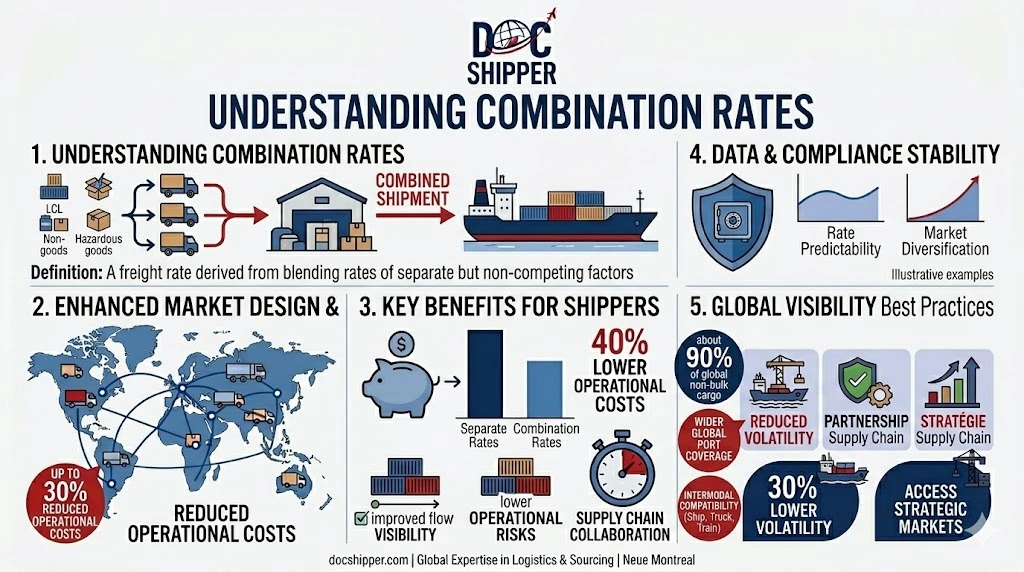
Combination Rate is a consolidated shipping charge that merges multiple cost components—such as ocean freight, terminal handling, and documentation fees—into a single all-inclusive rate. This pricing model simplifies budgeting and invoicing for importers and exporters by eliminating the need to track numerous separate line items throughout the logistics chain.
Introduction
International shipping involves dozens of fees: ocean freight, bunker adjustment factors, terminal handling charges, documentation, and more. Tracking each separately creates confusion, delays payment reconciliation, and complicates cost forecasting.
The Combination Rate addresses this challenge by bundling multiple charges into one transparent figure. This approach is particularly valuable in containerized trade, where shippers need predictable pricing to maintain competitive margins.
Key characteristics of Combination Rates include:
- Consolidated billing: Single invoice line instead of 5–10 separate charges
- Predictable budgeting: Fixed total cost for route planning
- Simplified negotiation: Discuss one rate rather than multiple surcharges
- Transparency: Clear breakdown available upon request
- Time savings: Reduces administrative overhead for finance teams
Understanding Combination Rate in Freight Pricing
A Combination Rate typically includes the base ocean freight plus ancillary charges that would otherwise appear as separate line items. Common components are:
Base ocean freight covers vessel space and transport from port to port. Bunker Adjustment Factor (BAF) compensates for fuel price fluctuations. Currency Adjustment Factor (CAF) accounts for exchange rate variations. Terminal Handling Charges (THC) cover loading and unloading at origin and destination terminals. Documentation fees include bill of lading issuance and customs paperwork preparation.
Carriers offer Combination Rates to streamline contracts with high-volume shippers. Instead of renegotiating each surcharge quarterly, both parties agree on a single rate valid for a contract period—often 6 to 12 months. This stability benefits cash flow planning and reduces disputes over unexpected fees.
However, shippers must verify what the rate includes. Some Combination Rates exclude destination charges, customs duties, or inland haulage. At DocShipper, we systematically review rate quotations to ensure clients understand exactly which services are covered, preventing costly surprises at delivery.
Regulatory bodies like the U.S. Federal Maritime Commission require carriers to disclose all charges, whether bundled or itemized. This transparency mandate protects shippers from hidden fees and ensures fair competition in international trade.
Understanding the difference between all-in rates and base-plus rates is critical. An all-in Combination Rate includes every cost from factory to port of discharge. A base-plus rate may still add destination terminal fees or delivery charges separately. Always request a detailed cost breakdown before signing contracts.
Practical Examples & Cost Data
To illustrate how Combination Rates work in real-world scenarios, consider the following comparative analysis for a 40-foot container shipment from Shanghai to Rotterdam:
| Cost Component | Itemized Pricing (USD) | Combination Rate (USD) |
|---|---|---|
| Base Ocean Freight | 1,200 | 2,100 (all-inclusive) |
| Bunker Adjustment Factor | 350 | |
| Terminal Handling (Origin) | 180 | |
| Terminal Handling (Destination) | 220 | |
| Documentation Fee | 75 | |
| Currency Adjustment Factor | 75 | |
| Total Cost | 2,100 | 2,100 |
While both approaches yield the same total, the Combination Rate simplifies invoice reconciliation and eliminates quarterly surcharge adjustments. Shippers benefit from predictable costs even when fuel prices fluctuate.
Use Case: A European electronics importer contracts 50 containers annually from Shenzhen to Hamburg. Under itemized pricing, they receive 6–8 invoice line items per shipment, requiring manual verification each time. Switching to a Combination Rate reduces administrative workload by 60% and locks in pricing for the fiscal year, protecting against BAF spikes during peak season.
Key considerations when evaluating Combination Rates:
- Volume commitment: Carriers typically require minimum shipment guarantees
- Contract duration: Longer terms offer better rates but less flexibility
- Exclusions: Verify whether customs duties, demurrage, or detention are covered
- Force majeure clauses: Understand how rates adjust during port strikes or fuel crises
- Benchmark comparison: Compare against spot market rates quarterly to ensure competitiveness
At DocShipper, we negotiate Combination Rates on behalf of clients, leveraging our shipping volume to secure preferential terms while maintaining full cost transparency throughout the supply chain.
Conclusion
The Combination Rate transforms complex multi-line freight invoices into a single, predictable cost structure. By consolidating ocean freight, surcharges, and terminal fees, it streamlines budgeting and reduces administrative burden for international shippers.
Need expert guidance on negotiating optimal Combination Rates for your trade lanes? Contact DocShipper for a customized freight pricing analysis.
📚 Quizz
Test Your Knowledge: Combination Rate
Q1 — What best defines a Combination Rate in international freight shipping?
Q2 — A shipper assumes that switching to a Combination Rate will always result in a lower total cost than itemized pricing. Is this correct?
Q3 — A European electronics importer ships 50 containers per year from Shenzhen to Hamburg. They currently receive 6–8 invoice line items per shipment and want to reduce administrative workload. Which approach is most appropriate?
🎯 Your Result
📞 Free Quote in 24hFAQ | Combination Rate: Definition, Calculation & Practical Examples
The primary benefit is cost predictability. Shippers lock in a single rate that remains stable regardless of fuel price or currency fluctuations, simplifying financial planning and reducing invoice reconciliation time.
Not necessarily. While they offer convenience and stability, the total cost may equal or slightly exceed itemized pricing. The value lies in administrative efficiency and protection against surcharge volatility rather than immediate savings.
Carriers typically reserve Combination Rates for high-volume clients with annual contracts. However, freight forwarders like DocShipper consolidate shipments from multiple clients to access these rates, extending the benefit to smaller importers.
Typical exclusions include customs duties, inland haulage beyond the port, demurrage and detention fees, cargo insurance, and special handling charges for hazardous or oversized goods. Always request a detailed breakdown.
Most contracts run for 6 to 12 months, with renegotiation timed to align with peak shipping seasons. Some agreements include quarterly review clauses if market conditions change drastically.
While less common, air cargo carriers do offer all-in rates that bundle freight, fuel surcharges, and security fees. However, the volatility of air freight markets makes long-term Combination Rates rarer than in ocean shipping.
Most contracts include minimum volume commitments. Falling short may trigger penalty fees or revert pricing to higher spot rates. Some agreements offer pro-rated adjustments instead of penalties.
Contracts usually include force majeure clauses allowing carriers to impose emergency surcharges during events like port strikes, wars, or pandemic-related disruptions. However, these adjustments require formal notification and justification.
Request a detailed cost breakdown showing each bundled component. Compare it against current spot market rates for the same route, and benchmark against industry averages using freight rate indices like the Shanghai Containerized Freight Index.
Yes. Maritime regulators like the U.S. Federal Maritime Commission and the European Commission require carriers to disclose all charges transparently, whether bundled or itemized, to prevent anti-competitive practices.
An all-in rate covers port-to-port costs including terminal handling. A door-to-door rate extends coverage to include inland trucking from the shipper's warehouse to the consignee's facility, making it more comprehensive.
Rarely. Customs duties and clearance fees vary by shipment value and classification, making them difficult to bundle into a fixed rate. Most Combination Rates stop at the destination port, with customs handled separately.
Need Help with
Logistics or Sourcing ?
First, we secure the right products from the right suppliers at the right price by managing the sourcing process from start to finish. Then, we simplify your shipping experience - from pickup to final delivery - ensuring any product, anywhere, is delivered at highly competitive prices.


Fill the Form
Prefer email? Send us your inquiry, and we’ll get back to you as soon as possible.
Contact us




