


In short ⚡
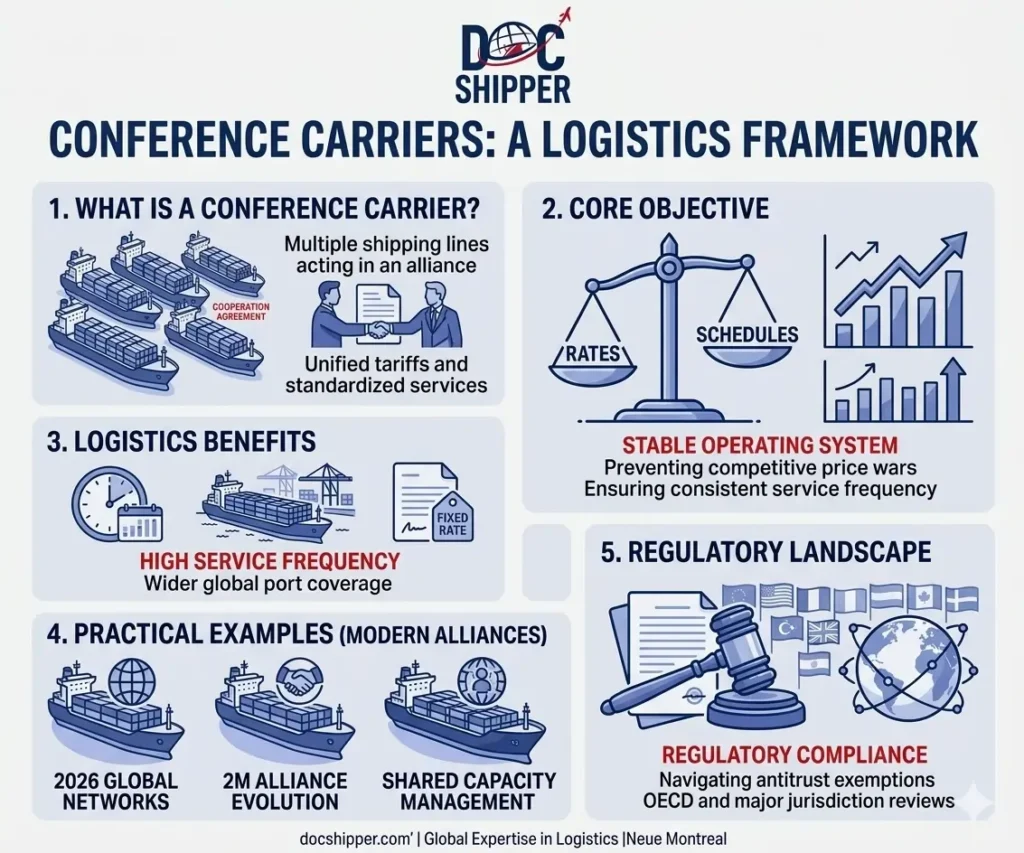
A Conference Carrier is a shipping line that operates within a shipping conference—a formal agreement among ocean carriers to standardize freight rates, schedules, and service conditions on specific trade routes. This collaborative framework aims to ensure pricing stability and service reliability while regulating competition in international maritime transport.
Introduction
Shippers often face confusion when encountering different freight rates from carriers on the same route. The concept of Conference Carriers emerged to address this chaos by creating organized rate structures and service standards.
In international maritime logistics, Conference Carriers play a critical role in stabilizing ocean freight markets. These carriers operate under collective agreements that define competitive boundaries while maintaining service quality across major shipping lanes.
Key characteristics of Conference Carriers include:
- Standardized tariff rates published collectively for specific trade routes
- Fixed sailing schedules ensuring regular service frequency
- Loyalty contracts offering discounts to committed shippers
- Regulated competition through binding conference agreements
- Service guarantees with agreed-upon transit times and cargo handling standards
Regulatory Framework & Operational Mechanics
Shipping conferences originated in the 1870s to bring order to chaotic ocean freight markets. These formal cartels allow carriers to coordinate pricing and capacity without violating antitrust laws in many jurisdictions.
The operational framework involves several mechanisms. Conference Carriers establish tariff schedules that set minimum and maximum rates for different cargo types. Members agree to maintain these rates for specified periods, preventing destructive price wars.
Loyalty agreements form a cornerstone of conference operations. Shippers who commit to using conference carriers exclusively receive rebates ranging from 10% to 20%. These deferred rebates are typically paid after six months of exclusive patronage.
Regulatory oversight varies globally. The European Union historically permitted conferences under Regulation 4056/86 but repealed this exemption in 2008, requiring carriers to comply with standard competition law. The United States maintains limited antitrust immunity through the Shipping Act of 1984, allowing discussion agreements filed with the Federal Maritime Commission (FMC).
Modern conference structures include dual-rate systems offering lower rates to contract shippers and higher rates to non-contract customers. This pricing differentiation incentivizes long-term commitments while accommodating spot market needs.
At DocShipper, we navigate these conference structures daily, ensuring our clients benefit from optimal rate agreements while maintaining flexibility for non-conference alternatives when market conditions favor independent carriers.
Practical Examples & Market Data
Understanding Conference Carriers requires examining real-world applications and comparative scenarios. The following data illustrates how conference membership impacts shipping costs and service reliability.
| Carrier Type | Rate Structure | Service Frequency | Loyalty Discount | Rate Stability |
|---|---|---|---|---|
| Conference Carrier | Published tariff + contract rates | Weekly fixed schedule | 10-20% deferred rebate | High (6-12 months) |
| Independent Carrier | Negotiated spot rates | Variable schedule | None or immediate discount | Low (weekly fluctuation) |
| Alliance Member | Coordinated but competitive | Multiple weekly departures | Volume-based incentives | Medium (quarterly adjustments) |
Use Case: Trans-Pacific Electronics Shipment
A European electronics importer ships 40 containers monthly from Shanghai to Rotterdam. Under a conference carrier agreement, they secure a rate of $1,850 per TEU with a 15% deferred rebate after six months. An independent carrier offers $1,700 per TEU but with weekly rate fluctuations.
Annual comparison:
- Conference route: (40 × 12 × $1,850) × 0.85 = $754,800 effective cost
- Independent route: (40 × 12 × $1,700) + potential surcharges = $816,000+ variable cost
- Net advantage: Conference carrier saves $61,200 annually with guaranteed capacity
Key market insights demonstrate that conference carriers maintain 98% schedule reliability compared to 82% for independent operators on major trade lanes. This predictability reduces inventory holding costs and improves supply chain planning.
The decline of traditional conferences post-2008 led to the rise of vessel-sharing agreements and strategic alliances (2M, Ocean Alliance, THE Alliance), which operate similarly but under different regulatory frameworks. These modern structures offer conference-like stability without formal rate-fixing mechanisms.
Conclusion
Conference Carriers represent a structured approach to ocean freight, balancing competitive pricing with service reliability through collective agreements. Understanding their operational framework enables shippers to make informed decisions about carrier selection and contract negotiations.
Need guidance on optimizing your carrier selection strategy? Contact DocShipper for expert consultation on conference versus independent carrier options tailored to your shipping requirements.
📚 Quiz
Test Your Knowledge: Conference Carrier
Q1 — What best defines a Conference Carrier?
Q2 — A shipper hears that modern shipping alliances (like Ocean Alliance or THE Alliance) are the same as traditional shipping conferences. Is this correct?
Q3 — A European importer ships 40 containers monthly from Shanghai to Rotterdam. They want maximum rate predictability over 12 months and are willing to commit to a single carrier group. Which option best suits their needs?
🎯 Your Result
📞 Free Quote in 24hFAQ | Conference Carrier: Definition, Framework & Practical Examples
Conference carriers operate under collective agreements with standardized rates and schedules, while non-conference (independent) carriers set their own pricing and service terms independently, offering more flexibility but less rate stability.
Legality varies by jurisdiction. The EU abolished conference antitrust exemptions in 2008, while the US maintains limited immunity through the Shipping Act. Most regions now favor alliance structures over traditional conferences.
Shippers receive rebates (typically 10-20%) after maintaining exclusive loyalty to conference carriers for a specified period, usually six months. The rebate is calculated on total freight paid during the qualifying period.
Yes. While conferences publish standard tariffs, individual carriers within conferences can negotiate service contracts with volume shippers, offering discounts from published rates based on commitment levels and cargo volumes.
Dual-rate systems offer two pricing tiers: lower contract rates for shippers committed to exclusive use of conference carriers, and higher rates for non-contract cargo. This incentivizes loyalty while accommodating spot shipments.
Vessel-sharing agreements allow carriers to share vessel space and coordinate schedules without collectively setting rates. They provide operational efficiency benefits while avoiding antitrust concerns associated with price-fixing in traditional conferences.
Breaking loyalty agreements typically results in forfeiture of accumulated deferred rebates and potential penalties specified in the contract. Some agreements include grace periods or allow limited non-conference shipments under specific circumstances.
Conference carriers generally provide higher schedule reliability (95-98%) and standardized service quality due to collective operational standards. However, independent carriers may offer specialized services or faster transit on specific routes.
Conference tariffs typically remain stable for 6-12 months, with scheduled review periods. Emergency surcharges (fuel, congestion) may be added more frequently, but base rates change less often than independent carrier spot rates.
No. Modern alliances (2M, Ocean Alliance, THE Alliance) coordinate vessel operations and schedules but do not collectively set freight rates. Each member prices independently, avoiding the rate-fixing characteristics of traditional conferences.
Standard documentation includes the bill of lading, commercial invoice, packing list, and any conference-specific service contracts. Conference carriers may require loyalty agreement documentation for rebate eligibility verification.
Yes. While volume shippers receive larger discounts, small shippers benefit from conference carriers through predictable pricing, reliable schedules, and standardized service quality. Some conferences offer tiered programs accommodating smaller cargo volumes.
Need Help with
Logistics or Sourcing ?
First, we secure the right products from the right suppliers at the right price by managing the sourcing process from start to finish. Then, we simplify your shipping experience - from pickup to final delivery - ensuring any product, anywhere, is delivered at highly competitive prices.


Fill the Form
Prefer email? Send us your inquiry, and we’ll get back to you as soon as possible.
Contact us




