


In short ⚡
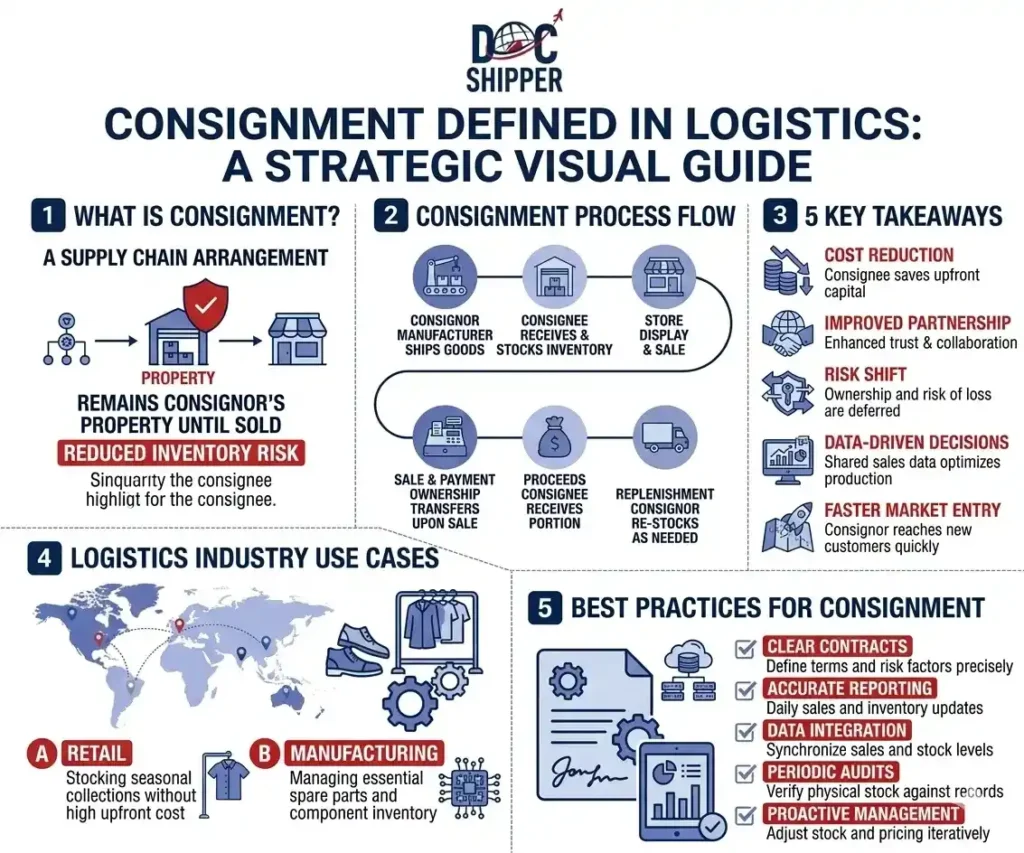
Consignment is a commercial arrangement where goods are shipped to an agent or distributor who sells them on behalf of the owner, with payment occurring only after the sale. The consignor retains ownership until the consignee successfully sells the merchandise, making it a low-risk distribution model widely used in international trade.
Introduction
Many businesses struggle with inventory risk when entering new markets. Should you commit capital to stock you’re unsure will sell? Consignment eliminates this dilemma by allowing distributors to hold goods without upfront payment.
This arrangement is critical in international logistics because it reduces financial barriers for market entry while protecting suppliers through retained ownership rights. From fashion retail to industrial equipment, consignment bridges the gap between production and sale.
- Ownership retention: The consignor keeps legal title until goods are sold
- Payment upon sale: The consignee remits funds only after customer purchase
- Return rights: Unsold inventory typically returns to the consignor
- Commission structure: The consignee earns a percentage of sales revenue
- Risk distribution: Financial exposure shifts from buyer to seller during the holding period
In-Depth Analysis & Legal Framework
The consignment model operates on a principal-agent relationship governed by contract law. Unlike traditional sales where ownership transfers immediately, consignment creates a bailment—the consignee holds goods as custodian without acquiring title.
From a customs perspective, consignment shipments require special documentation. The pro forma invoice must clearly indicate “goods on consignment” to avoid incorrect duty assessments. According to U.S. International Trade Administration guidelines, proper classification prevents valuation disputes at borders.
The accounting treatment differs significantly from standard sales. Consignors maintain goods as inventory on their balance sheet until the point of sale. Revenue recognition follows specific standards—under IFRS 15 and ASC 606, revenue is recognized only when control transfers to the end customer, not when shipped to the consignee.
Insurance responsibility typically remains with the consignor during transit and storage. This creates unique liability concerns. At DocShipper, we systematically verify insurance coverage extends through the entire consignment period, protecting clients from gaps that could result in uncompensated losses.
The termination clause in consignment agreements defines what happens to unsold inventory. Standard terms include return shipping responsibilities, restocking fees, and time limits. Clear contractual language prevents disputes when market conditions change or products become obsolete.
Concrete Examples & Industry Data
Understanding consignment requires examining how different industries apply this model. The following comparative analysis shows typical commission structures and terms:
| Industry Sector | Typical Commission | Average Holding Period | Return Rate |
|---|---|---|---|
| Fashion Retail | 30-40% | 90-120 days | 15-25% |
| Art Galleries | 40-50% | 6-12 months | 30-40% |
| Industrial Equipment | 10-20% | 180-365 days | 5-10% |
| Books/Publishing | 35-45% | 60-180 days | 20-35% |
| Automotive Parts | 15-25% | 120-180 days | 8-12% |
Use Case: A French luxury goods manufacturer ships €500,000 worth of handbags to a U.S. retailer on consignment. The agreement specifies a 35% commission and 120-day selling period. After 90 days, 70% of inventory sells, generating €350,000 in retail revenue. The consignee remits €227,500 (€350,000 minus 35% commission). The remaining 30% returns to France, with the consignor absorbing return shipping costs of approximately €3,200.
Key financial considerations in this scenario:
- Cash flow delay: The manufacturer waits 90+ days for payment versus immediate payment in traditional sales
- Inventory carrying cost: Capital remains tied up during the consignment period
- Currency risk exposure: Exchange rate fluctuations between shipment and payment dates
- Return logistics expense: Additional transportation costs reduce net profit margins
- Market intelligence value: Real sales data informs future production decisions
Conclusion
Consignment represents a strategic tool for managing market entry risk while maintaining control over valuable inventory. Understanding its legal, financial, and operational implications ensures successful implementation in cross-border trade.
Need expert guidance on structuring consignment shipments or navigating customs requirements? Contact DocShipper for tailored logistics solutions that protect your interests throughout the supply chain.
📚 Quiz
Test Your Knowledge: Consignment
Q1 — What best defines a consignment arrangement in international trade?
Q2 — Under a consignment agreement, when is revenue recognized according to IFRS 15 and ASC 606?
Q3 — A French manufacturer ships luxury handbags to a U.S. retailer on consignment with a 35% commission. After 90 days, 70% of the €500,000 inventory sells. How much does the consignee remit to the consignor?
🎯 Your Result
📞 Free Quote in 24hFAQ | Consignment: Definition, Process & Real-World Examples
In consignment, ownership never transfers to the intermediary. In sale or return, ownership transfers immediately but the buyer has the right to return unsold goods within a specified period.
Typically, the consignee pays import duties as the importer of record, though contractual terms may allocate this cost differently. Proper documentation prevents double taxation when goods return unsold.
VAT becomes due when the consignee sells to the end customer, not when goods arrive. Consignors must register for VAT in the destination country if holding inventory there exceeds certain thresholds.
Since the consignor retains ownership, these goods remain on their balance sheet and can potentially be pledged as collateral, subject to lender policies and proper disclosure of the consignment arrangement.
The consignor's ownership rights provide protection in bankruptcy proceedings. However, retrieving goods may require legal action and proof of ownership through proper documentation and inventory tracking systems.
Duration varies by industry and contract, typically ranging from 60 days to one year. Extended periods increase carrying costs and obsolescence risk, requiring careful contract negotiation.
Regulated products like pharmaceuticals, food items, and hazardous materials face additional compliance requirements. Some jurisdictions restrict consignment for certain goods to prevent tax evasion or consumer protection issues.
Subtract the consignee's commission, return shipping costs, insurance, and carrying costs from gross sales revenue. Compare this net figure against direct sale scenarios to assess the model's economic viability.
Cloud-based systems with real-time visibility allow both parties to monitor stock levels, sales velocity, and payment obligations. Integration with accounting software ensures accurate financial reporting and revenue recognition.
Yes, hybrid models exist where the consignee commits to purchasing a minimum quantity or value within the contract period, providing the consignor with guaranteed baseline revenue while maintaining consignment benefits.
Traditional invoice financing becomes complex since no invoice exists until sale. Specialized consignment financing or inventory-based lending may be available, though typically at higher costs reflecting increased lender risk.
Track sell-through rate, average days to sale, return percentage, commission costs as percentage of revenue, and compare these against direct sales channels to optimize your distribution strategy continuously.
Need Help with
Logistics or Sourcing ?
First, we secure the right products from the right suppliers at the right price by managing the sourcing process from start to finish. Then, we simplify your shipping experience - from pickup to final delivery - ensuring any product, anywhere, is delivered at highly competitive prices.


Fill the Form
Prefer email? Send us your inquiry, and we’ll get back to you as soon as possible.
Contact us




